The 2026 year has started off at pace for Mulloon Institute. Dry conditions continue over large parts of southeastern Australia, while record rainfall has occurred in the central west of NSW and in the Northern Territory. We welcome our new Board and eagerly anticipate the Board meeting later in March. The new subcommittees for Finance, Audit and Risk and for Nominations and Remuneration have been established, and our initial meetings undertaken. This is a new era for Mulloon Institute, for our governance, for nature repair in Australia and for expanded collaboration.
The team is focused on grant delivery activities and on construction. We have hosted a number of our grant consortium members at Mulloon Creek Natural Farms and this has allowed the farm team to meet our key collaborators and gain an understanding of our grant-based work. It is great to see such a high level of activity on the farms and to have the opportunity to share the story of the Mulloon Rehydration Initiative and our broader project work with new visitors.
Grant project reporting has been a great opportunity early in the calendar year to take a deep dive into the First Nations Water Skills certificate project, our Landscape Function Toolkit (LiFT) project, and the TIMME project to set priorities for the next six months. These are very exciting and challenging projects that work to Mulloon’s strength in real collaboration, scientific rigour and, increasingly, metrics and data for landscape repair.
We welcome our new General Manager of Mulloon Creek Natural Farms, Tom Redfern. Tom brings over 20 years’ experience in regenerative agriculture, a newfound passion for poultry and a real alignment with the values and mission of Mulloon Institute. Tom is joined by his wife Bec and three children on farm.
We also welcome Jess McElroy as a senior landscape planner, Jess brings a wealth of experience in high-value construction and land management projects, from strategic planning through to on-ground implementation. Jess’s expertise in project planning, design and management comes at the perfect time when we are embarking on a major construction program across our grants and the Water Stewardship Program.
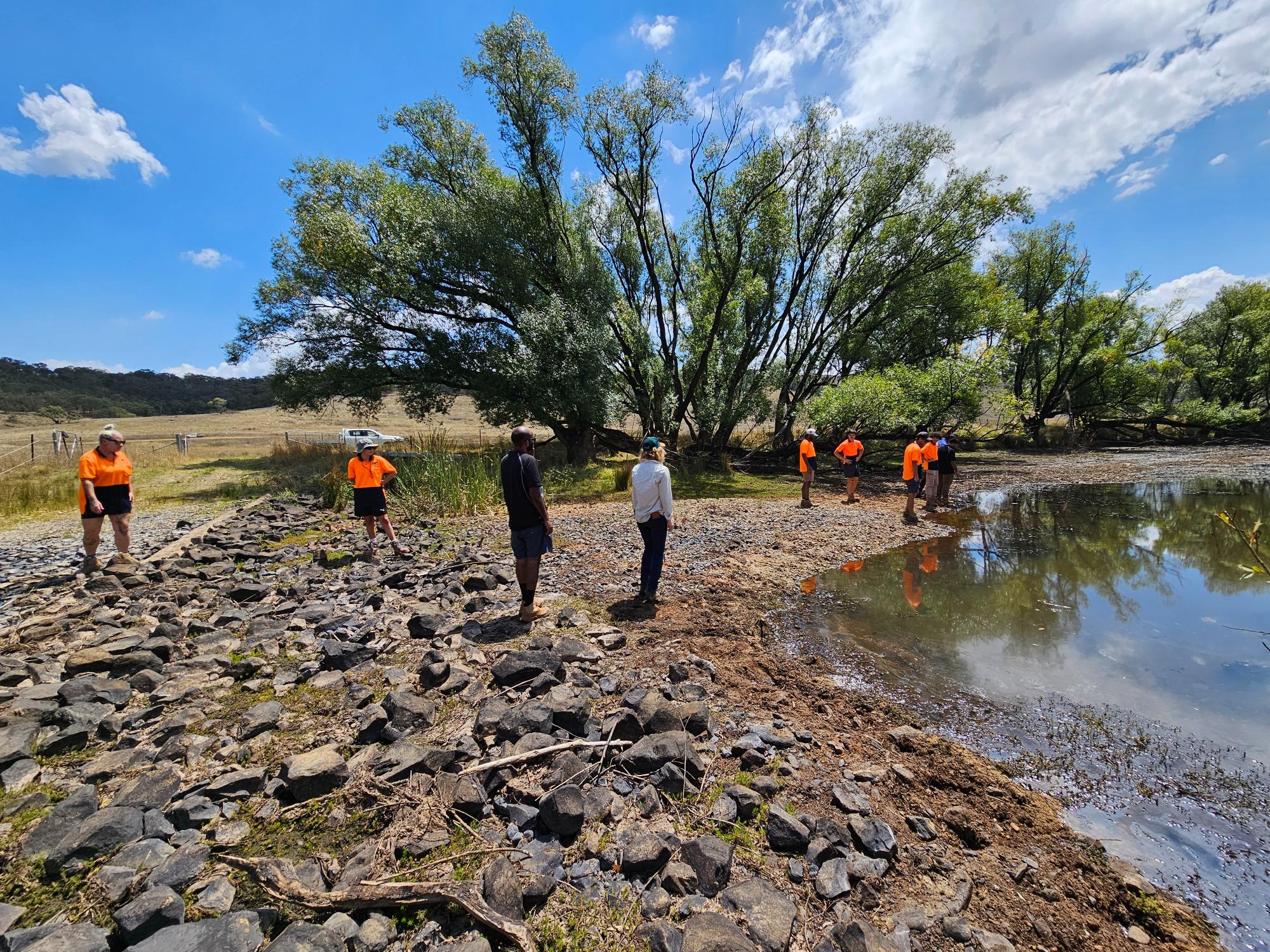
Pictured right: The Walbunja Rangers from Yuin Country visited Mulloon to explore landscape rehydration in action and will help shape the future First Nations Water Skills Certificate.
We have received some very positive feedback from the DAFF team on how well the Communities of Practice Project (COPP) was received by our funders. This reflects the passion, determination and hard work of our team and the five communities of practice whom we worked with across Australia. We have upskilled these communities in practices that will see our rural communities better prepared for, and more resilient to, drought. This model is being regularly refined and can be replicated in partnership with other rural communities.
The executive team has been busy planning for the year ahead and providing support to spread the workload across the team and to undertake recruiting to provide additional human resources. We recently re-advertised the TIMME project manager role, and we received over 170 applications. The word is out that Mulloon Institute is a great place to work, where people can make a real difference to the future of landscapes and agriculture in Australia.
We are also excited to be working with Oliver Wyman, following selection to be part of their social impact program. Oliver Wyman has worked to provide a snapshot of where Mulloon Institute is today, our key challenges and our opportunities. This Strategic refresh has enabled the new Board to take a deep dive into the Mulloon Group ,and we are all excited to be working on the business together.
Our team has also kicked off work on the Transgrid project. This is a remarkable project that provides the opportunity to work with impacted landholders under the Humelink route to build their capacity to repair and restore the function of their landscapes. This will leave a positive legacy for this project that is part of Australia’s transition to net zero.
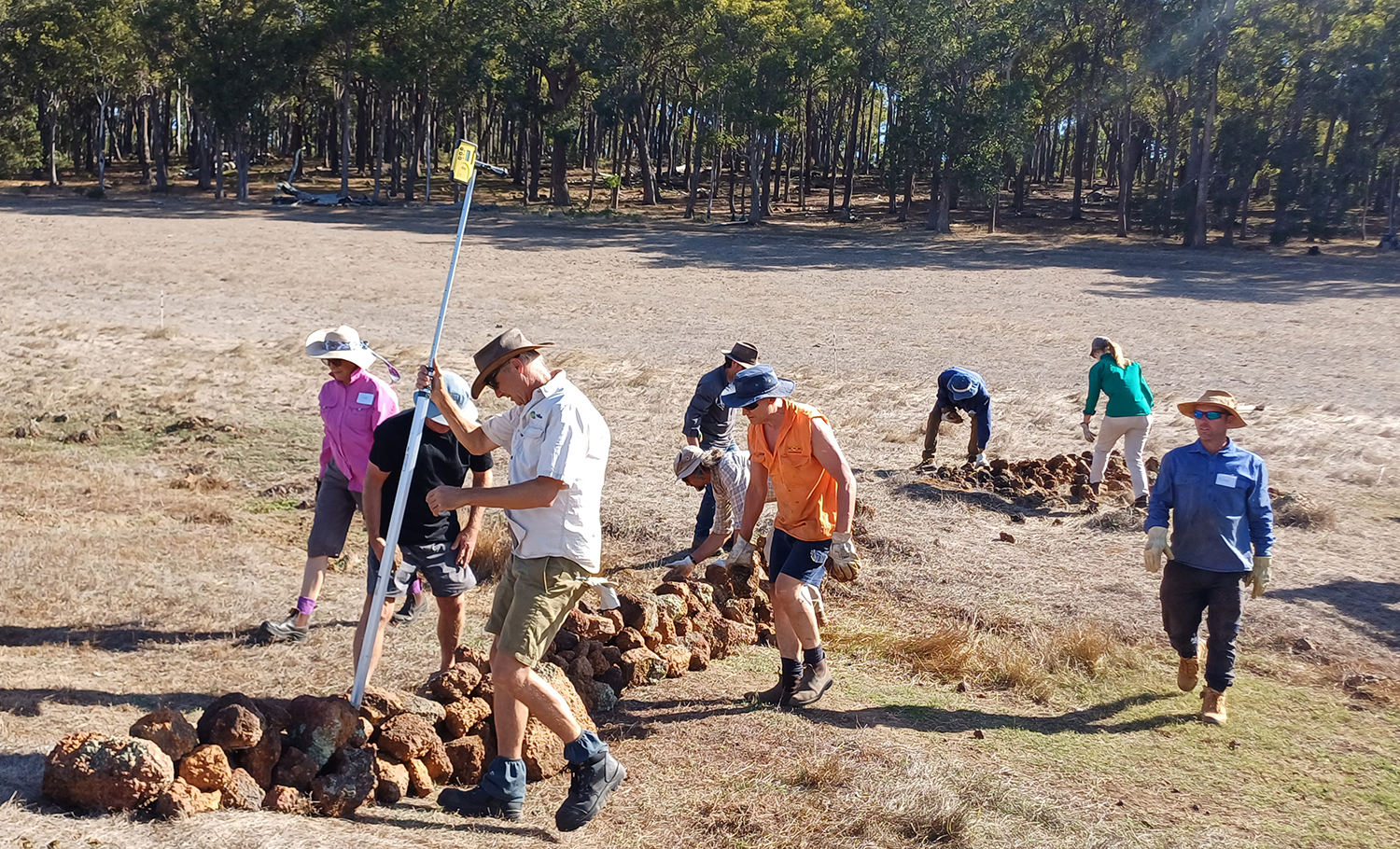
Pictured right: Communities of Practice in action in Western Australia
I have also been busy working with our colleagues from the One Basin CRC. The Basin Plan is under review and Professor Mike Stewardson and his team are committed to enabling a variety of voices to be heard. In November last year I was invited by Mike to attend a One Basin CRC workshop on Scaling Up Integrated Waterway and Catchment Management in the Murray–Darling Basin. I was privileged to be one of 20 leaders in integrated waterway and catchment management to be invited to this workshop. The workshop provided a focused environment for honest dialogue, shared insight and collaborative problem-solving. This small, diverse group, including policymakers, practitioners, researchers, First Nations experts and innovators, laid the foundation for broader Basin-wide engagement on the future of waterway and catchment recovery.
An output of that workshop was the Basin SCALE Declaration – a collaborative call for a fundamental shift in how we approach the future of the Murray–Darling Basin, toward integrated waterway and catchment management solutions.
In February I was a panel member on a webinar that over 330 people registered for to explore Integrated catchment management at Basin SCALE. You can view the webinar here. In this new era of landscape repair, building trusted relationships is still at the core of delivering better environmental outcomes, aided now with incredible data and the promise of natural capital markets to incentivise ecological restoration.
This is an exciting time for Mulloon Institute; a new Board, a new General Manager of Mulloon Creek Natural Farms and a new positive energy as our grant projects take shape and our team grows.
Carolyn Hall
CEO
Pictured right: Promotional image for the Basin SCALE Declaration webinar, March 2026.