One of the most encouraging developments for Mulloon Institute recently has been the successful approval of a private landscape rehydration project after what has been a long and often challenging regulatory process.
This approval is a significant achievement for the landholder involved and reflects the persistence of Mulloon Institute’s talented landscape rehydration team, particularly Jack Smart, who has worked patiently and professionally through changing requirements and lengthy assessment timeframes. We also acknowledge the NSW Department of Climate Change, Energy, the Environment and Water (DCCEEW), whose staff are navigating the challenge of assessing innovative landscape restoration projects within regulatory frameworks that were not originally designed with nature repair in mind.
While this approval is a positive outcome, it also highlights a much larger issue facing landscape restoration across Australia.
Across the country, organisations, communities and landholders are increasingly ready to invest in environmental restoration, yet regulatory pathways often remain complex, inconsistent and costly.
The current regulatory approval pathway in NSW effectively doubles the cost of Mulloon Institute’s projects. When combined with uncertainty on the information required and approval timeframes this is a disincentive for investment in nature repair. The scaling Mulloon Institute is working so hard for remains elusive, when high costs and uncertainty persist, the market resists.
Importantly, progress is being made. The development of a landscape rehydration infrastructure planning pathway came into effect in March 2023 in NSW. This is a great step towards regulatory reform for nature repair. What is clear now is that regulatory reform requires more than a new planning pathway. It needs to be supported by capacity building within the agencies tasked with determination these projects and the regulations that govern their responsibilities. Updated policy is also needed to reflect the current science and knowledge underpinning landscape repair.
Mulloon Institute has long advocated for the development of a nationally consistent framework for landscape rehydration and restoration, while acknowledging the complexities for each State and Territory who are responsible for determining these projects.
The Australian Government has a natural leadership role here. It can bring the States and Territories together and agree on the outcomes of that are required to deliver against global commitments and national policy for ecological restoration and repair. Our government can provide support in the consultation required for national alignment so Australia can attract the capital required to deliver nature repair at scale.
The benefits extend well beyond individual projects. Australia is entering a period where significant investment is expected to flow into nature repair, water stewardship, biodiversity enhancement and landscape resilience. To attract and deploy that investment effectively, regulatory systems are needed that enable good outcomes while maintaining appropriate safeguards. A nationally consistent approach is urgently required to unlock the pace and scale of restoration needed for Australia’s food and water security, to increase biodiversity, strengthen regional communities and build resilience to drought, floods and climate variability.
Mulloon Institute will continue to raise these issues with government and industry leaders, advocating for practical reforms that support the emergence of a thriving restoration economy. Every successful project demonstrates what is possible when science, community and good policy work together. The opportunity before Australia is not simply to improve individual landscapes, but to enable nature repair to be delivered at the pace and scale Australia needs.
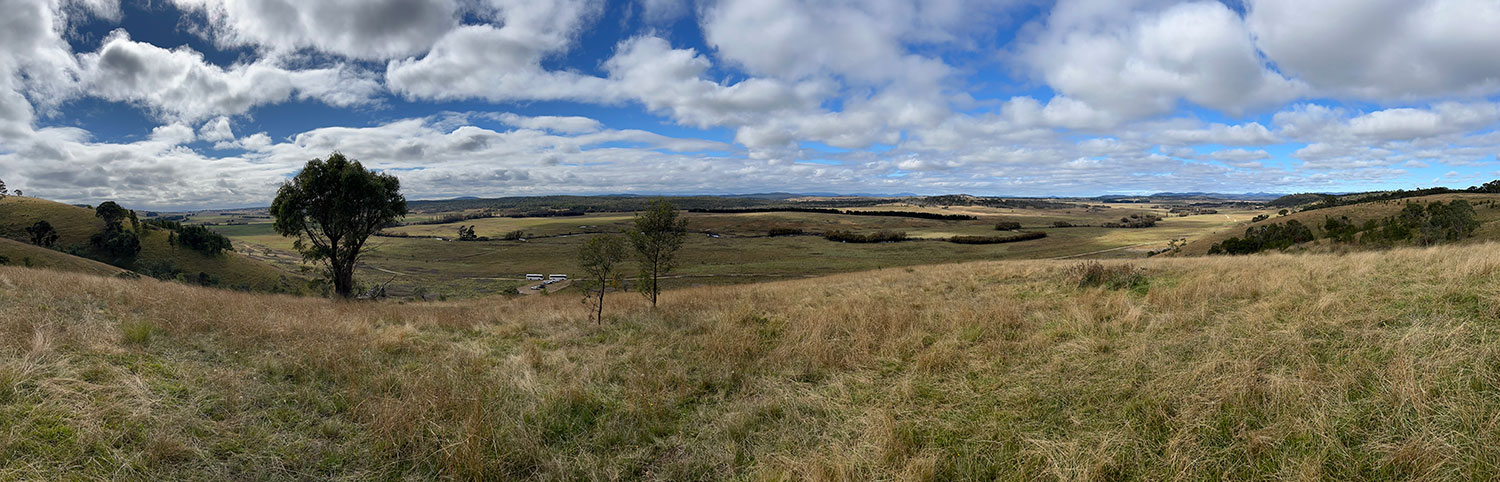
Top image: Woodlands at Mulloon’s Home Farm
Bottom image: The Mulloon floodplain at Duralla