On-ground works are complete at Lorrina, our Water Stewardship Program demonstration site on Brushy Hill Creek near Braidwood, where new natural infrastructure is boosting biodiversity, habitat and water security in an ephemeral gully system – and an 18-month monitoring program is just getting started.
Five kilometres north of Braidwood, Brushy Hill Creek winds through Lorrina, the 102-hectare grazing property of landholders Justine and Andrew. It’s an ephemeral creek, one that flows after rain, then shrinks back to a chain of quiet ponds, or a dry bed, in between. Creeks like this are easy to overlook, but they’re the fine capillaries of a catchment: when they’re healthy, they hold water, habitat and life through the driest months.
Earlier this year, after two weeks of careful construction, we celebrated the completion of Stage 2 at Lorrina, a Water Stewardship Program (WSP) demonstration site focused on strengthening biodiversity, habitat and water security in this ephemeral gully system.
Lorrina sits in the Durran Durra catchment, one of the WSP’s newer catchment areas. Brushy Hill Creek joins St Omer Creek, then Durran Durra Creek, before reaching the Shoalhaven River. And there’s more to come: over the next year we’ll begin working with landholders on other tributaries of the Durran Durra, thanks to a fantastic round of expressions of interest.
Like much of the Southern Tablelands, this creek has felt the effects of historical clearing and long–term grazing – incised banks, active erosion and little riparian (creek–side) vegetation. Stage 2 introduced natural infrastructure to the lower reach: seven log–sill and rock structures, two rock structures. These simple structures slow the water down, letting sediment settle, ponds form and vegetation return – rebuilding the creek from the bed up. All works were carried out with the necessary regulatory approvals in place, including a permit from Fisheries NSW.

Above: Mid-construction – two weeks of careful construction completed nine in-stream structures on Brushy Hill Creek.
The design dates back to 2022, when Mulloon prepared a whole-of-farm plan with Justine and Andrew, and the project was welcomed into the WSP in winter 2025. A huge thank you to the skilful team at Joel Griggs Earthworx – especially our operator Jake – whose precision made light work of some fiddly structures. We also acknowledge the foundations laid in Stage 1 back in 2023: riparian fencing, revegetation and the first in-stream structures, supported by Greening Australia, the Rivers of Carbon program and Mulloon’s own team. Two years on, that upper reach is thick with aquatic plants and holding water through dry spells.
Lorrina is already earning its keep as a demonstration site. In February, we brought a group of natural resource management professionals – council staff, Landcare coordinators, earthworks operators and consultants – out to the property as part of our WSP Professionals Intensive. It was a great opportunity to explore the site, see the structures at work and talk through monitoring opportunities together.
The story doesn’t end when the excavator leaves the paddock. We’ve now kicked off an 18-month monitoring program, funded through Mulloon’s LiFT grant, trialling and testing new holistic monitoring methodologies at the site. Watch this space – we’ll be sharing what the data (and the song meters!) tell us about how the birds, frogs and water respond as the creek recovers.
Lorrina is part of the Water Stewardship Program, which drives collaborative, community-scale projects to repair and regenerate waterways across the Sydney Drinking Water Catchment.
These activities have been funded by WaterNSW, The Ian Potter Foundation and the DAFF Climate Smart Agriculture program Natural Heritage Trust grant to the Landscape Function Toolkit project.

Above: One of seven log-sill and rock structures, designed to slow flows, settle sediment and create ponds and riffles in this ephemeral gully.

Above:The Stage 1 reach following construction
Below and top banner: NRM professionals gather at Lorrina as part of the WSP Professionals Intensive to learn about natural infrastructure and talk through monitoring strategies.
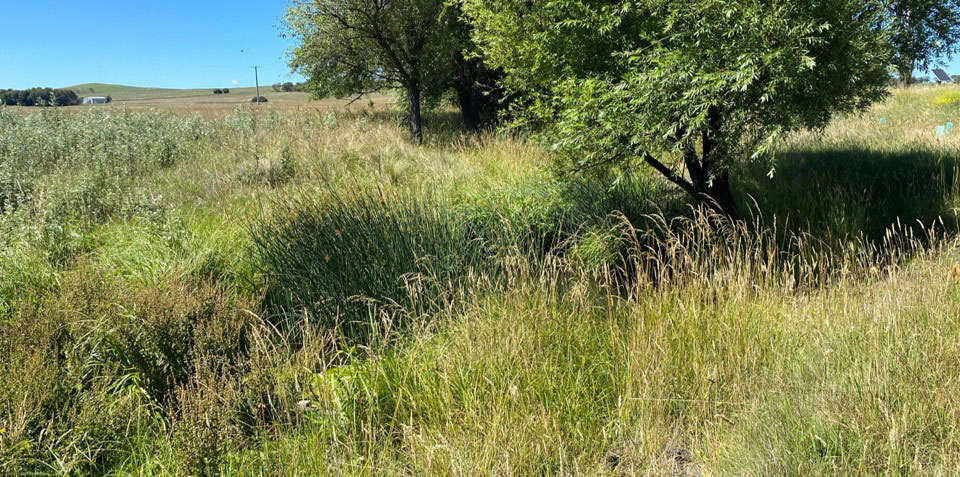
Above:The Stage 1 reach two years on – aquatic plants thriving and water held through dry spells, a preview of what’s ahead for the Stage 2 reach.
