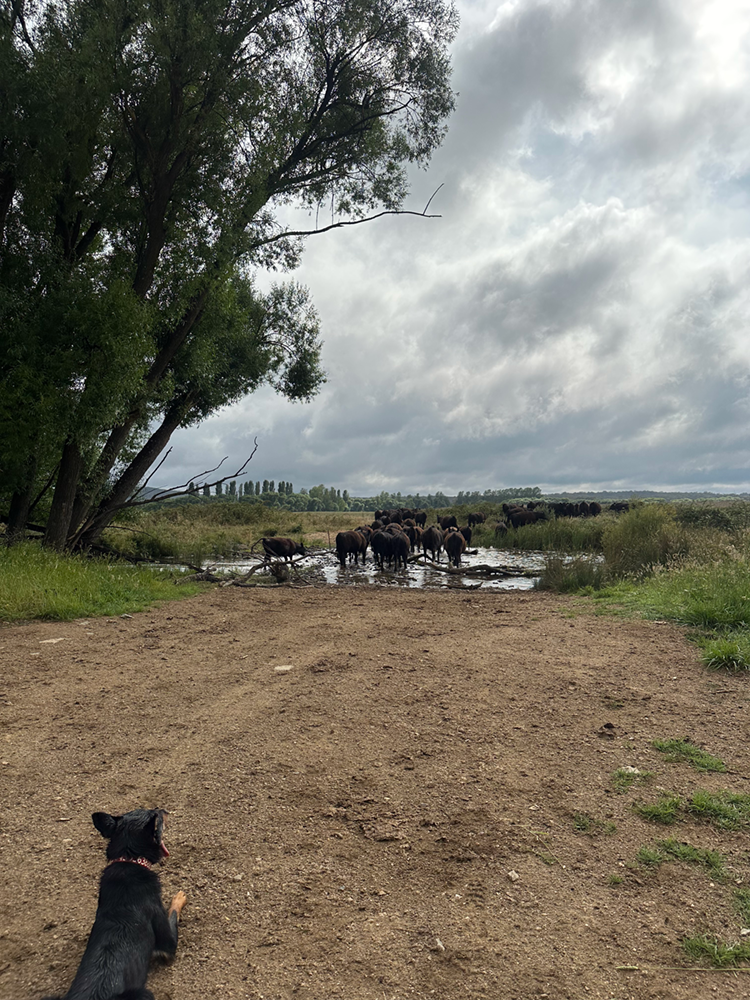
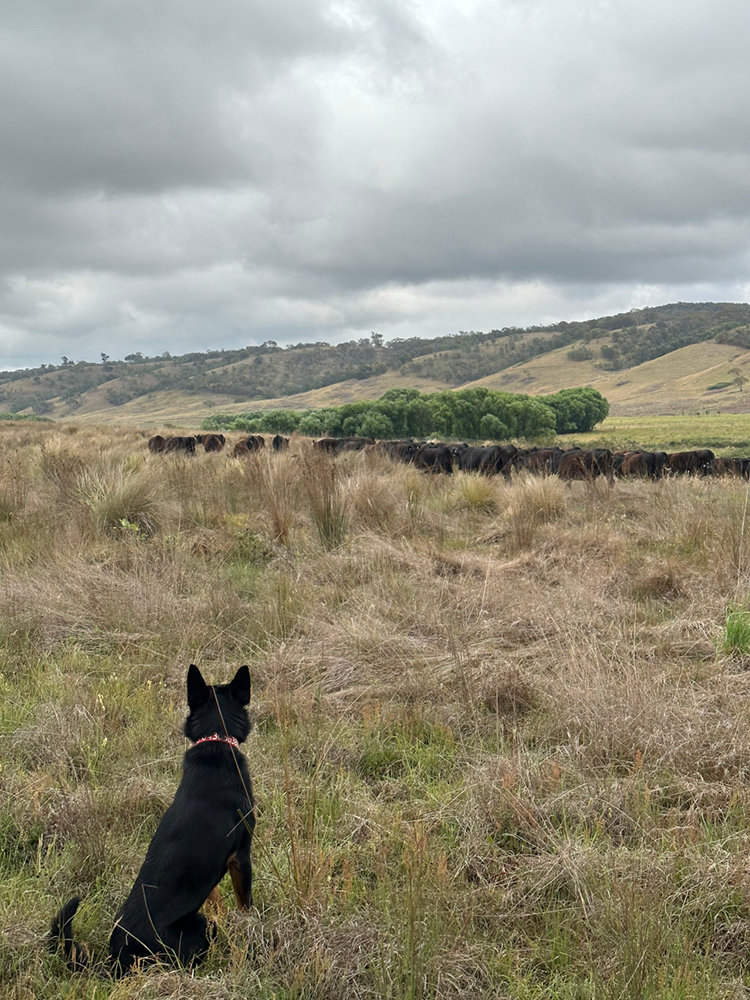
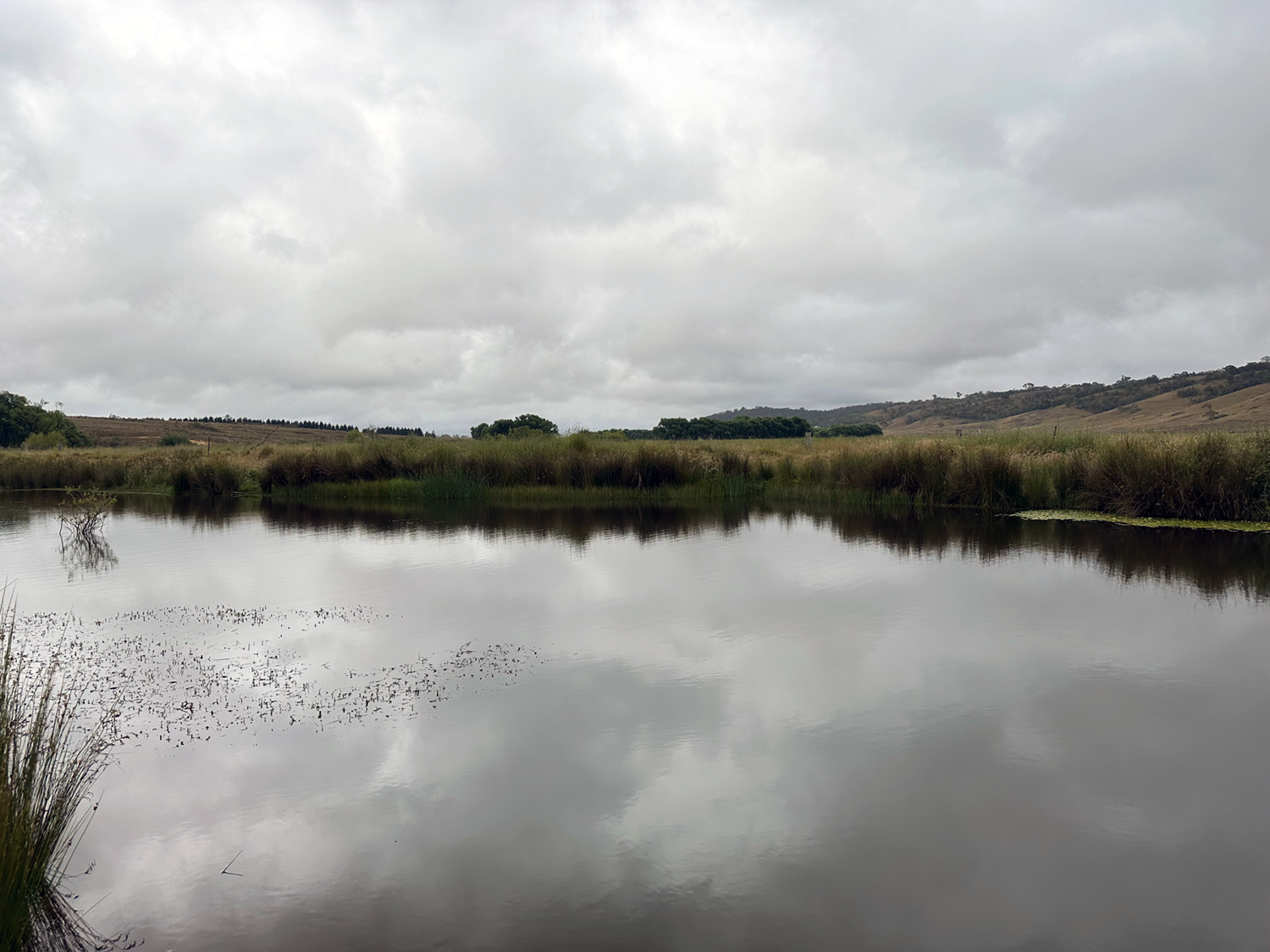
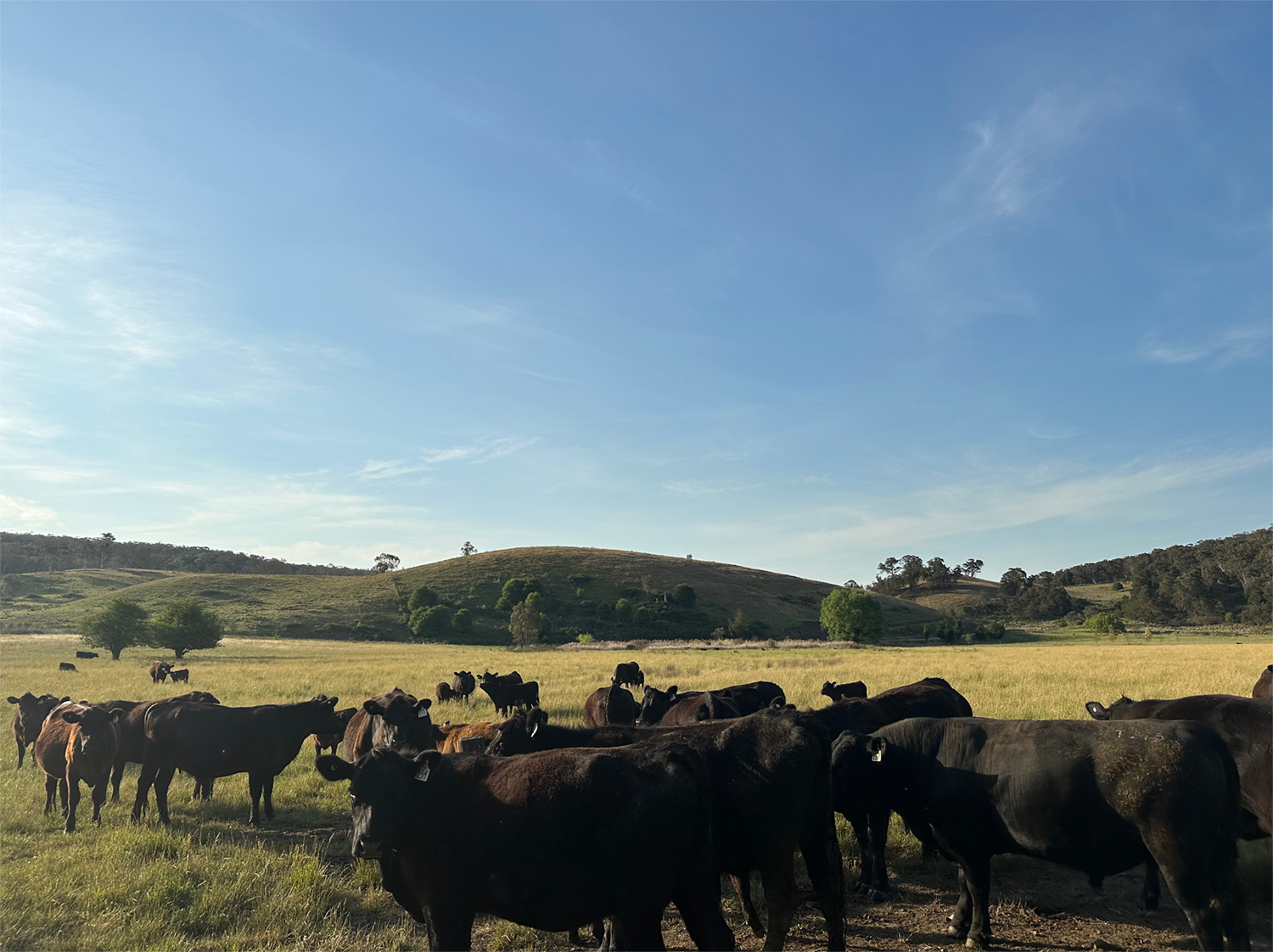
Spring on the farms was a dry one this year with well below average rainfall through until the very final days of November where the rain didn’t let up for about three days dropping a very welcomed 110+ mm on the region. Within a few days the farm had turned from varying shades of yellow and brown to bright green once again; dams from just about empty to full. The long-term forecast is looking like we may see some more rain into December but for now, we’re just grateful for what we’ve had.

Doug the kelpie stepping into Jacko’s big boots with gusto!

Doug taking his mustering duties very seriously.

The Mulloon Creek flats held up well throughout the dry spell thanks to plenty of stored moisture after a few consecutive wet years. We utilised these quality pastures over the spring to get our cows through the first few months of rearing their calves and back on to a rising plane of nutrition leading up to our joining period which began at the start of November – and a few weeks earlier for our weaner heifers.  

It was great to see the genetic gain in our cattle herd at marking this year. We’ve invested in a team of quality Bongongo Angus bulls over the past few years and that quality is really starting to come through to the next generation as we build a herd of easy-care animals well suited to our tough country here in Bungendore.  

Bring on summer!

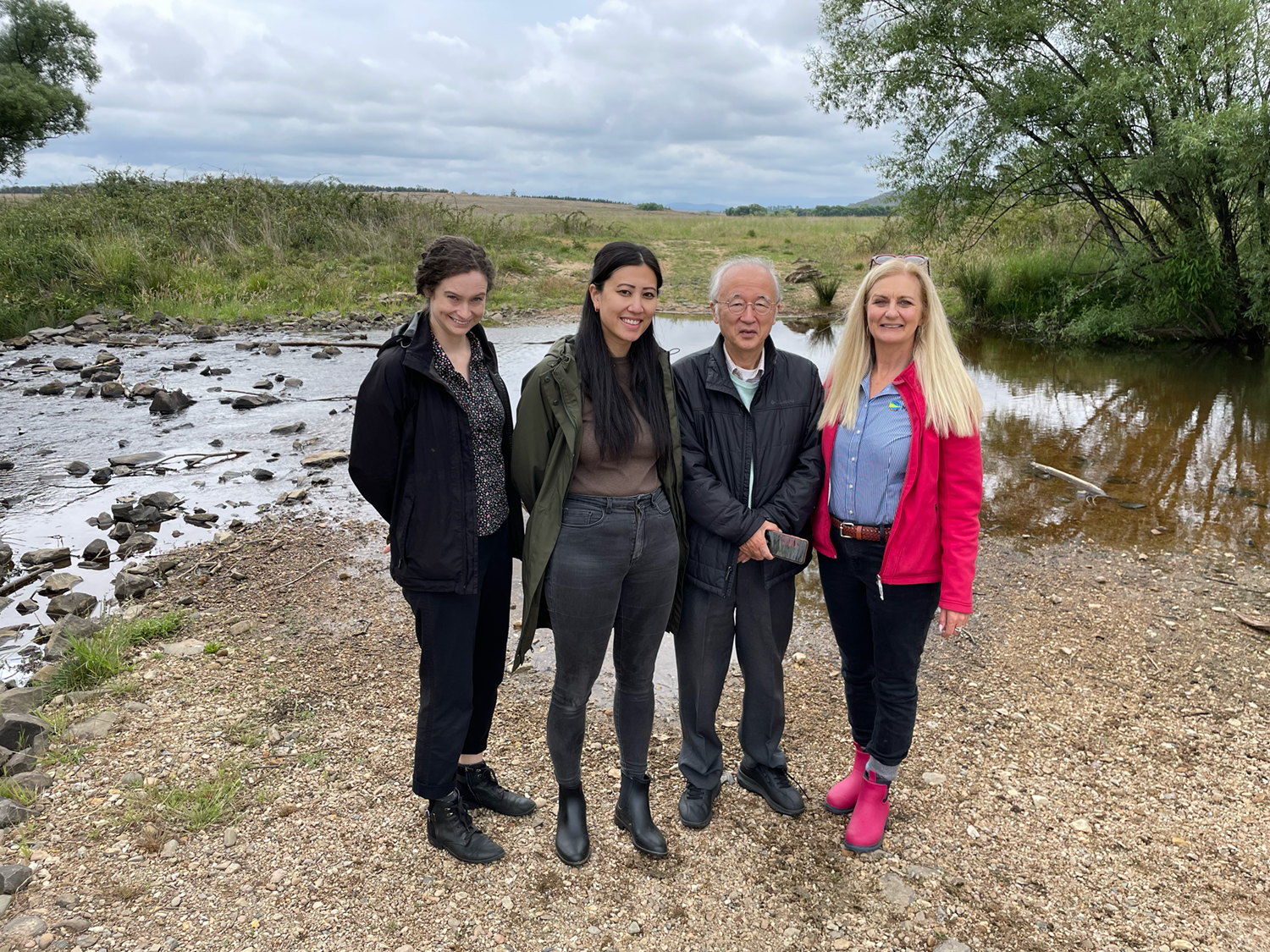
Dr Komatsu, Carolyn Hall and Rob Langtry tour the farms

BY CEO + MANAGING DIRECTOR, CAROLYN HALL

Following the World Soils Day breakfast on 28 November, we were treated to a visit to the Mulloon farms by Dr Masayuki Komatsu, President of the Institute of Ecosystem Research Japan

Dr Komatsu’s focus includes work on fisheries, water policy, and related environmental impact and management and he specifically requested a visit to the Mulloon Institute. He is exploring ways of integrating ecosystem/environmental management into the operation of fisheries and is currently conducting surveys in Japan on the impacts of land activities (i.e. industrial development, discharges of treated water from wastewater treatment plants, construction of concrete seawalls and river banks, etc.) on ecosystems and/or fisheries.

The visit was requested by the Department of Agriculture, Fisheries and Forestry (DAFF), Agricultural Trade & Market Access Branch, Trade & International Division North Asia Section (Japan, Korea and Taiwan markets). 

Dr Komatsu was accompanied by two DAFF Officers Rosemary Reilly, and Senior Policy Officer Lauren Cha. We were also joined by management consultant and marketing guru, Rob Langtry who is assisting the Institute with the development of our next strategic plan.

We enjoyed a morning showcasing the Mulloon Rehydration Initiative. The rain held off and we were able to show Dr Komatsu the results of the rehydration work on the lower Mulloon floodplain, the view from the Hill at Duralla never disappoints and the restoration of the hydrological function of the floodplain resonated with Dr Komatsu. He was also interested in the leaky weirs on Mulloon Creek and their impact on water quality and native fish stocks, and was keenly interested in the involvement of the landholders in the catchment project.

We finished the morning with lunch at the Homestead and we look forward to staying in touch with Dr Komatsu. Our Executive Landscape Planner, Nolani McColl had recently visited Japan and observed an in stream pin weir and this was also of great interest to Dr Komatsu.

Dr Komatsu was accompanied by two DAFF Officers Rosemary Reilly, and Senior Policy Officer Lauren Cha. 

Mulloon has signed the Call to Action as part of the United Nations Climate Change Conference, COP28. The UN Climate Change High-Level Champions (HLCs) have collaborated with Non-State Actors – from farmers and fishers to businesses, cities, civil society, consumers and all those engaged in food systems – to develop a Non-State Actors Call to Action for Transforming Food Systems for People, Nature, and Climate. 

The Call to Action mobilises collective efforts around a shared vision of food systems that deliver significant, measurable progress for people, nature, and climate by 2030. Through this shared agenda, the aim is to scale action, raise ambition and unlock the potential of food systems as one of the main solutions for people, nature, and climate. 

This call has resonated strongly with Mulloon Institute, and we have signed the call to action and provided a Statement of Action. Over 155 non-state actors have also signed the call to action and the statements of action provided will go towards informing a package of announcements on food systems transformation at COP28.

We can’t be at COP28 although many of our regenerative agricultural colleagues are including the Machdoch Group and Farmers for Climate Action. DEECCW is hosting the Australian Pavilion.  

Australia was represented at the opening plenary by its Climate Change Ambassador, Kristin Tilley and news this week coming out of CoP 28 reveals Australia has along with 117 other countries signed up to back a to triple global renewable energy capacity and double the annual rate of energy efficiency improvements by 2030.

Australia has also joined the Emirates Declaration on Sustainable Agriculture, Resilient Food Systems and Climate action at COP28.

This is good news, let’s hope the agreements at COP28 can result in real on-ground action not just in Australia but across the world putting food production systems at the centre of the response to climate change.

Gardens at the Home Farm

On November 24 we hosted members and guests of Mulloon Institute at our Annual General Meeting.

The AGM is always a nice opportunity to reflect on what we have achieved over the previous year. Ably chaired by Deputy Chair Matt Egerton-Warburton, the meeting presented the audited financial statements and involved the re-election of Directors Kathy Kelly and Carolyn Hall.

Our Chairman Gary Nairn AO was able to attend via Zoom along with several other members. CEO Carolyn Hall provided a comprehensive summary of some of what Mulloon Institute and Mulloon Consulting have been up to this year, including our major advances in the education program, our works in Western Australia and the central desert rangelands, and the potential of our work in the natural capital space.

Kathy Kelly provided an update into our finances including the significant decline in donations this year and the capex expenditure on the farms including the egg grading and packing machine that will enable further expansion of the egg enterprise.

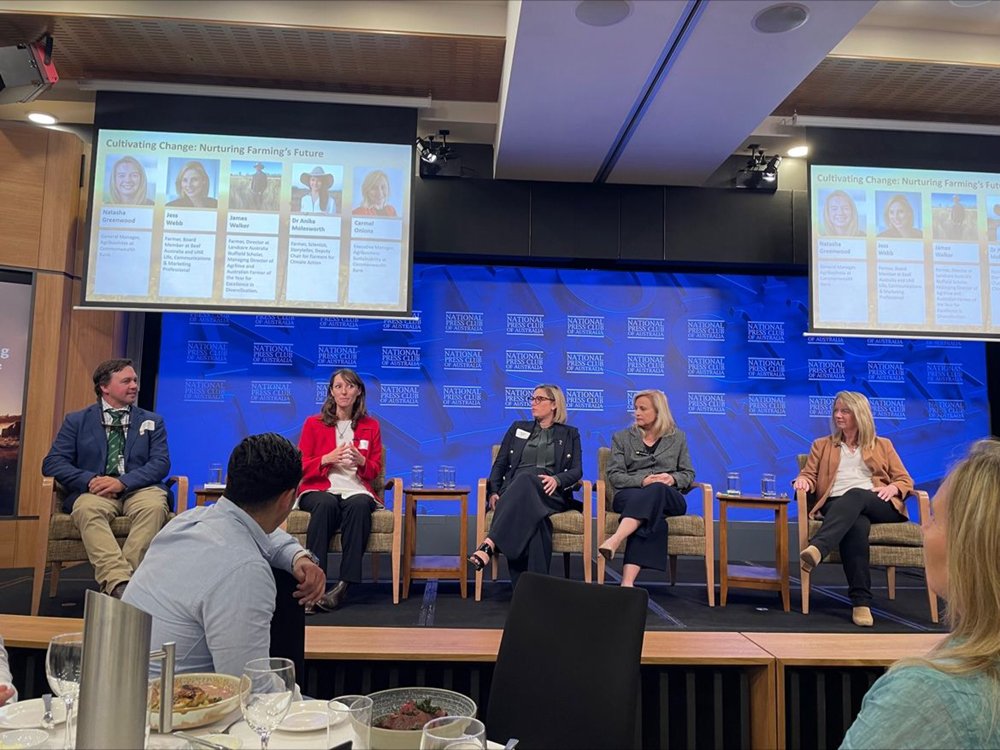
An amazing panel with Anika Molesworth, James L Walker, Jess Webb,  Carmel Onions and facilitated by Natasha Greenwood.

BY CEO + MANAGING DIRECTOR, CAROLYN HALL

At the National Press Club Lunch: Cultivating Change, Nurturing Farming’s Future, Senator the Hon. Minister for Agriculture Murray Watt spoke on Agriculture leading the charge to a net zero future and ensuring the whole sector remains productive and profitable with Industry and Government working together. Mulloon Institute’s work on rehydration and restoration of agricultural landscapes can certainly help with that!

“Optimising production optimises natural capital.”

Carmel Onions, quote of the day.

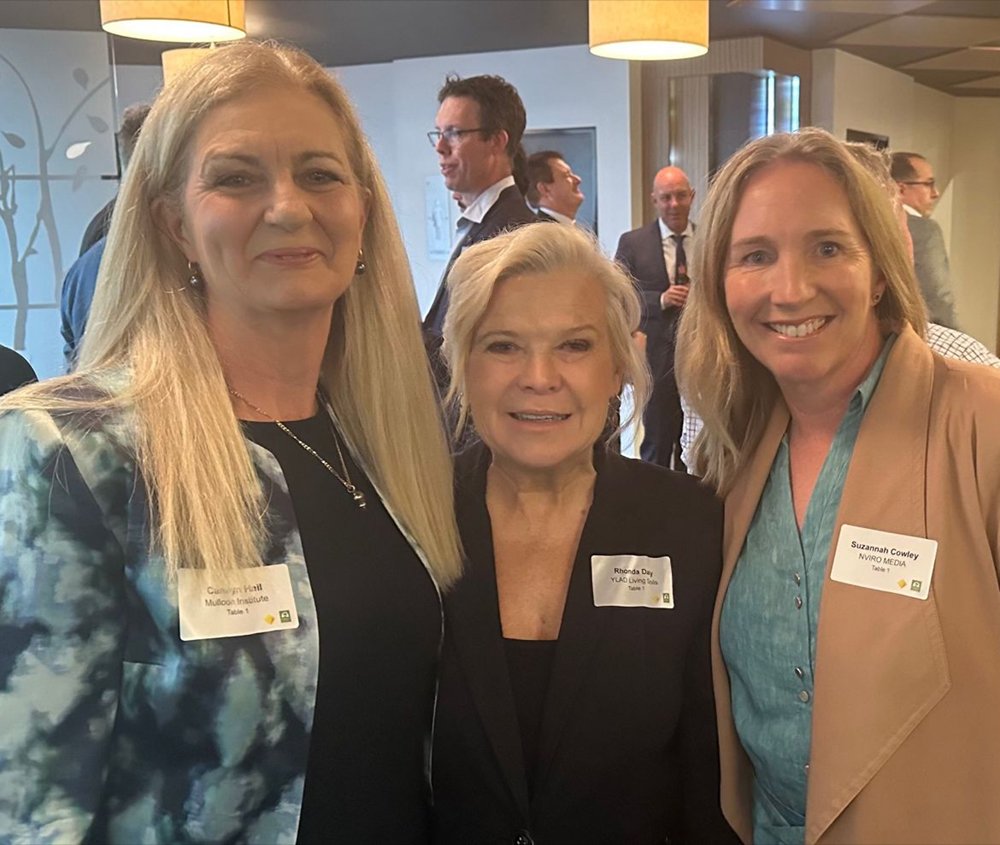
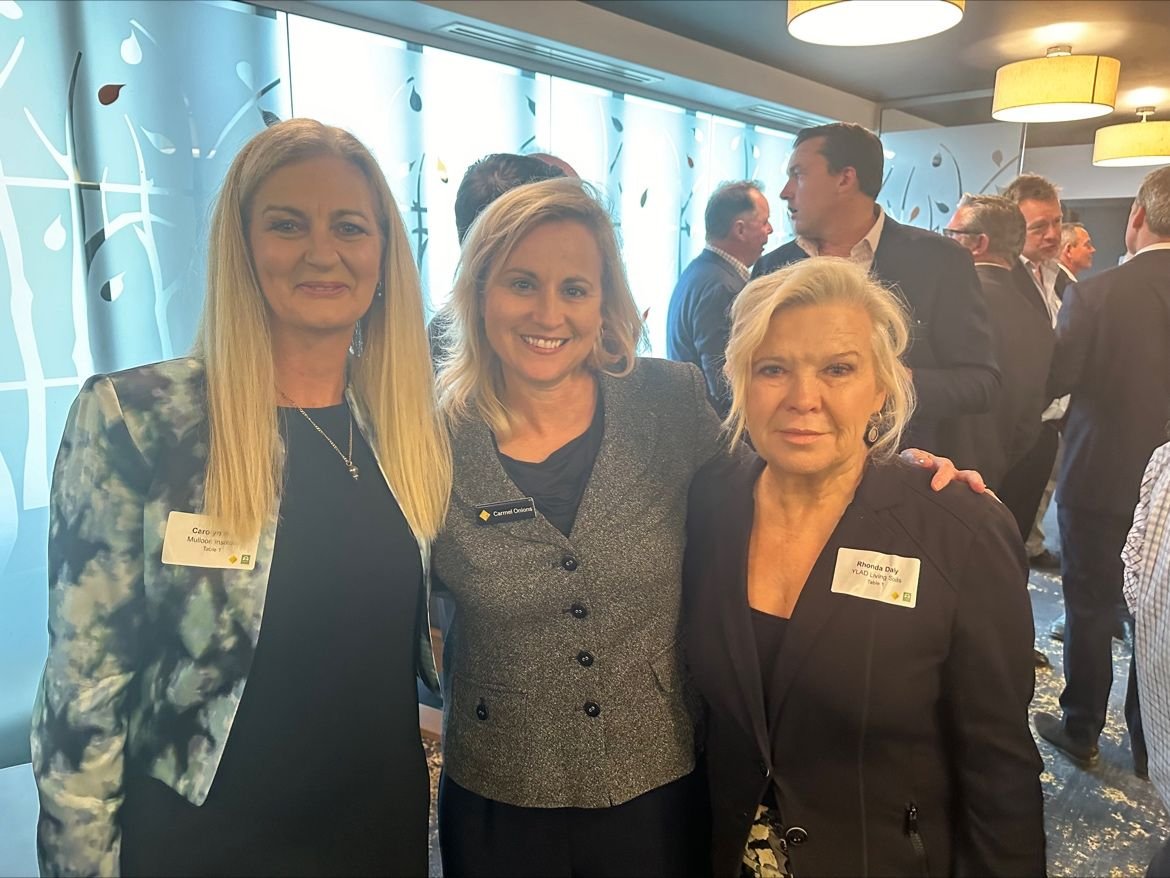
It was great to catch up with Suzannah Cowley from NVIRO Media (right) and Rhonda Daly from YLAD Living Soils.

There was plenty of time for networking and I did make some new friends, always a great opportunity to tell the story of hope that Mulloon brings.

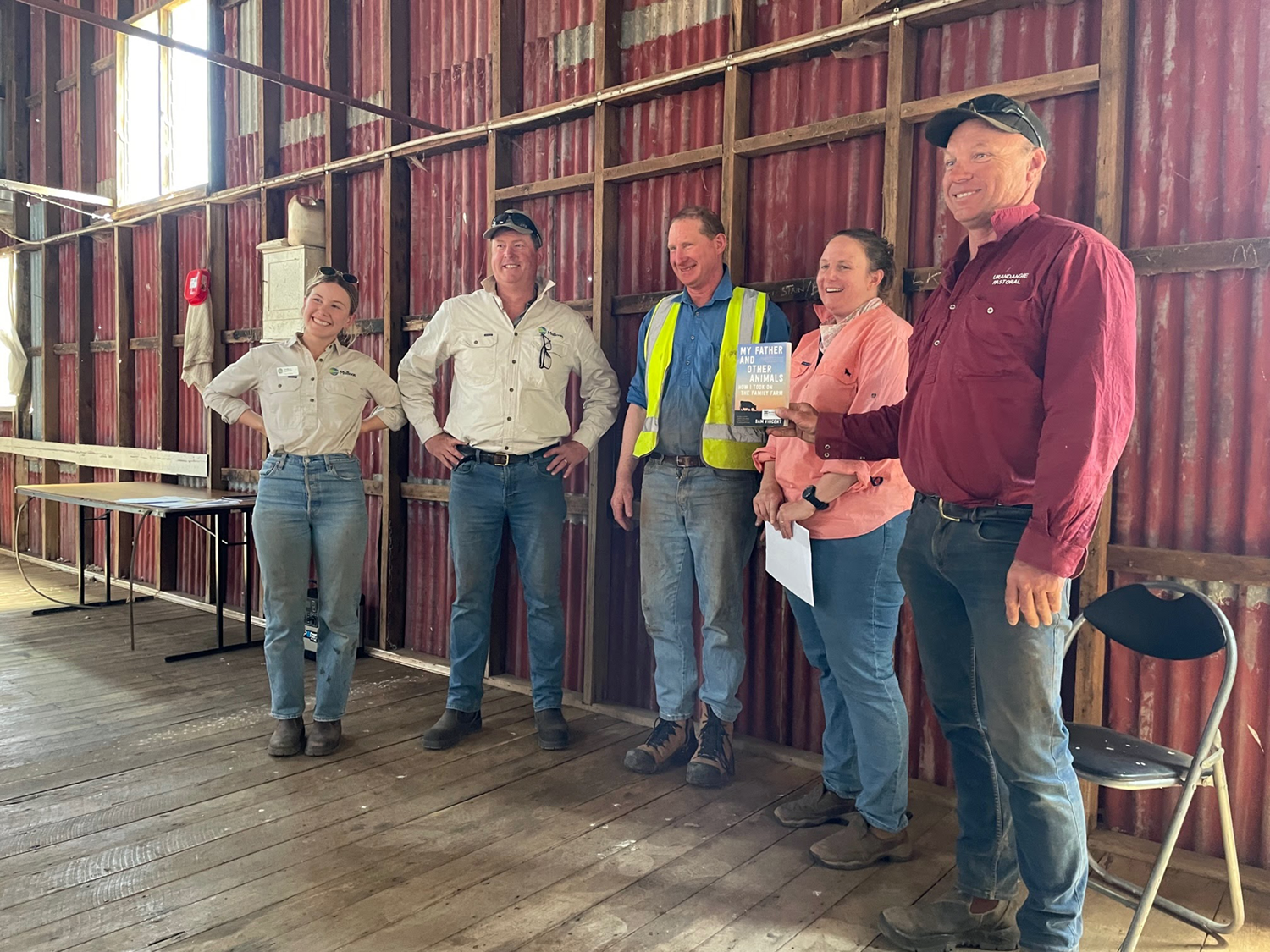
The day was made special as I had the opportunity to hand Senator the Hon. Murray Watt a copy of our freshly printed Annual Report, and to catch up again with Secretary, Sustainability, Climate & Strategy, DAFF Nick Blong.

I also had the opportunity to bring Karen Walsh from Landcare Australia up to speed on our Learning Programs.  A catch-up with Rob Purves at the Press Club, saw us discussing the uncertain future for the Green and Golden Bell Frog on the Molonglo River at Carwoola.

Meryl Swanson MP and The Hon Michael McCormack MP presenting the 2023 World Soils Day Breakfast (image supplied)

By CEO + Managing Director, Carolyn Hall

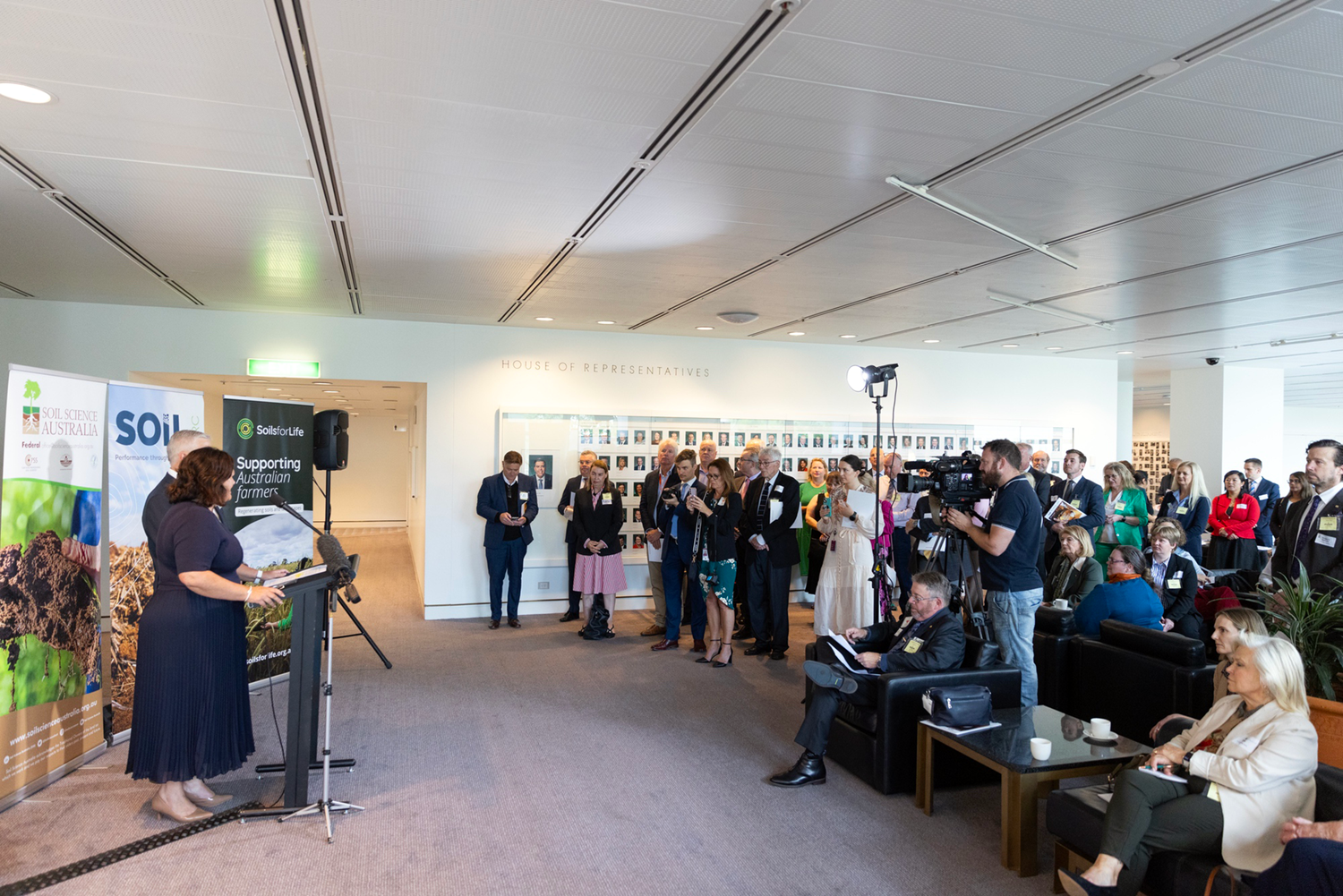
The Mulloon Institute was happy to be an industry supporter of the World Soil Day breakfast at Parliament House: Soil and Water: a source of life.

Senator the Hon Murray Watt announced Australia’s first National Soil Action Plan. Key focus areas of Measure, Strategy, Adoption and Workforce. We are ready to help drive adoption of landscape rehydration at the catchment scale an approach we know can contribute to soil health. 

Mulloon had a lovely shout-out from Meryl Swanson, Member for Patterson and co-chair of the Parliamentary Friends of Soil and chair of the House of Representatives Standing Committee on Agriculture.

It was great to hear Eli Court, CEO at Soils for Life singing the praises of landscape rehydration at Martin Royd’s property, Jillamatong.

Soil and Water: a source of life.

Always great to attend an event with my fellow Mulloon Board Director, Kathy Kelly.

Carolyn Hall, left, with Thankful 4 Farmers’ COO, Mike Chuter. (image supplied)


The Parliamentary Friends of Soil group’s purpose is to bring together a non-partisan forum for parliamentarians to interact with land managers, farmers, scientists, industry groups and policy makers on issues relating to health and maintenance of Australia’s soils.

DID YOU KNOW 

  • World Soil Day (WSD) is held annually on 5 December.

  • 95% of our food comes from soils.

  • One cubic metre of healthy soil can retain over 250 litres of water.

  • Healthy soil plays a crucial role as a natural filter, purifying and storing water as it infiltrates into the ground.

(image supplied)

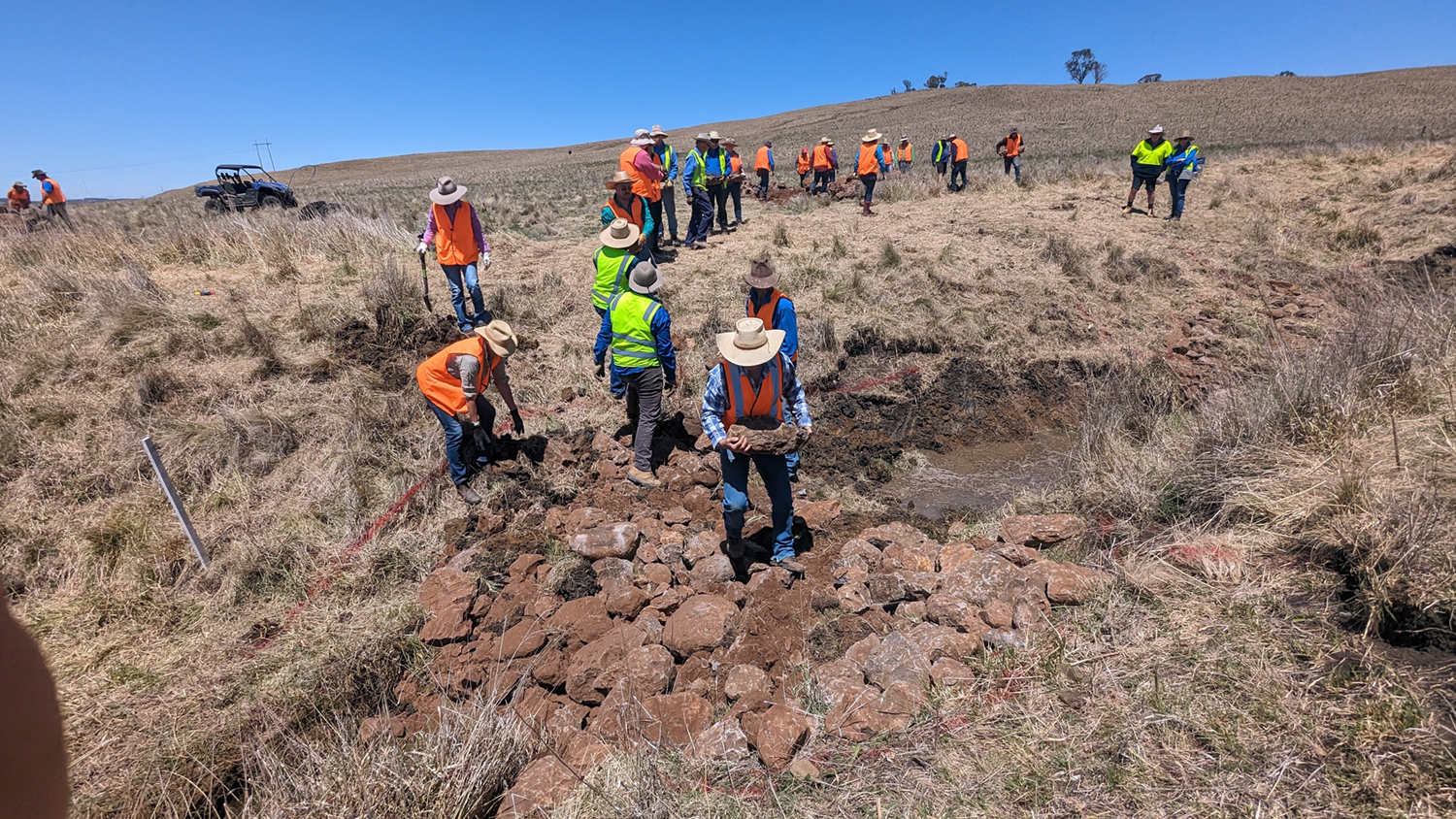
Above: A community at work building a series of in-stream rock structures in Guyra, NSW

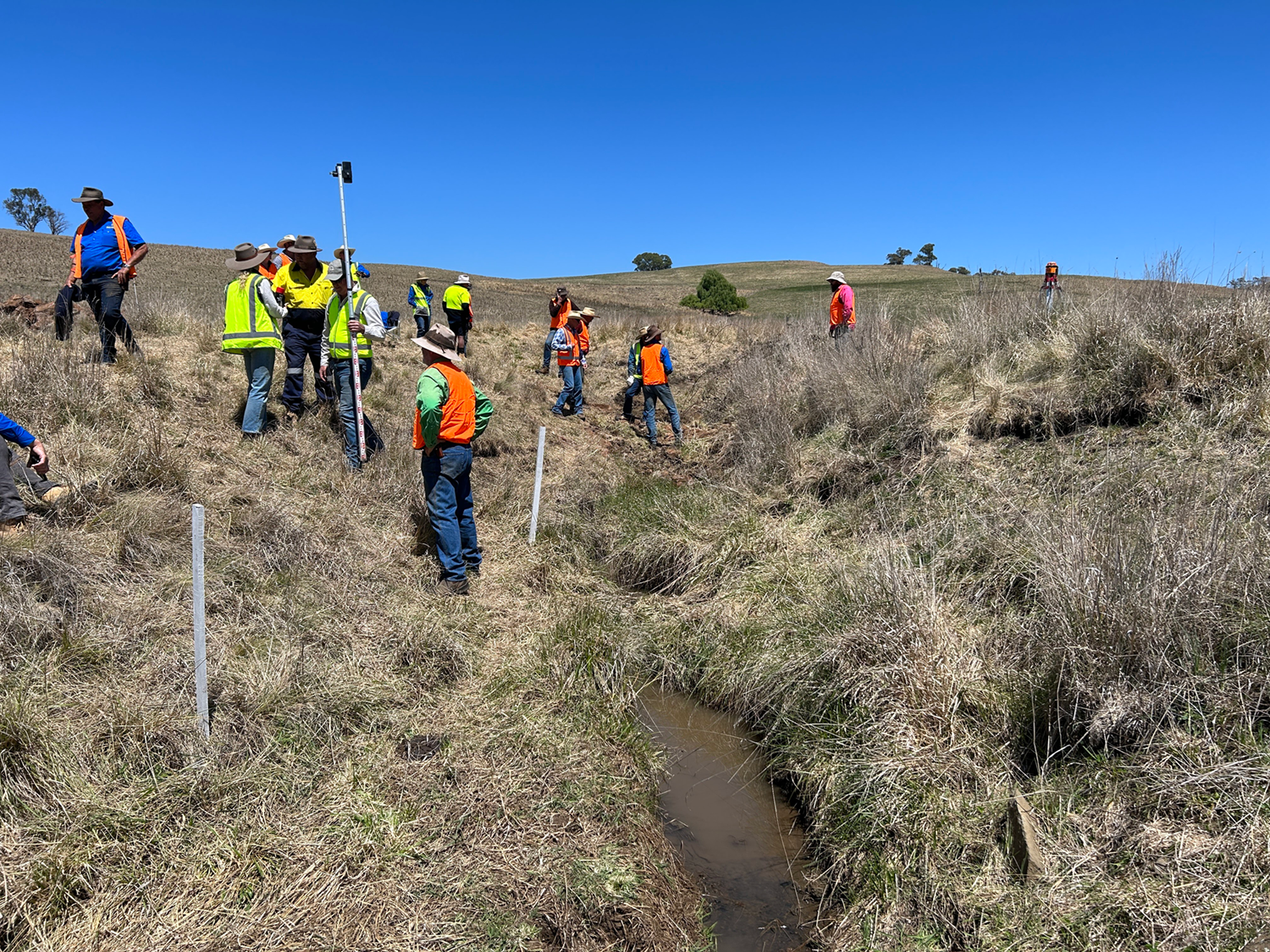
‘Learning by doing’ was the motto of the Mulloon Insitute Bootcamp hosted by Southern New England Landcare and Armidale Regional Council in the Guyra region of NSW. In a first, the education team delivered a three-day program integrating theory and practice with a series of small structures built in an eroded flowline. The host property is a mixed beef cattle, sheep and goat enterprise managed by a combination of rotational grazing and fenced-off waterways with some tinkering of landscape rehydration tactics (brush and logs). The project location for the structures is an actively eroding flowline that’s advancing into productive land upslope and impacting water quality downstream leading into the MALPAS dam.   

Utilising materials sourced from the property, and equipment generously provided by the Council, the group were set to task in assessing and planning the small-scale project. Peter and Erin introduced Mulloon Consulting’s rigorous technical design process, which factors in the many risks and opportunities associated with landscape rehydration infrastructure. The group then selected appropriate intervention styles and locations utilising desktop and field observations as well as precision laser level measurements. Two rock ramps were built in only two hours using a 12-tonne excavator and then finished off by hand, with the whole team coming together to place the final layer of rocks, soil and vegetation in and around the newly created structures. The implementation process was, according to one participant “simple once you do the planning”.  

The comradery and ‘can-do’ attitude by all who participated made this bootcamp a wonderful experience and hopefully the beginning of some future projects on the ground in the region. 

Mulloon Institute’s Learning Programs have been developed with the assistance of the NSW Government’s Environmental Trust.   

We have published our Annual Report and successfully held our Annual General Meeting. As an organisation, we are in tip-top shape and are moving into 2024 with determination and vigour. 

At the end of one year and the start of a new year, it’s good to take a step back and review our Vision, our Mission, and what we are doing with the wonderful legacy granted to us by the Coote Family.

Our Vision and Mission are simple – we want to assist and facilitate landscape and catchment remediation in Australia – but there are several challenges that slow this vital work. 

There is some underlying cynicism about our new techniques and methods. We are solving this with science and evidence through the work of our Scientific Advisory Committee and our research teams – read more.

There is a lack of knowledge among landholders about our techniques and methods. We are solving this through our education programs. Our educators conduct workshops, bootcamps, mentoring, farm tours, school tours and university field trips across Australia – read more.

There is the time, cost and expense of implementing landscape remediation. We are solving this through Mulloon Consulting – providing landholders with the guidelines, plans, tools and experts to rehydrate and remediate their land.

And finally, there is regulation. Government laws, regulations, notifications and approvals that slow down or prevent landscape and catchment remediation in Australia.

The Mulloon Law Committee has been looking into this regulatory problem since 2019. At first, we conducted a review and audit of all laws and regulations that applied to this work and what approvals were necessary. Unfortunately, land and water usage is mainly controlled by state governments and state legislation. That meant if we wanted to make landscape and catchment remediation easier, we would have to deal with environment, planning, heritage, fisheries and water legislation with government departments in Brisbane, Sydney, Perth, Melbourne, etc… no fun. No fun at all.

So we decided on a different tack – instead of amending 50 or 60 pieces of legislation, we would seek a simple and elegant one-stop solution – a national building code for catchment remediation structures. Our idea is that if a landowner follows the Code, the landowner would be exempt from the need to seek all the approvals, notifications and expert reports required by the various regulators in each state.

We asked the NSW Government to assist us in drafting the Code – but they declined. We then asked environmental consulting experts to assist, but we could not come to a satisfactory arrangement. So finally, we decided to do it ourselves.

Dr Gerry Bates, in conjunction with others, has drafted the attached Proposal for a National Code of Practice.

It is a significant document and a great achievement.

We are now taking this Code to all major environment and planning groups and leaders in Australia to seek their support. Then, with their backing, we will be approaching Minister Plibersek and the Commonwealth Government to encourage them to publish the Code and push it out to the States.

There is a long way to go, but we have a plan and strategy to solve these regulatory constraints. Can I encourage all of you to send the Code to leaders in your communities? The more the merrier!

Matt

Matt Egerton-Warburton
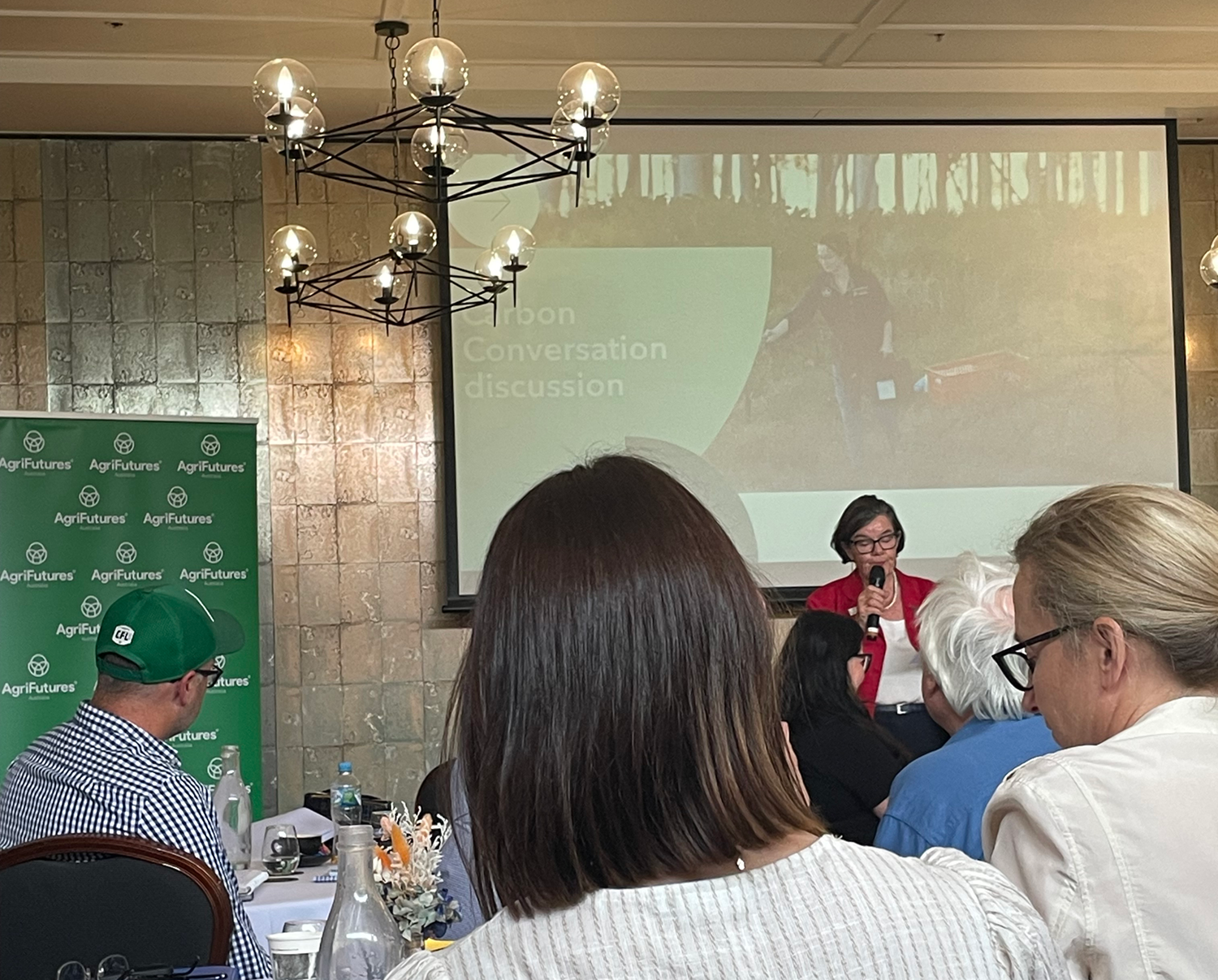
AgriFutures Chair, Cathy McGowan presents at the Agrifutures Carbon Conversations

Launch of report and next steps

On November 22, Mulloon Institute CEO Carolyn Hall and other invited guests from across Australia came together with the AgriFutures Chair Cathy McGowan and CEO John Harvey to explore what should be captured in Australia’s first agriculture and land sector plan for reducing emissions. 

Adam Fennessy PSM, the new Secretary for the Department of Agriculture, Fisheries and Forestry (DAFF) provided the opening address. Nick Blong, First Assistant Secretary for Sustainability, Climate & Strategy at DAFF introduced the Agriculture Land and Emissions Discussion paper. 

All attendees were asked to provide a 60-second pitch for what should be included in the sector plan. MuIloon Institute called for a national program for landscape rehydration and restoration that will rebuild our agricultural landscapes, enabling them to sequester carbon into the soil and, importantly, manage the increased energy coming from the sun with climate change. These rehydrated landscapes can deliver gains in biodiversity and productivity and unite rural communities and First Nations people in caring for Country to build landscape resilience to climate change. 

The Mulloon Institute now has a model that has provided a landscape rehydration priority map for NSW catchments, we know how to scale. We need regulatory reform to support landscape repair and we need ongoing education and capacity building for landscape rehydration and restoration for farmers, professionals and students. Funding delivery needs to drive collaboration rather than competition to ensure the best outcomes for the limited funds available to the agricultural sector. It was a great day that finished with envisioning the future of AgriFutures.

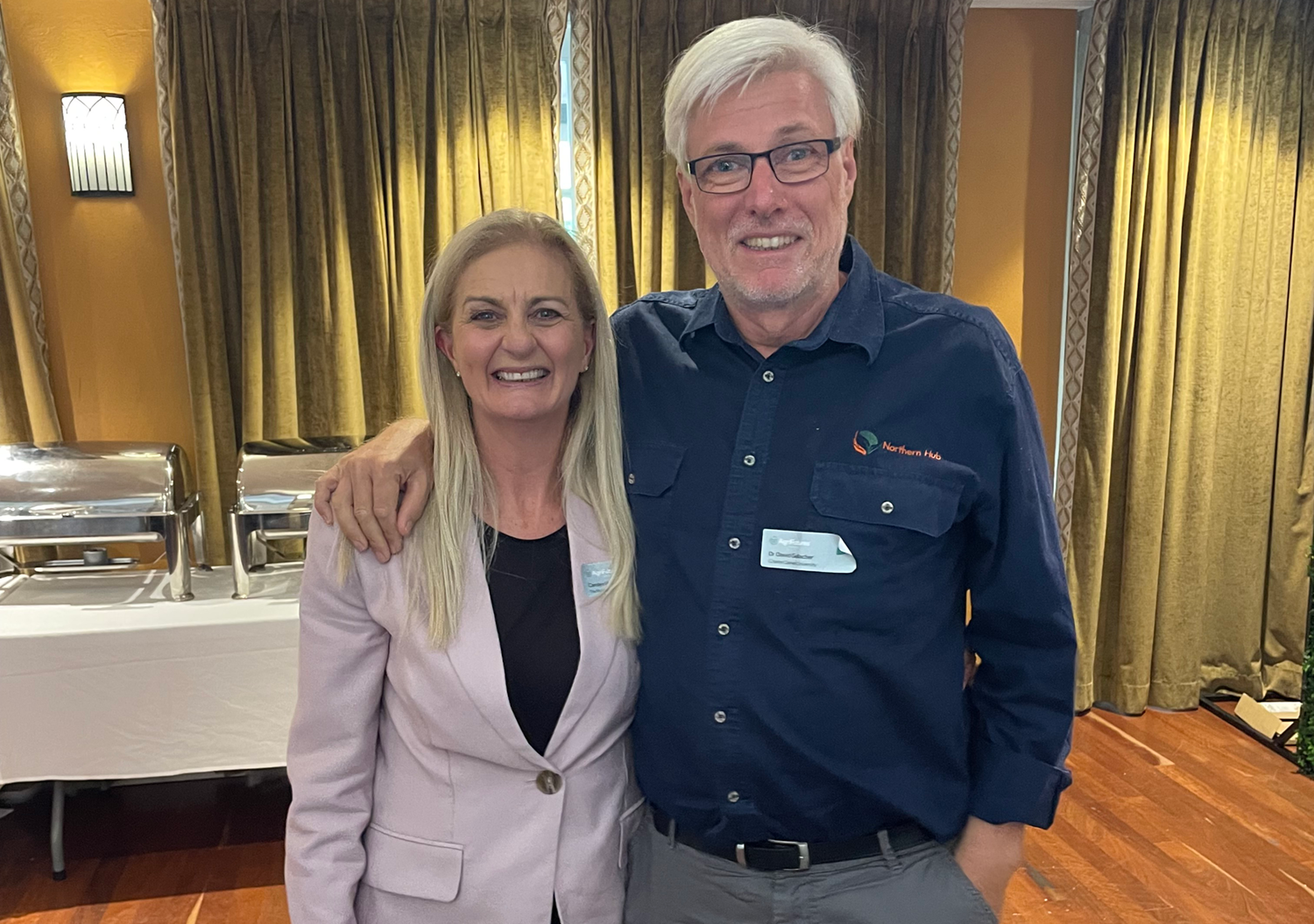
Mulloon institute CEO + Managing Director, Carolyn Hall, with David Gallacher, Knowledge Broker, Northern Hub.

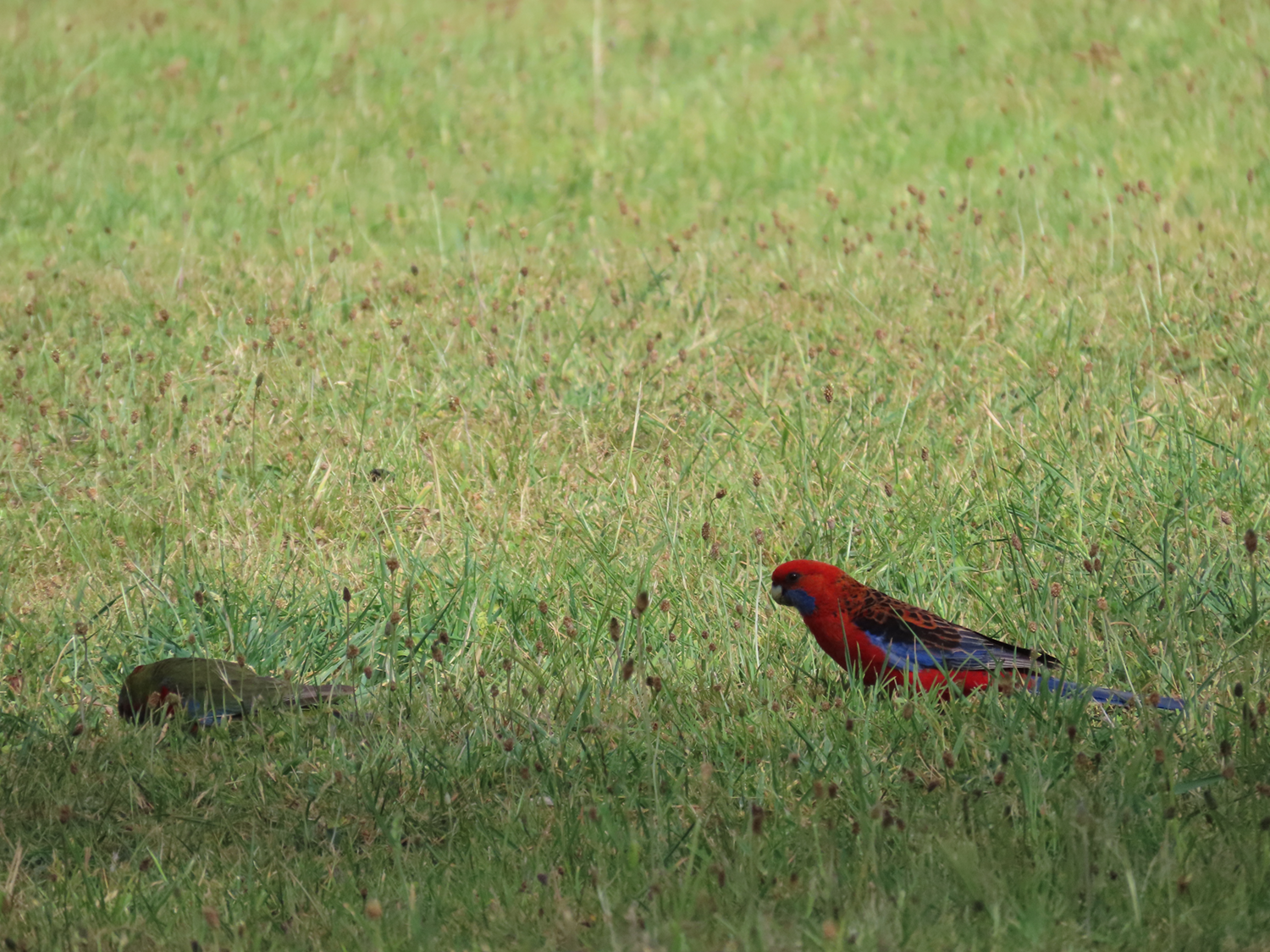
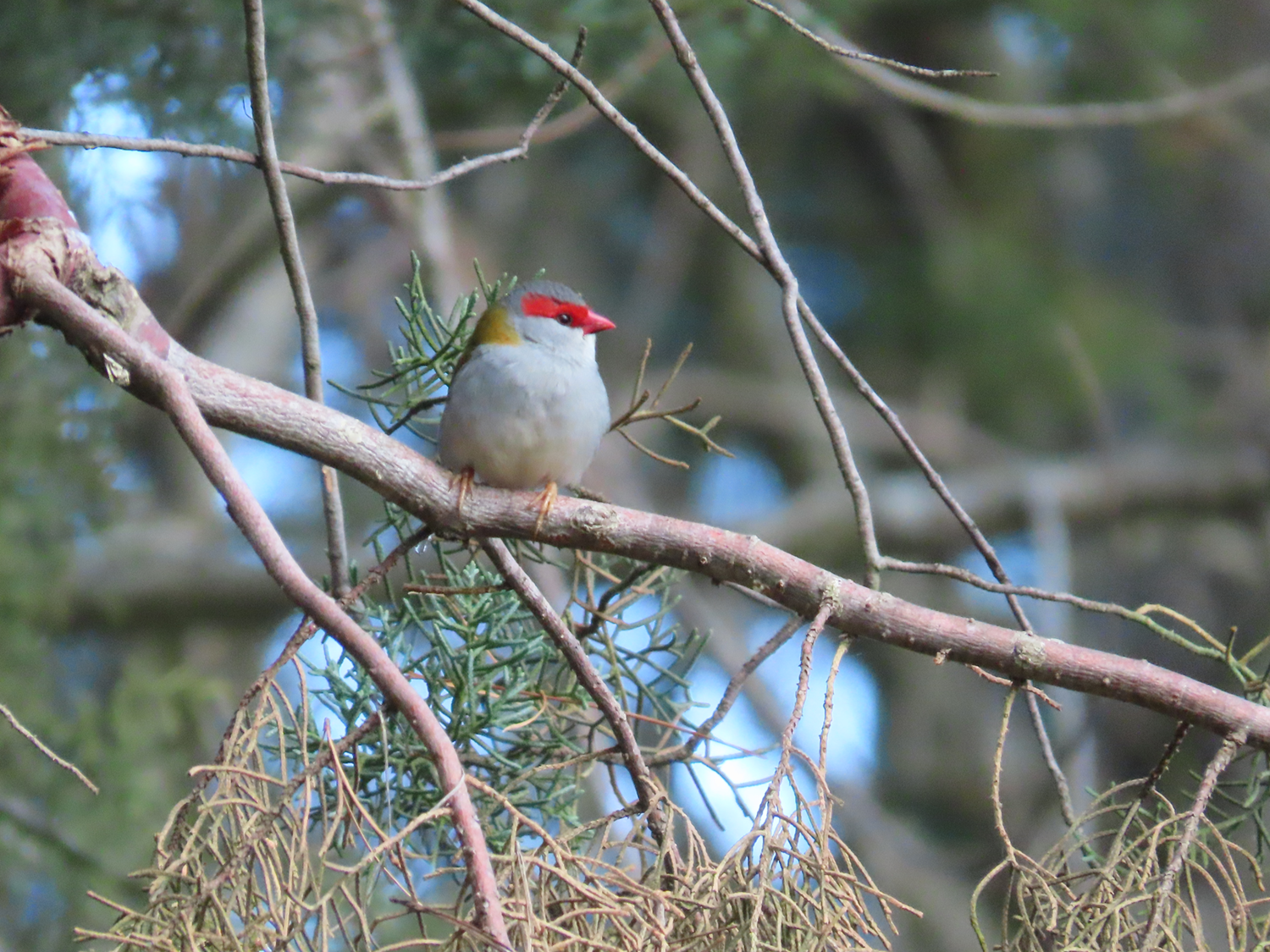
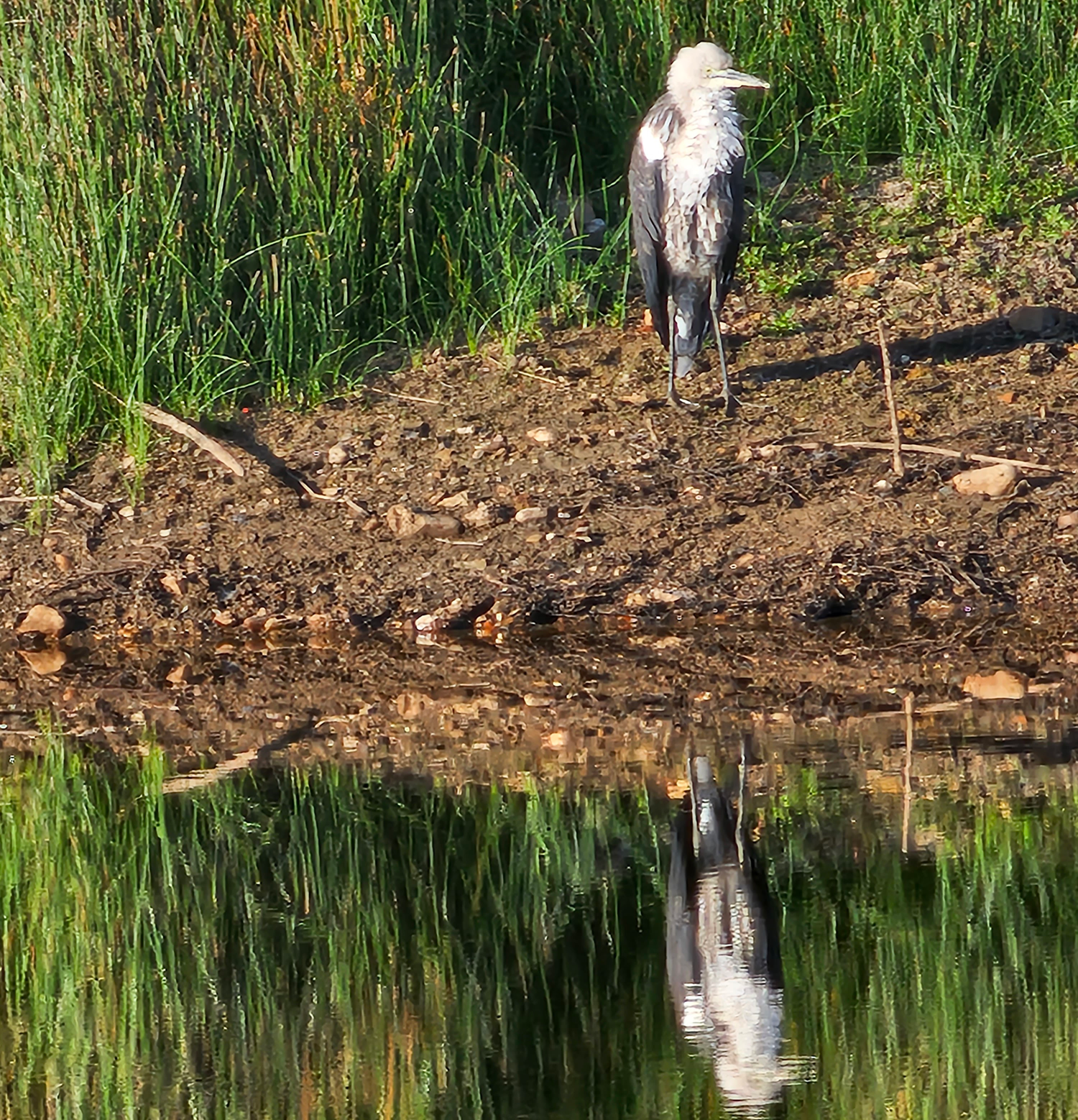
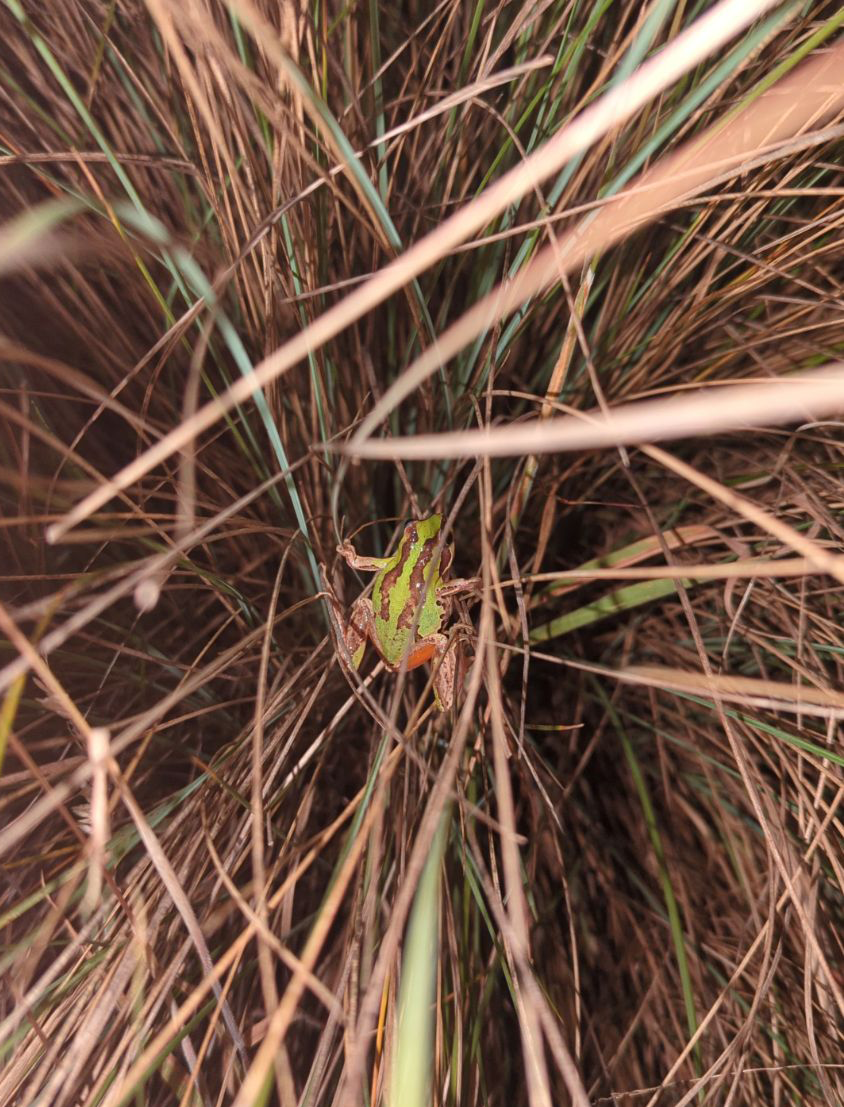
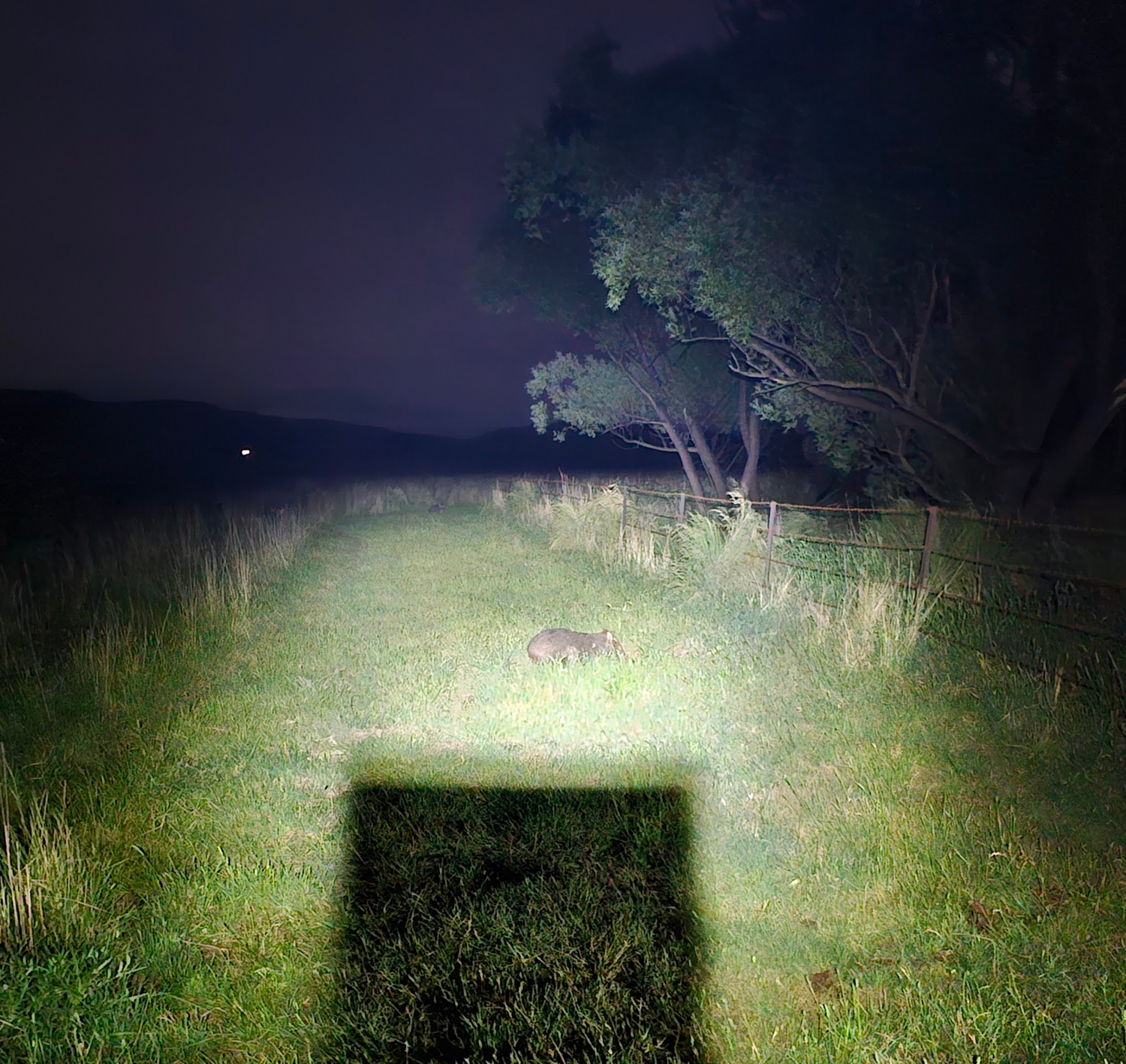
This is an abundance of bird life and frogs around at this time of the year. Herons, rosellas and finches are just a small sample the team have seen during their field work recently, alongside the odd cheeky wombat.

The team continues the regular maintenance and download runs in which each individual instrument site is visited and regular maintenance, repair and download works completed. We have also been rolling out some replacement sensors we have recently received.  

These instruments included:  

  • Hydrological & groundwater monitoring stations  

  • Stream gauges  

  • Climate stations or Automated Weather Stations (AWS) 

The team has also been in recent discussions with Sydney University regarding a couple of honours projects where we are more closely interrogating and analysing Mulloon’s RARC (Rapid Assessment Riparian Condition) and fish data undertaking biodiversity and land function studies.