The winter months have been a very busy time for the Mulloon Consulting (MC) team.

We have been very pleased to have Matt Smith join our team, who comes to us with significant experience in project management and delivery, as well as a keen interest in agriculture, spending his spare time with family on his own property near Toowoomba.

June was the official completion month for the Communities of Practice Project (CoPP), and I would like to thank our Learning Programs Manager, Tam Connor, with the close support of Dr Laura Fisher, and the rest of the MC team who presented field days, bootcamps, provided mentoring support to landholders and delivered boots on ground days.  We also had the eastern and western Professionals Intensives for NRM professionals.  It has been a fantastic project, leaving five communities in NSW, WA, Victoria, NT and Queensland with increased capacity to keep undertaking landscape rehydration projects, as well as the completion of numerous on-ground works as demonstration sites to inspire other land managers.

The Water Stewardship Program (WSP) is in full swing with six communities in the Sydney Drinking Water Catchment committed and a lot of interest from others. Field days are being undertaken (with more Learning Programs activities to come), EOI’s are flowing in, and individual project plans are being developed for the demonstration sites.  We are looking forward to construction on some of these projects in spring.

Peter Hazell is on his last construction project, on Larry’s Creek to the west of Canberra at the Deep Space Communications Complex, and is joined by Jack Smart, Tony Wells and Mitch Lennon. Peter has pioneered the field of Landscape Rehydration, leading its technical design discipline, advancing the underlying science, and helping to drive regulatory reform to create more streamlined pathways for this vital work on Country. It’s been a privilege to work with him.

We also have construction happening on the second stage of the Carwoola Station component of the Molonglo Catchment Rehydration Initiative, the floodplain earthworks, which includes two constructed wetlands designed as part of the crucial habitat for the Green and Golden Bellfrog.  Congratulations to Jack on the final stages of this very important project.

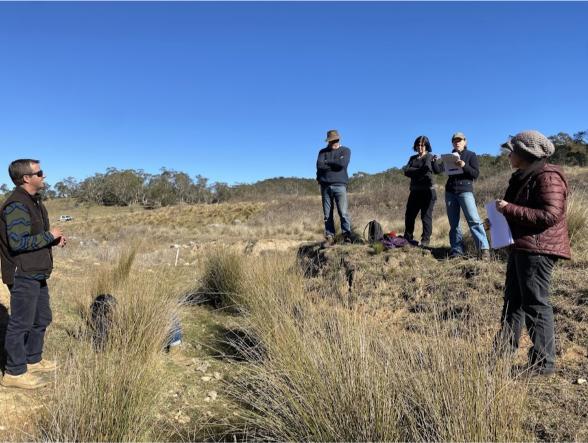
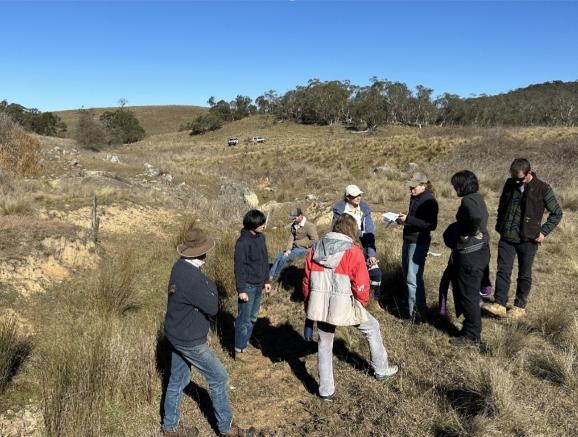
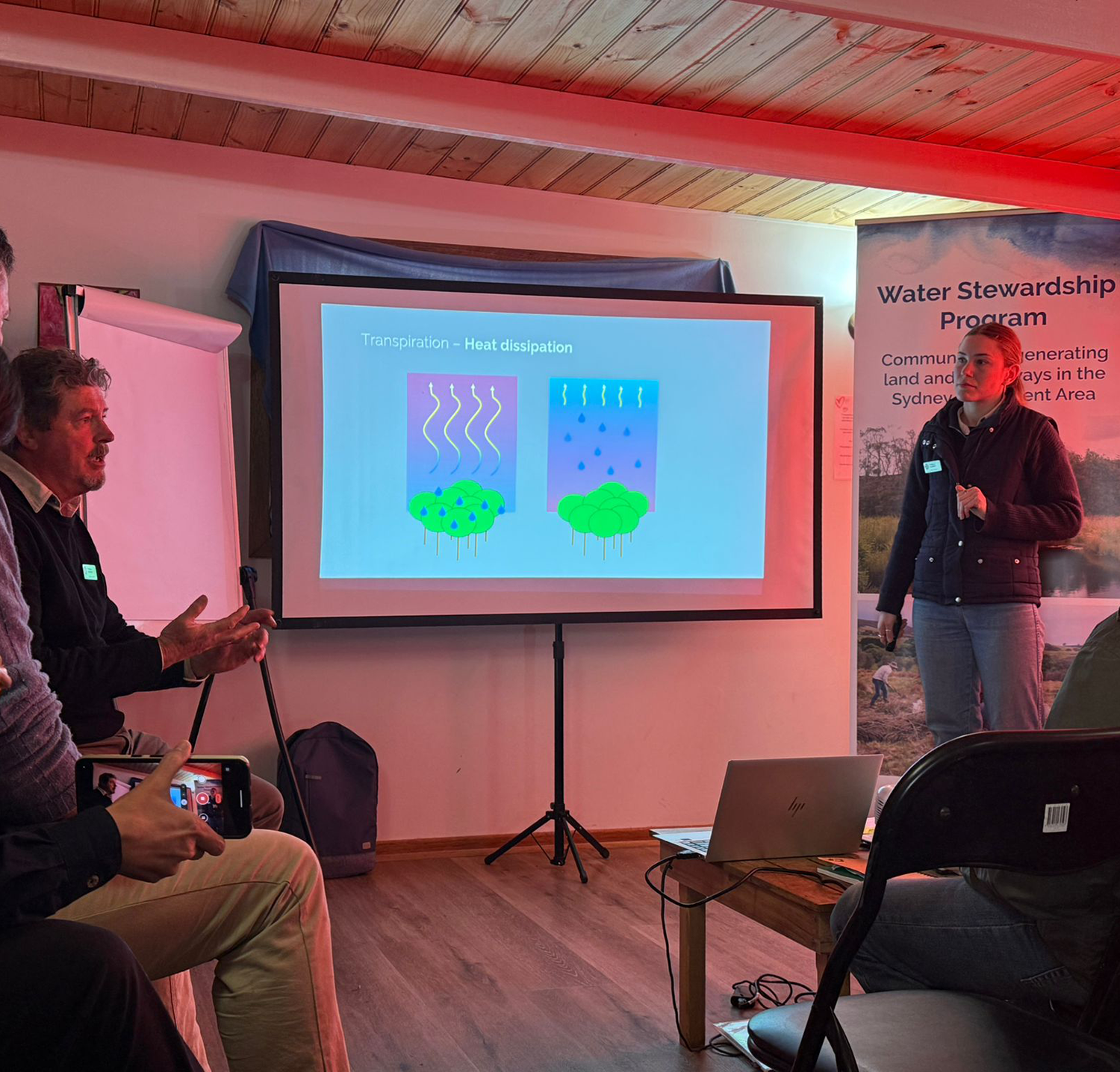
Pictured right: Peter Hazell and Erin Healy presenting at the Water Stewardship Program field day in Braidwood. 
During winter, we have been relatively quiet on the Learning Programs front (with the exception of field days at Tuntable Creek and Braidwood), although Lance Mudgway has a number of field days coming up in WA, including one at Boyup Brook that is happening as part of the Regen WA conference activities. Keep an eye on our Events page as more Learning Programs activities are scheduled over spring and summer.

Work on our other major projects, LiFT, First Nations Water Skills, and TIMME have kept the rest of our team very busy.  A literature review for LiFT is in the final stages of review, the monitoring matrix has been developed, and the next step will be a thorough review of these outputs with consortium partners. Planning for the TIMME project is well underway, and initial engagement with a couple of the communities is happening. The co-design process with consortium members is the next step over the coming months. Sophie Hall-Aspland and Brooke Cunningham recently joined Lance in WA to meet with representatives of Noongar Land Enterprises and Boyup Brook landholders, Warren and Lori Pensini, as part of the LiFT and TIMME projects.

Lance and Henry Burt are currently in Darwin as part of a project that we are doing for Landcare NT, assessing the current state, function and potential for nature-based solutions across key waterways as part of their Darwin Harbour Catchment Waterways project.

There’s plenty planned as we go into the warmer spring months, so look out for the coverage of that in the next update.  We also have a new team member, Ryan Badowski, joining the team on the first day of spring!

This is my last report as GM of Mulloon Consulting. While my decision to move on has not been an easy one, the fact that the business is in good shape with a fantastic team and a good pipeline of ongoing work made me feel more comfortable with the timing. I remain a huge supporter of what Mulloon does and I wish the team all the best with continuing to do great work around the country, and our landscapes will be a whole lot better off for it.

Jono Forrest
General Manager
Mulloon Consulting 

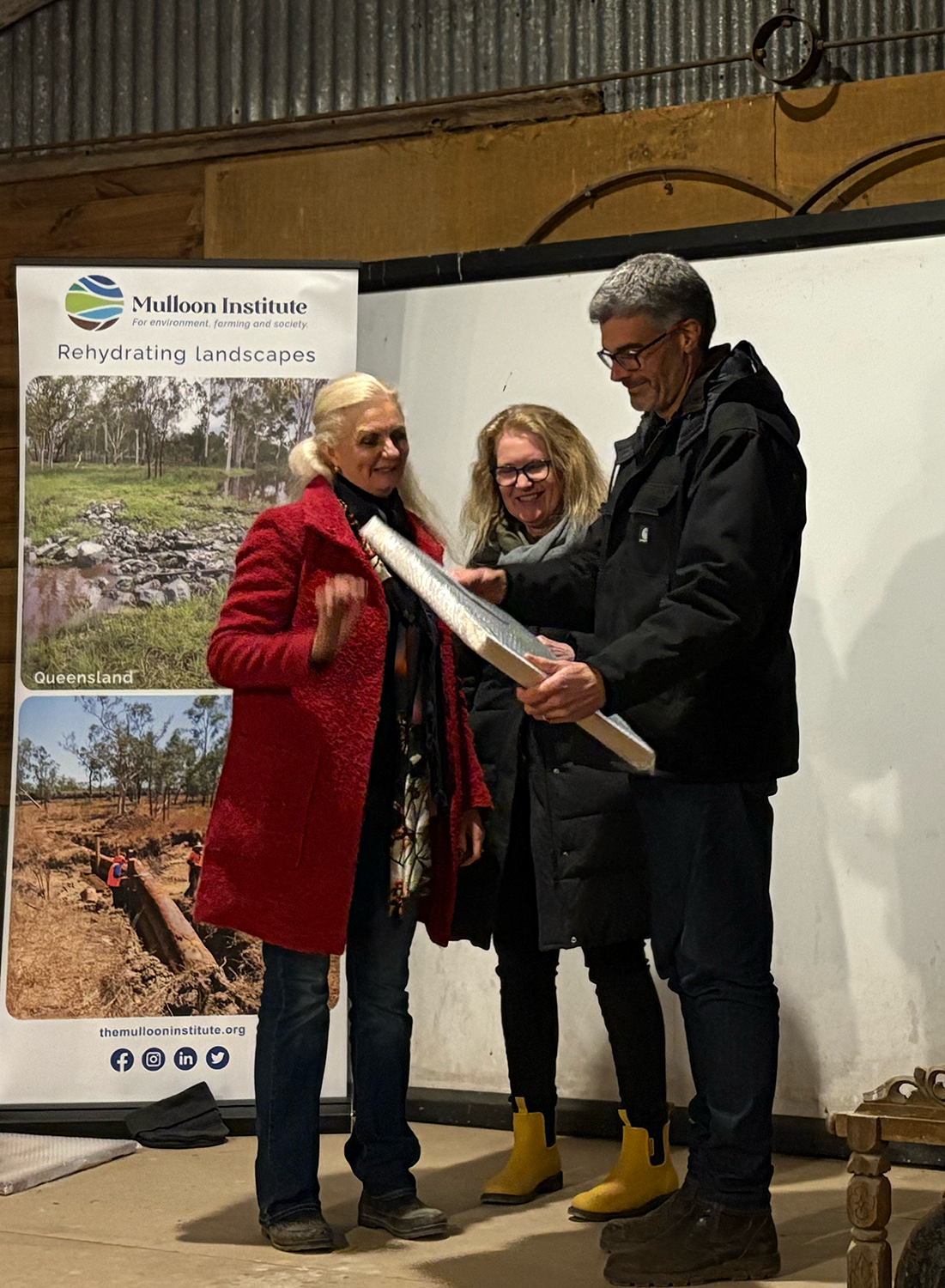
Pictured right: Jono receiving a farewell gift from Carolyn Hall and Kathy Kelly on Home Farm at the recent farewell event.
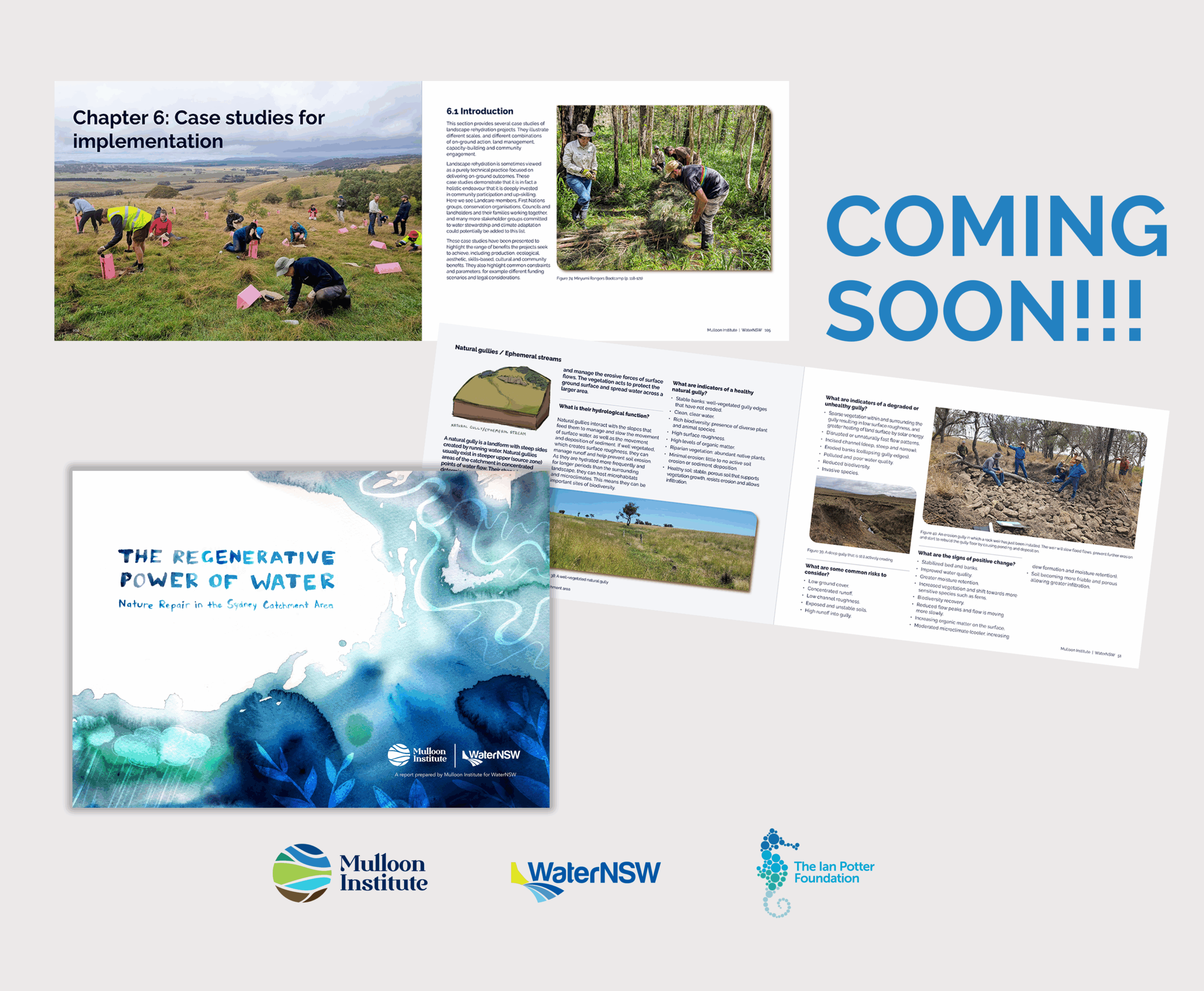
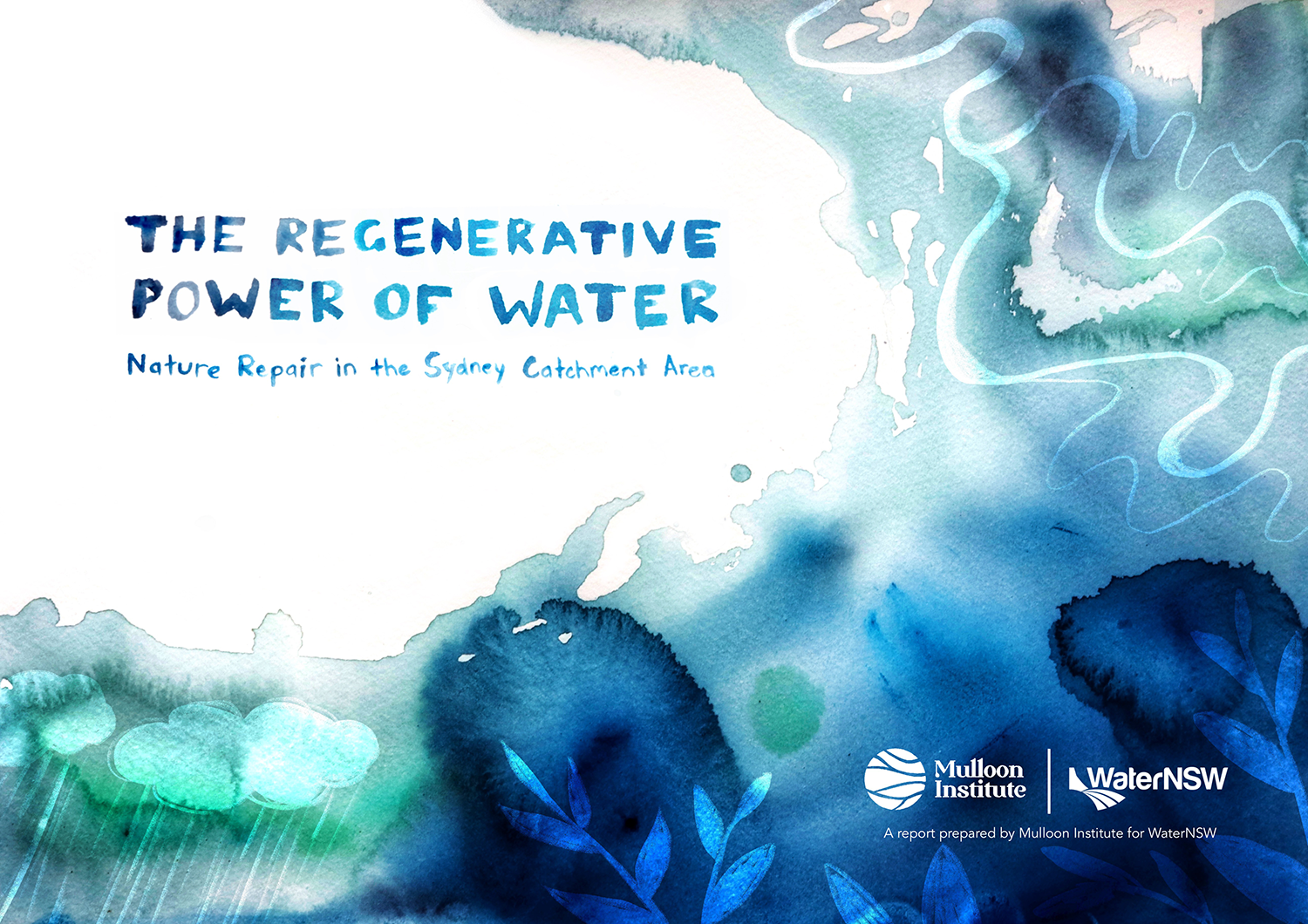
The Regenerative Power of Water: Nature Repair in the Sydney Catchment Area was commissioned by WaterNSW as part of our new Water Stewardship Program.

Here’s Laura in her car, with rain pouring outside, very happy to be holding the proofs of a publication she’s been wrestling into existence for 6 months – it’s a real thing!  

The Regenerative Power of Water: Nature Repair in the Sydney Catchment Area was commissioned by WaterNSW as part of our Water Stewardship Program. Co-authored by several team members, it shares the context, science and practice of landscape rehydration, with plenty of visuals, fact sheets and case studies to tell the story.  

Thanks to The Ian Potter Foundation’s support, we were able to work with illustrators Kim Williams and Tilda Joy to create a suite of illustrations for the report, and we’re so proud of their original work. We also love the photographic record of all the remarkable communities gaining the skills to heal landscapes and rebuild resilience through water-focused strategies. 

Publication is just a few weeks away, keep an eye out for news so you can get a copy! 

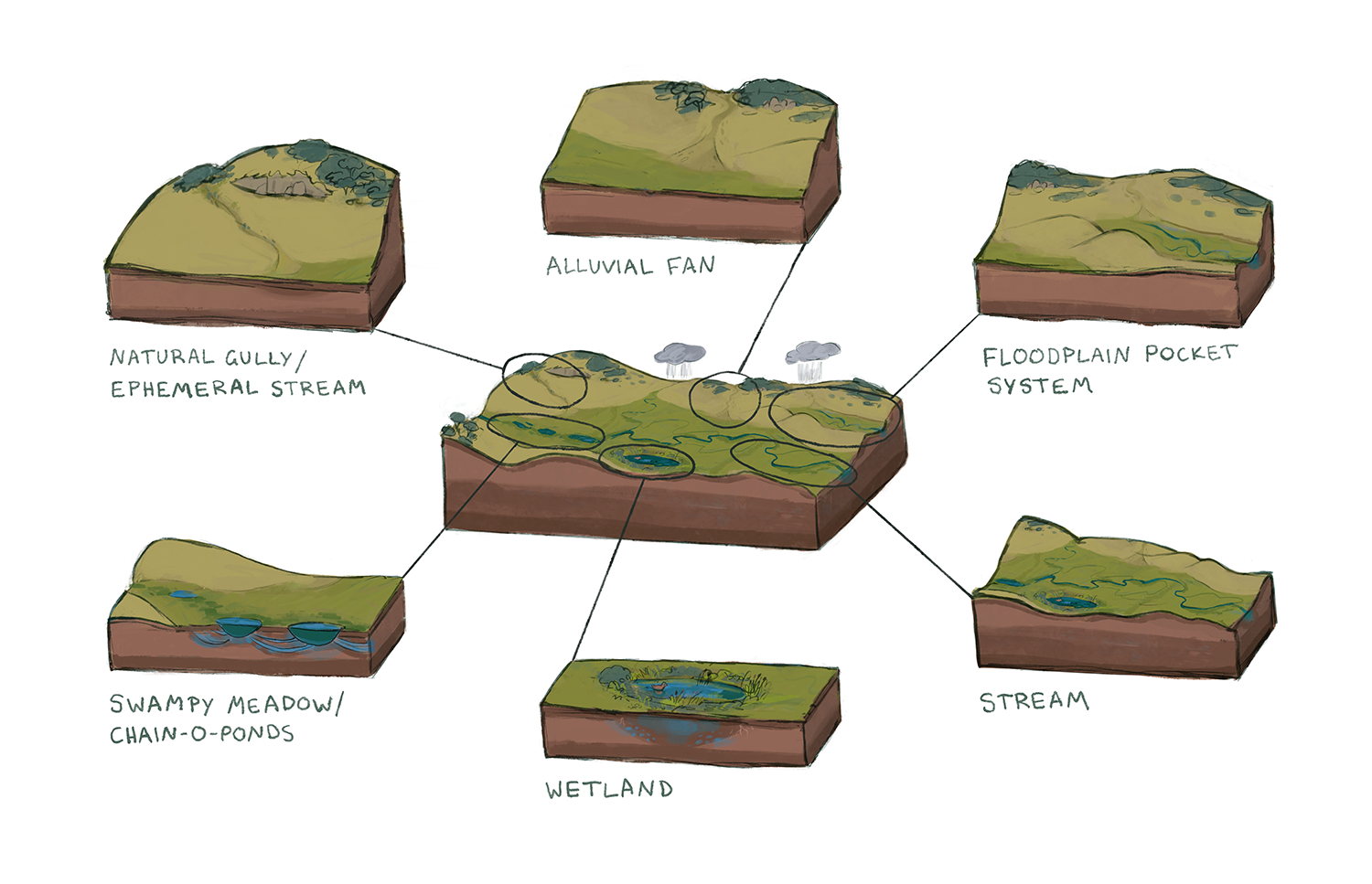
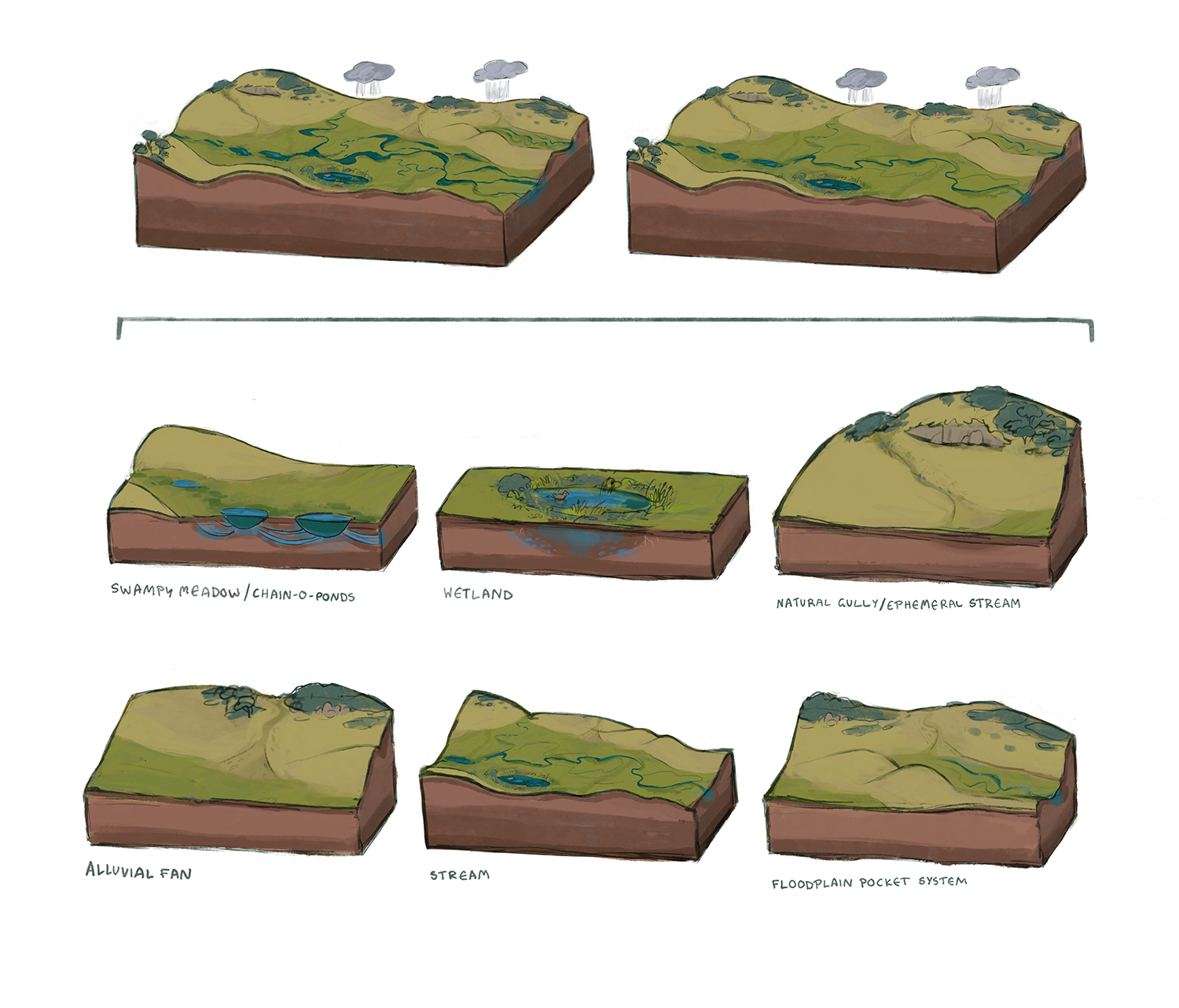
Before we dive into any nature repair project at Mulloon, we work out where in the landscape we are situated. Are we in a natural gully, a floodplain pocket, or a swampy meadow? Our catchments are a mosaic of features, shaped by the movement of water, sediment and organic life over thousands of years. Each feature has a unique hydrological story – its particular way of managing water.

For National Science Week this year we are celebrating the Hydrological Landscape. And true to Mulloon form, there’s an artist involved! We commissioned illustrator Tilda Joy to help us foster wider understanding of how the hydrological features of South Eastern Australia function, how to tell if they are dysfunctional, and how we can heal them and reestablish water’s cycling, hydrating patterns across the landscape.  

Science Week graphic

Tilda’s beautiful illustrations are part of a forthcoming publication we are very excited about: The Regenerative Power of Water: Nature Repair in the Sydney Catchment Area, which was commissioned by WaterNSW as part of our Water Stewardship Program. Keep an eye out on our news pages and socials for the announcement of its release so you can get a copy! 

Science Week graphic 3


So… what hydrological feature are standing on right now ? 

Defining ‘hydrological function’

Hydrological functions are the processes and interactions that govern the movement, distribution, and quality of water within the environment, including on the surface of the land, in the soil and underlying rocks, in the atmosphere, and in relation to living things. 


Science Week graphic 1

The Friends of Grasslands group visited the Home Farm in June and published this piece by Ann Milligan and Margaret Ning in their most recent newsletter. We’re pleased to reproduce it here with permission.

The part of Mulloon Home Farm we visited on Friday afternoon 20 June is not only beautiful but also a rich example of natural temperate grassland (NTG). Our group’s attention was engaged for over 2 hours as we wandered across the valley sides and hilltops, spotting plant species until the sun sank into the western hills.

We were welcomed and accompanied by Peter Hazell and his three offsiders (Chris, Louis and Colby) who manage the property, its vegetation, livestock, natural assets and science. After acknowledging Traditional Owners and Elders, Peter explained the importance of bringing this land (at the top of the Great Dividing Range locally) into excellent ecological condition. First, it is significant to local Indigenous groups. Second, it is in the mid-reaches of the Mulloon Creek catchment (part of the Shoalhaven River catchment) and is a demonstration area for natural rehydration of agricultural catchments.

Around 2006 the owner, the late Tony Coote, decided to test Natural Sequence Farming – a system of managing catchment water flows devised by a NSW farmer named Peter Andrews – which consists of the partial damming of natural gullies and small creeks such as occurs when, say, rocks and branches accumulate in one place. This system of leaky weirs aims to imitate the chains of ponds that used to occur naturally along creeks before Europeans started clearing land for agriculture. Often those natural ponds would stay bank-full even when the creek had long since ceased to flow, because the ponds were connected to underlying floodplain aquifers. This helped keep the surroundings alive.

The Mulloon farms and all the landholders along the Mulloon Creek are installing leaky weirs now to slow the flow of water that would otherwise drain quickly off these upland water catchments after rainfall. The resulting ponding and slower flow keep the banks above the gullies wetter (rehydrated) and better able to maintain their plant cover. Monitoring of stream flow since 2006 suggests there is no apparent detriment to the landholders downstream of Mulloon Creek along the water’s journey to the Shoalhaven.

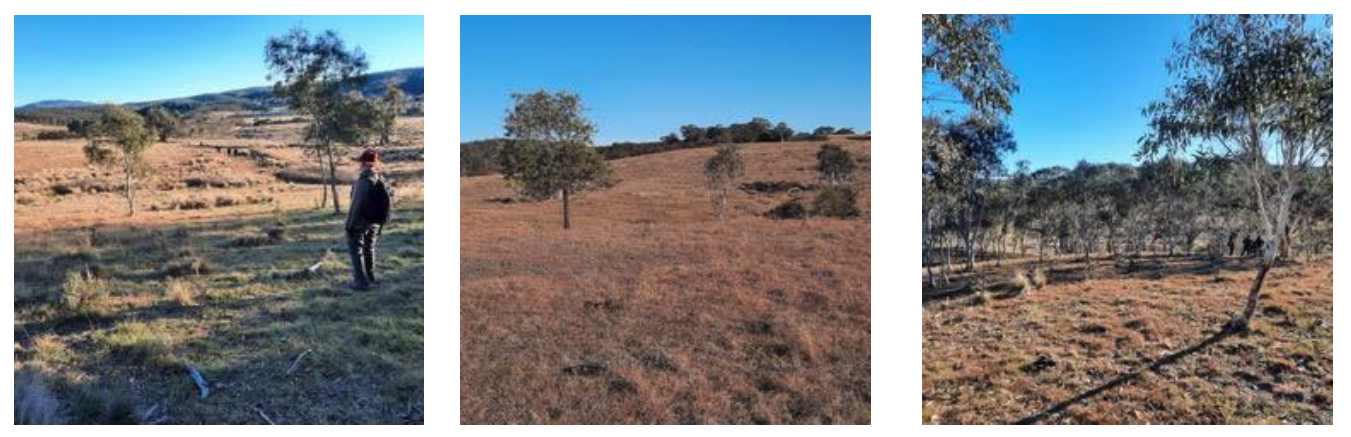
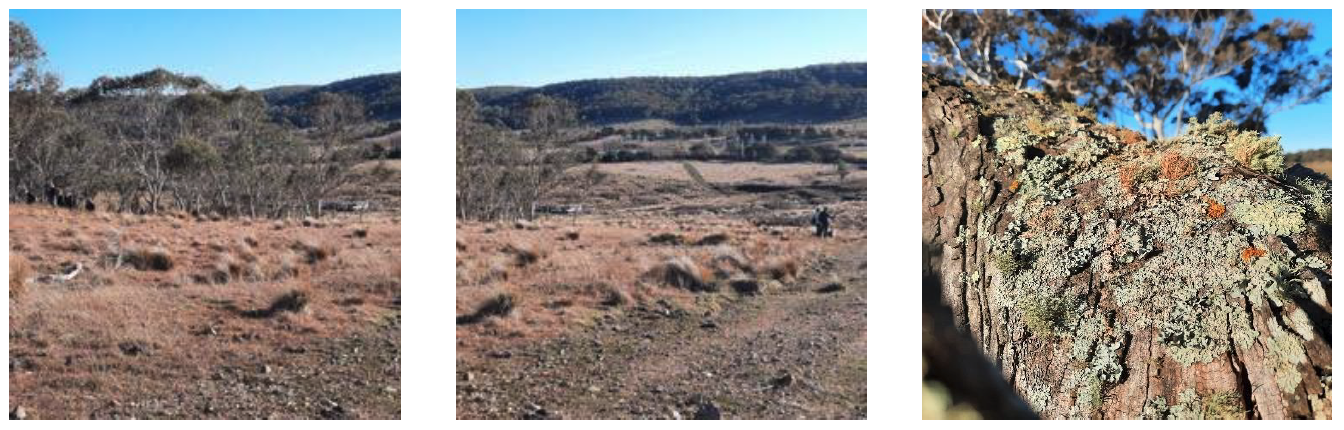
Our group walked slowly, heads bent, cameras clicking, across the large paddocks on the hillside and hilltop and valley bottom (the subcatchment) exploring the numerous grassland species. There is a west-facing hillside stand of snow gums (Eucalyptus pauciflora), and a hilltop stand of E. mannifera, and remnant very old E. dives. There are expanses of pinkish Themeda (middle photo above) on the slopes and ridges, easily seen from a distance by the colour. Grasses on the eastern facing slope include Dichelachne. Beyond the creek at the valley bottom is a green and orange dirt heap remaining from former copper mining.

The subcatchment we explored is being considered by the NSW Biodiversity Conservation Trust for possible funding to support its management as grazed natural grassland and woodland, Peter said.

The main aim of our visit was to determine if the area we explored was in fact NTG, and it didn’t take us long to compile a plant list of just under 70 species to confirm that. In our group we had a keen lichen enthusiast who assured us that we would also have sighted a minimum of 20 lichen species (photo on the right above) during the course of the afternoon.

Thank you, Peter and team, for welcoming us and for suggesting we come back sooner rather than later!

All photos in this article are by Ann Milligan

In early June, a team of Mulloon staff working on the Landscape Function Toolkit (LiFT) came together to share ideas and run some data collection methodologies through their paces.  The day was a culmination of months of research and collaboration and brought together staff from various scientific disciplines with experience as science communicators/educators, landscape planners, remote sensing specialists and engineers. This wonderful interdisciplinary convergence of diverse skills and expertise merged critical thinking and creative flow for a fantastic day together. 

Measuring landscape function is nuanced and complex, requiring a whole of system approach that has led to many conversations around state and transition, flux and flow, metrics, and key aspects of landscape function. Notably, the small water cycle and its importance in a healthy landscape are front and centre of our conversations.  

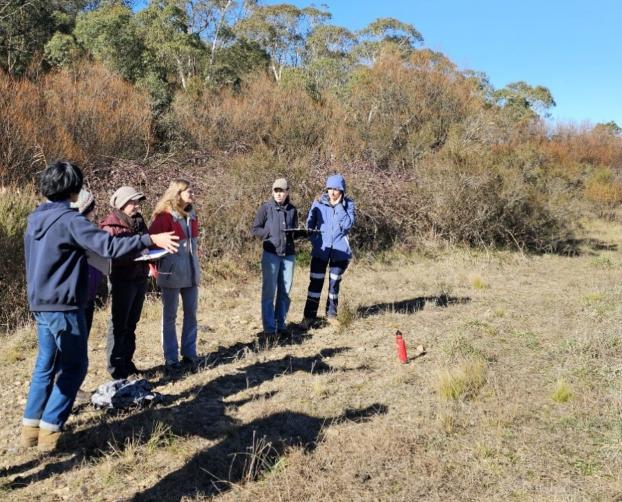
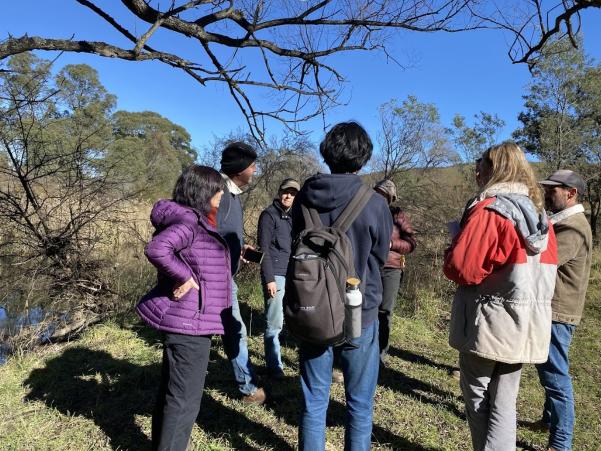
We began the day in the paddock, alongside Mulloon Creek to put Alex Sun’s (PhD Candidate, Sydney University) ‘Riparian Assessment Scorecard’ to the test, looking at diversity and density of riparian vegetation from trees and shrubs to grasses and forbs.  


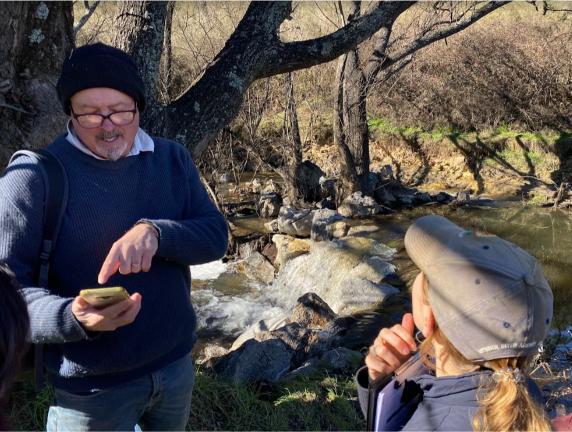
Photos below left to right: 1. Alex giving instructions to the team before doing the riparian assessment, 2. Peter Hazell at Peters Pond using the phone app version of the structure health scorecard, 3. The team discussing the merits and drawbacks of the Structure Health Scorecard, 4 & 5. Erin Healy reading the Ephemeral Drainage Assessment criteria 

From there we moved across to Peters Pond to look at the first in-stream structure built along this creek system. Peter Hazell led the team through the Mulloon Institutes ‘Structural Health Scorecard’.  This scorecard is used by Mulloon to monitor the Integrity (the structures ability to withstand its intended load), and Function (how well the structure performs its intended task) of instream structures as well as assess the health, diversity and coverage of vegetation throughout the natural infrastructure. 

By mid-morning we were ready to leave the frosty paddock and went in search of warming sunshine and an ephemeral drainageWe ran through the ‘Ephemeral Drainage-line Assessment: Indicators of stability’ which has been directly adapted from Tongway and Ludwig’s Landscape Function Analysis, before breaking for a well-earned lunch.  

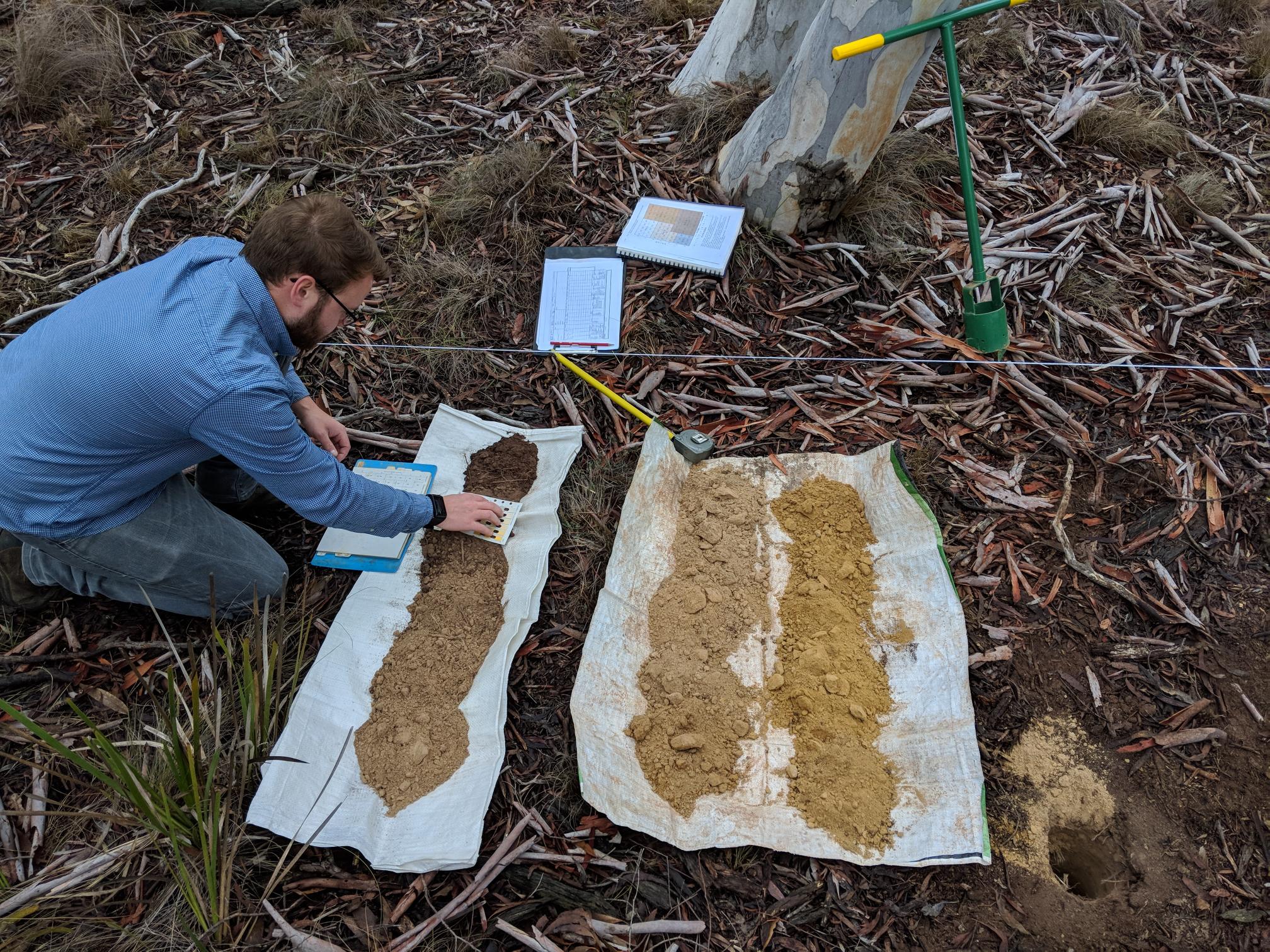
Throughout the afternoon we gathered inside and had a look at a some of the mobile phone apps currently available, and their associated desktop platform. We focused on biodiversity, vegetation and soil assessments, using Covram and SoilMentor.  We ran through their various functions including user friendliness and the speed at which information collected on the app was synced across platforms.  Functionality and information gathered were key focus areas.  

Finally, we wrapped up the afternoon with some discussion on next steps before saying our goodbyes and heading home in various directions.   

Overall, it was a fantastic day and a great opportunity to come together as a team to share knowledge and learning. 

Further information on the LiFT project can be found here. 

The Landscape Function Toolkit (LiFT) project is a climate resilience project funded by the Australian Government under the National Heritage Trust’s Climate-Smart Agriculture Program

The Board has commenced a director renewal process that will involve a public recruitment process in coming months. As part of that renewal process, the Institute announces the following changes to its Board – as of 1 July 2025:

  • Resignation of Matt Egerton-Warburton, Carolyn Hall and Kathy Kelly as Directors

Matt Egerton-Warburton has resigned from the Mulloon Institute Board. The Institute acknowledges the contribution that he and his family have made to the Institute in recent years. Matt, as Chair of the Mulloon Law Committee following its inception in 2019, member of the Board from August 2022 and Chair from January 2024, provided countless hours passionately leading both the Law Committee and the Board. We thank him for his service and wish him well.

Carolyn Hall and Kathy Kelly have resigned from the Mulloon Institute Board, but remain in their executive roles.

All former Directors will be welcome to re-apply for their roles as Directors through the upcoming director recruitment process.

  • Appointment of Rose Nairn OAM and Rob Purves AM as Interim Directors

Rose Nairn OAM and Rob Purves AM – both highly accomplished current members – have been appointed as Interim Directors by the Board until the director recruitment process finalises a new permanent board.

  • Appointment of Wilfred Finn as Interim Chair

Current Director Wilfred Finn has been appointed as Interim Chair of the Board, again until the director recruitment process finalises a new permanent board.

The Interim Board, executive team, staff and members are excited at the prospect of this Board renewal process, to build on the growth of the organisation since its establishment in 2011, and particularly in recent years.

Our winter eNewsletter is out now!


Catch up on all the latest from the Mulloon team — including a brand new video, project updates (old and new!), fresh animations, an OAM award, stories from Erin’s North America working trip, and what’s been happening at Mulloon Creek Natural Farms.


READ NOW

Why Berlin’s global soil summit revealed the economic opportunity hiding beneath our feet.

CEO Carolyn Hall recently represented Mulloon Institute and Australia at Berlin’s Partners for Change – SOILutions for a Food Secure, Resilient, and Sustainable Future conference in May. Carolyn shares a series of blog posts reflecting on the aims, challenges, impacts and themes that ran throughout the conference.

When colleagues from the German Society for International Cooperation Deutsche Gesellschaft für Internationale Zusammenarbeit (GIZ) GmbH invited me to Berlin for the Partners for Change – SOILutions for a Food Secure, Resilient, and Sustainable Future conference, I knew this wasn’t just another conference. As CEO of Mulloon Institute and an ELD – Economics of Land Degradation Initiative member, I was joining a critical conversation about scaling soil restoration globally.

Australia’s Proven Formula

Speaking to the Plenary Session on Enabling Environments, I shared what’s worked in Australia: combining smart policy (our National Soils Strategy), strategic funding (Natural Heritage Trust and Futures Drought Fund), and community collaboration through Landcare groups and NRM bodies.
But the key insight? We need environmental-financial brokers—professionals with diplomatic skills who can channel private capital while ensuring equitable benefits for communities. Richard Thomas first raised these points at the UNCCD COP16Riyadh at the launch of the Economics of Drought Report.

The Regulatory Challenge

Here’s the uncomfortable truth: even countries with good intentions often have regulatory frameworks that aren’t fit for purpose. Australia isn’t alone in facing barriers that limit our ability to deliver on international commitments to combat desertification and restore ecosystems.

The Numbers That Matter

The Economics of Drought report reveals staggering potential: a nature-positive economy could generate $10 trillion annually and create 395 million jobs by 2030 (ELD – Economics of Land Degradation Initiative The United Nations University Institute for Water, Environment and Health (UNU-INWEH). Our Mulloon Rehydration Initiative, featured as the Australian case study, proves these aren’t just projections—they’re achievable returns.

What’s Next
Success requires financial innovation, regulatory reform, capacity building, and global coordination. The conversations in Berlin weren’t just about soil – they were about reimagining our relationship with the land that sustains us.

The solutions to food security, climate resilience, and economic prosperity literally lie beneath our feet. It’s time we started treating them that way.

What 150 Global Delegates Taught Me About Soil.

CEO Carolyn Hall recently represented Mulloon Institute and Australia at Berlin’s Partners for Change – SOILutions for a Food Secure, Resilient, and Sustainable Future conference in May. Carolyn shares a series of blog posts reflecting on the aims, challenges, impacts and themes that ran throughout the conference.

Picture this: “You have exactly five minutes to summarise 90 minutes of expert discussion about soil health and the Rio Conventions to 150 global delegates in Berlin”. The pressure was intense, but what emerged revealed critical truths about our planet’s future.

The sobering reality: When asked how well soil health was incorporated into 2024’s COPs, experts agreed – only slightly. The substance that produces 95% of our food and stores more carbon than the atmosphere barely gets mentioned at our most important environmental summits.

The breakthrough insight: Land restoration isn’t one solution among many – it’s THE key solution for all three Rio Convention challenges:

  • Land degradation neutrality
  • Biodiversity loss
  • Climate resilience

One integrated challenge, one integrated answer: healthy soil.

The game-changer: We need coordination that starts from the bottom up. Farmer’s voices and women’s stories must be central to planning. National Focal Points need better support to include local communities in global conversations.

The path forward requires three strategies:

  1. Leverage less controversial entry points like soil and human health
  2. Highlight economic benefits that are impossible to ignore
  3. Strengthen partnerships to ensure proper funding

The five-minute truth: We have the science, economics, and examples. What we need is political will to put soil health at the centre of our response to climate change, biodiversity loss and land degradation.

The health of our planet depends on the health of the ground beneath our feet. It’s time our policies and markets reflected that reality.

Your belief in our work has helped Mulloon Institute reach extraordinary heights. As we reflect on 2025, we’re humbled by what our collective action has achieved – and excited by what’s still possible.

Right now, we face a pivotal moment that demands immediate action. With over 60% of Australian landscapes still degraded, the need for restoring resilience, productivity, and biodiversity to our landscapes is urgent.

Our Progress – A Year of Firsts

Personal and corporate investment has already created remarkable breakthroughs:

  • Scientific validation of our methods, with peer-reviewed studies showing improvement in water retention across demonstration sites.
  • National recognition with wins in the Biodiversity categories at both the Banksia State and NationalSustainability Awards, celebrating our evidence-based approach to landscape restoration.
  • Global leadership at COP16 in Riyadh, where we shared Australia’s rehydration solutions on the world stage as a keynote speaker and panellist.
  • Doubled impact through our education programs, we have empowered over 500+ landholders with skills to restore water in their landscapes.
  • Our Learning Programs now extend to a wide range of additional learning experiences for community groups, landholders, business owners, Indigenous groups, schools, and volunteer organisations across Australia.
  • Demonstration sites constructed in the Southern Tablelands NSW, Northern Territory, Western Australia, ACT, Queensland.
  • Regulatory reform in NSW and dialogue progressing with regulators in QLD, NT and WA.

Strong partnerships

  • Our continuing partnership with Vitasoy takes our sustainability message to all Australians
  • Our new partnership with WaterNSW will see landscape rehydration delivered in communities across the Sydney Drinking Water Catchment
  • Grant success with the Australian Government Climate Smart Agriculture Program and Futures Drought Fund drives expanded project activity.

These partnerships amplify every dollar you give, creating a ripple effect of restoration across Australia.

Why your support matters more than ever

We are proving that collaboration creates transformation. We know how to rehydrate and restore Australia’s landscapes for increased biodiversity, improved agricultural productivity and climate resilience, we cannot afford to wait.

Philanthropic support remains central to Mulloon Institute’s survival. It is with support like yours we can continue to expand our important work.

Your tax-deductible gift before 30 June will:

  • expand our partnership model to new catchments
  • help us build the capacity of new landholders to restore and rehydrate their landscapes
  • develop the next generation of catchment-scale solutions
  • convert our scientific insights into more on-ground action.

Please, DONATE NOW

Please consider giving generously so we can continue to rehydrate and repair Australian landscapes.