In March/April Science Officer Nolani McColl and CEO & Managing Director Carolyn Hall travelled to Western Australia to meet with Landscape Planner Lance Mudgway and progress the WA Community Stewardship grant project – ‘Landscape Rehydration Trial & Demonstration in the Wheatbelt of WA’, which is supported by funding from the West Australian Government’s State NRM Program.
During the trip, the team presented at Wheatbelt NRM’s ‘REstore. REshape. REnew’ conference, where more than 70 people joined Terry McCosker OAM, various Wheatbelt farmers and the Mulloon Institute for a day of exploring soil, business and farmer health. TMI staff facilitated an interactive session of learning landscape rehydration tools and techniques and took participants on a tour of proposed works at the Muresk as part of the WA Community Stewardship grant project.
While they were in the Wheatbelt, TMI also supported the Muresk Institute in piloting an interactive Q&A webinar session with Year 12 students from the Western Australian College of Agriculture Cunderdin and provided a landscape demonstration for Curtin University students studying the Associate Degree in Agribusiness on the Muresk campus.
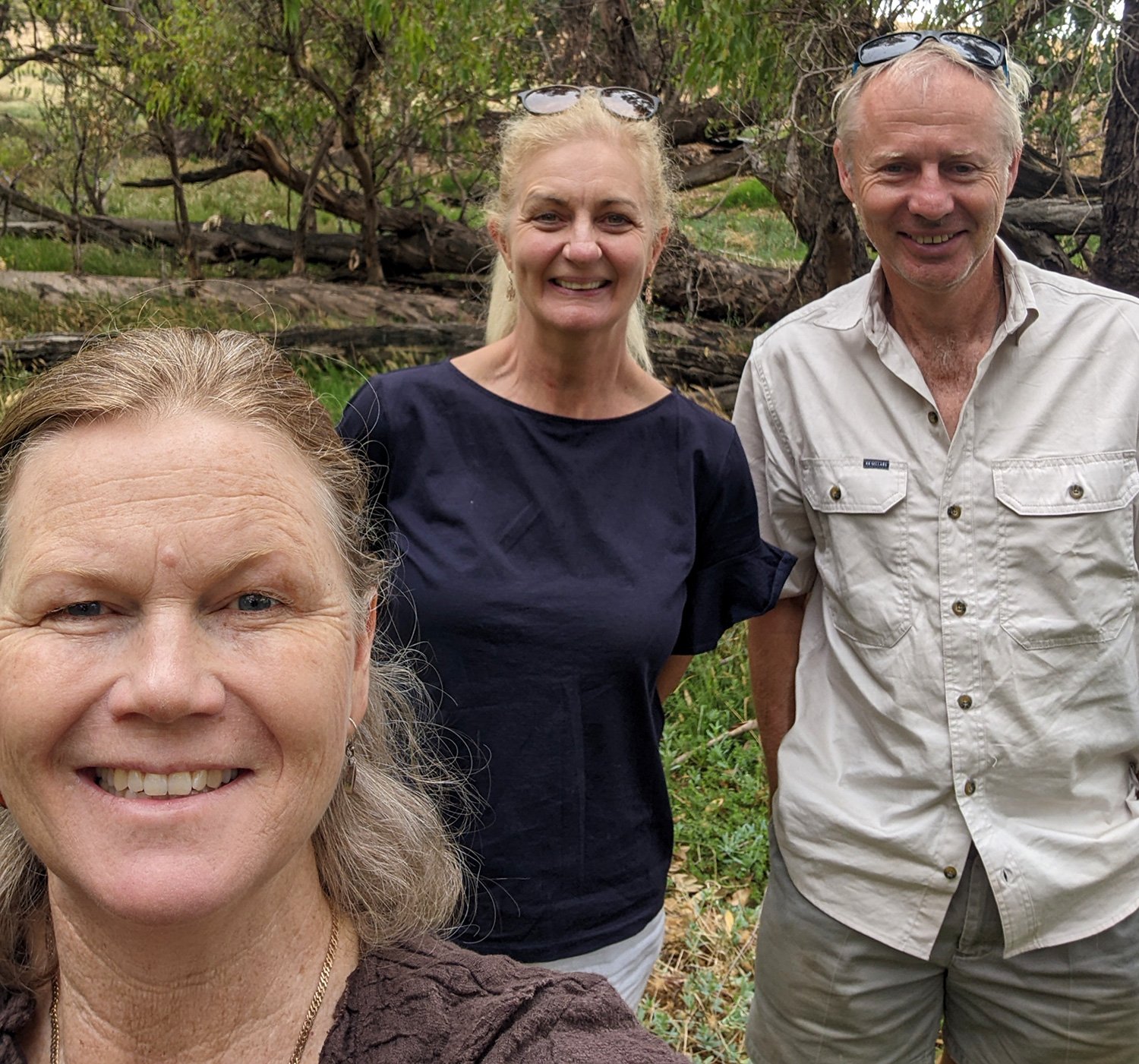
L-R: TMI’s Nolani McColl and Carolyn Hall catching up with Lance Mudgway in Western Australia.

At Muresk Institute, Lance Mudgway (TMI) shows Agribusiness Associate Degree students from Curtin University how water flows in the landscape, naturally and after clearing and erosion.
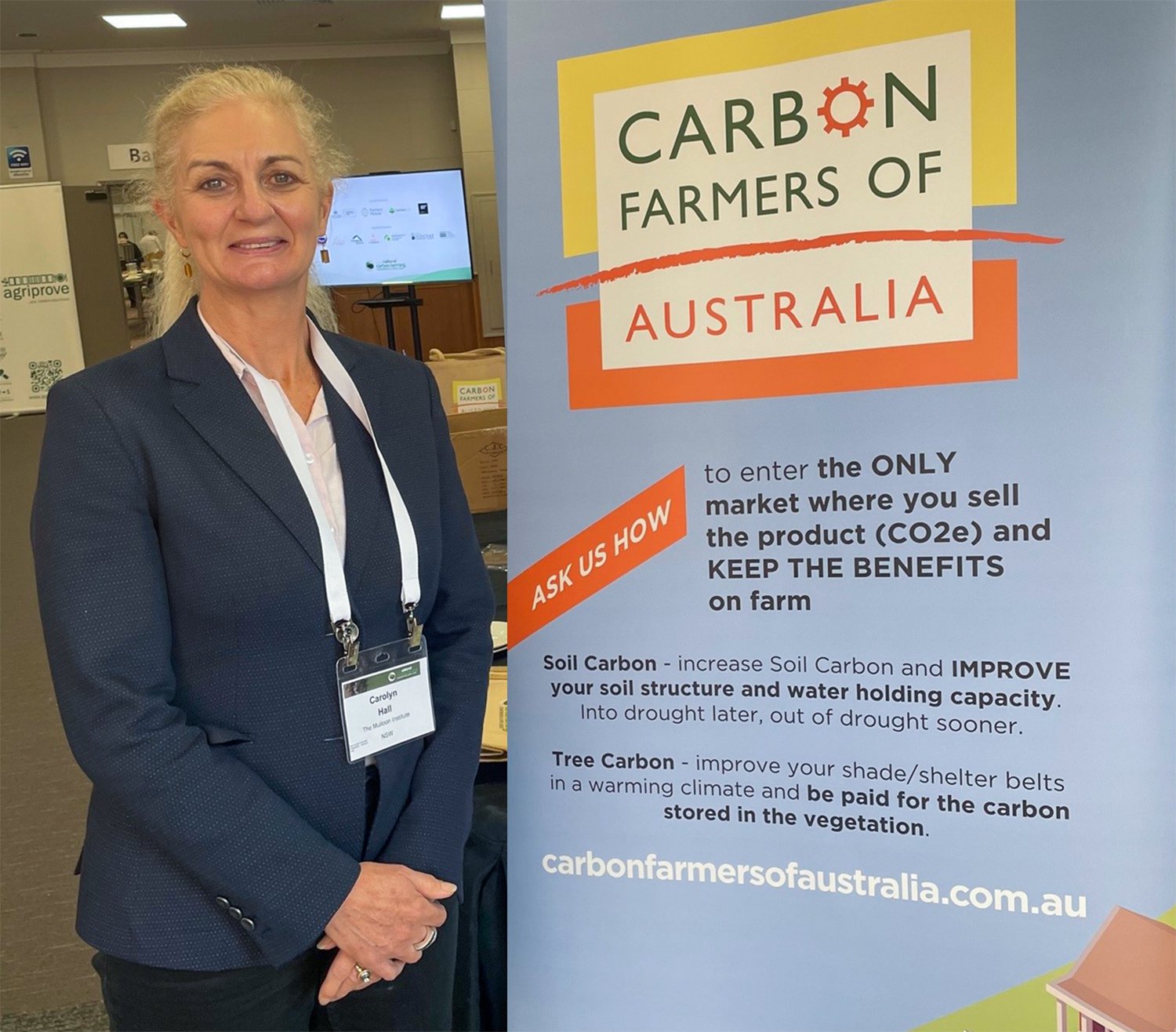
Mulloon Institute’s CEO & Managing Director Carolyn Hall at the 10th National Carbon Farming Conference and Expo in Albury.
There was a real buzz in the air at Albury for the 10th National Carbon Farming Conference and Expo during May 2022. Carolyn Hall CEO Managing Director of the Mulloon Institute was warmly welcomed by key players in a rapidly expanding industry. Paris Capell, Mulloon’s Landscape Planner also attended the conference as part of her Agrifutures Horizon scholarship.
Louisa Keily from Carbon Farmers of Australia and Matthew Warnken from Agriprove brought together a remarkable range of speakers on all things carbon farming. The conference has expanded significantly over the past 10 years and reflects the growing interest in opportunities for carbon sequestration and the co-benefits, including building biodiversity when managing for soil health.
The conference also hosted an expo of organisations linked to the carbon farming industry. It was great to catch up with key partners and friends of Mulloon including RCS, Natures Equity, Carbon Link, the Maia Grazing team and Regen Farmers Mutual. Connections were also made with the Jennifer Lauber-Patterson Frontier Impact Group, Carbon 8 and the National Soils Advocate.
Great conversations were had during the breaks around the challenge and opportunity for landscape rehydration and carbon projects with friends of the Mulloon Institute across the industry and academia. It was great to catch up with Carmel Onions General Manager Agribusiness at Commonwealth Bank, Brad Tucker Director at Tucker Environmental, Professor Justin Borevitz from the ANU Research School of Biology and Stuart Austin from Wilmot Cattle Co.
Some key learnings for the conference include that 10% of Australia’s landmass is currently in carbon projects. When baselining soil carbon depth really does matter to take account of the flux in soil carbon levels. Technology has moved at an amazing rate in the soil carbon space both in measurement and modelling and data validation. We learned about a carbon farming app and how blockchain, crypto and NFT (non-fungible tokens) will be used in the carbon market.
Carolyn Hall, CEO & Managing Director
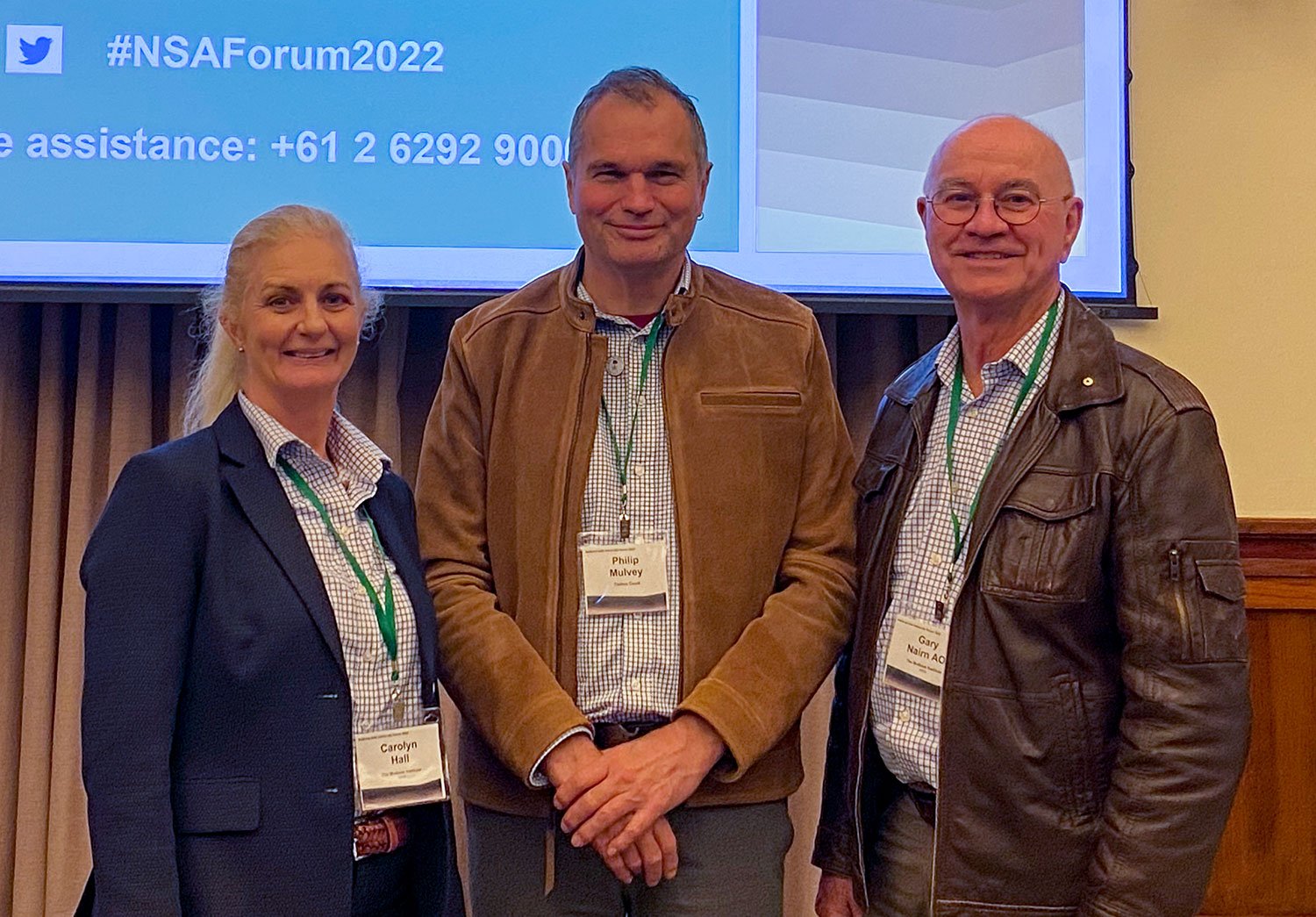
L-R: Carolyn Hall (TMI), Philip Mulvey (Carbon Count) and Gary Nairn AO (TMI).
The Mulloon Institute’s Chairman Gary Nairn AO and CEO Managing Director Carolyn Hall attended the National Soils Advocate Forum 2022: Economic considerations and market-based drivers of soil health change.
The National Soils Advocate the Honourable Penelope Wensley AC and her capable team including Sue Bestow Senior Policy Adviser to the National Soils Advocate hosted the event at Old Parliament House for a day all about improving soil health.
A selection of interesting presentations focused on the biodiversity below ground and how important soil health is to the agricultural sector and our economy. The need for soil extension skills was recognised to engage the broader community in the importance of soil health along with the links between soil health and land management practices. Decision support for farmers to achieve practice change was a common theme throughout the day. The potential to sequester carbon from the atmosphere and hold it in healthy soils over time was also explored as a real strategy to assist Australia and the rest of the world to reach net-zero emission targets.
The market based instruments that can drive change in how soils are managed were explored with a dynamic presentation on the generation of Australian Carbon Credit Units (ACCUs) from Phil Mulvey of Carbon Count and co-author of Ground Breaking: Soil Security and Climate Change.
How land management for soil health can be communicated to consumers was also considered and highlighted the range of accreditation schemes in development to recognise sustainable farm management practices and outcomes.
Overall, this was a very informative day with a variety of researchers including a number form the Soil CRC presenting their research.
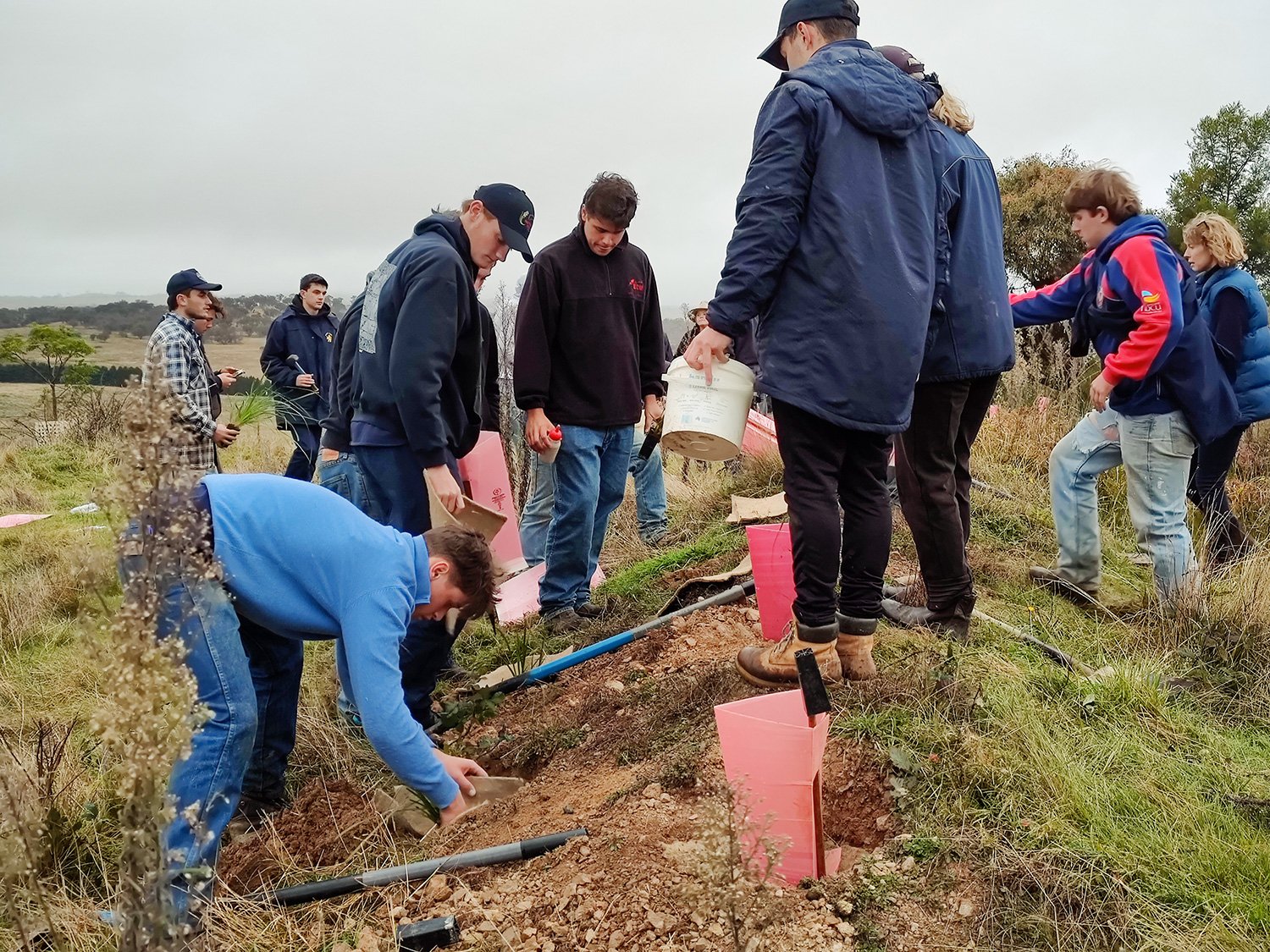
Revegetation planting on the hilltop contour at ‘Duralla’, Mulloon Creek Natural Farms.
Education team Tam Connor and Laura Fisher had a blast recently hosting the Year 12 Agriculture class camp from The Scots College. The students were a fantastic bunch: engaged, questioning and with much knowledge of their own to share.
The students investigated Landscape Rehydration strategies across the Home Farm, including contours, grazing management, weirs and riparian zone restoration. They planted Lomandra grass on the breezy Duralla hilltop, practiced assessing soil health, analysed phases of gully erosion and repair, and talked with Farm Manager Matt Narracott around the campfire about Mulloon Creek Natural Farms.
This was all tied together with a ‘Heal your Hydrograph’ modeling exercise with model-maker Gary McGuigan, who had prepared a new prototype utilising fine silt material. When sprayed with water, this model displayed creek meandering, erosion and alluvial fan formation in fine detail. The students interacted with a miniature version of the Home Farm landscape, adding the Landscape Rehydration strategies they’d learnt about during the day. They then measured how long it took for the water to move through the catchment as it progressively slowed the flow.
The Modelling Landscape Rehydration for Catchments, Communities and Curriculum project received grant funding from the Australian Government. Led by Research Officer Laura Fisher, the project will generate models of all kinds to catalyse learning about landscape rehydration.
The Mulloon experience opened my eyes to applying the methods we learned in class surrounding Regenerative Agriculture. I realise now that it is of key importance that in the future the regenerative way of agriculture is practised and taught to producers across Australia. Using scale models and visiting sites on-farm, we were able to visualise and see the regenerative agriculture technologies being applied today and it was great to recall the aspects of the theory we knew, and learn about new and exciting techniques in the field. The changing landscape of modern Agriculture is ongoing and producers need to adapt to the climate, for the future success of the industry. – William Farquhar
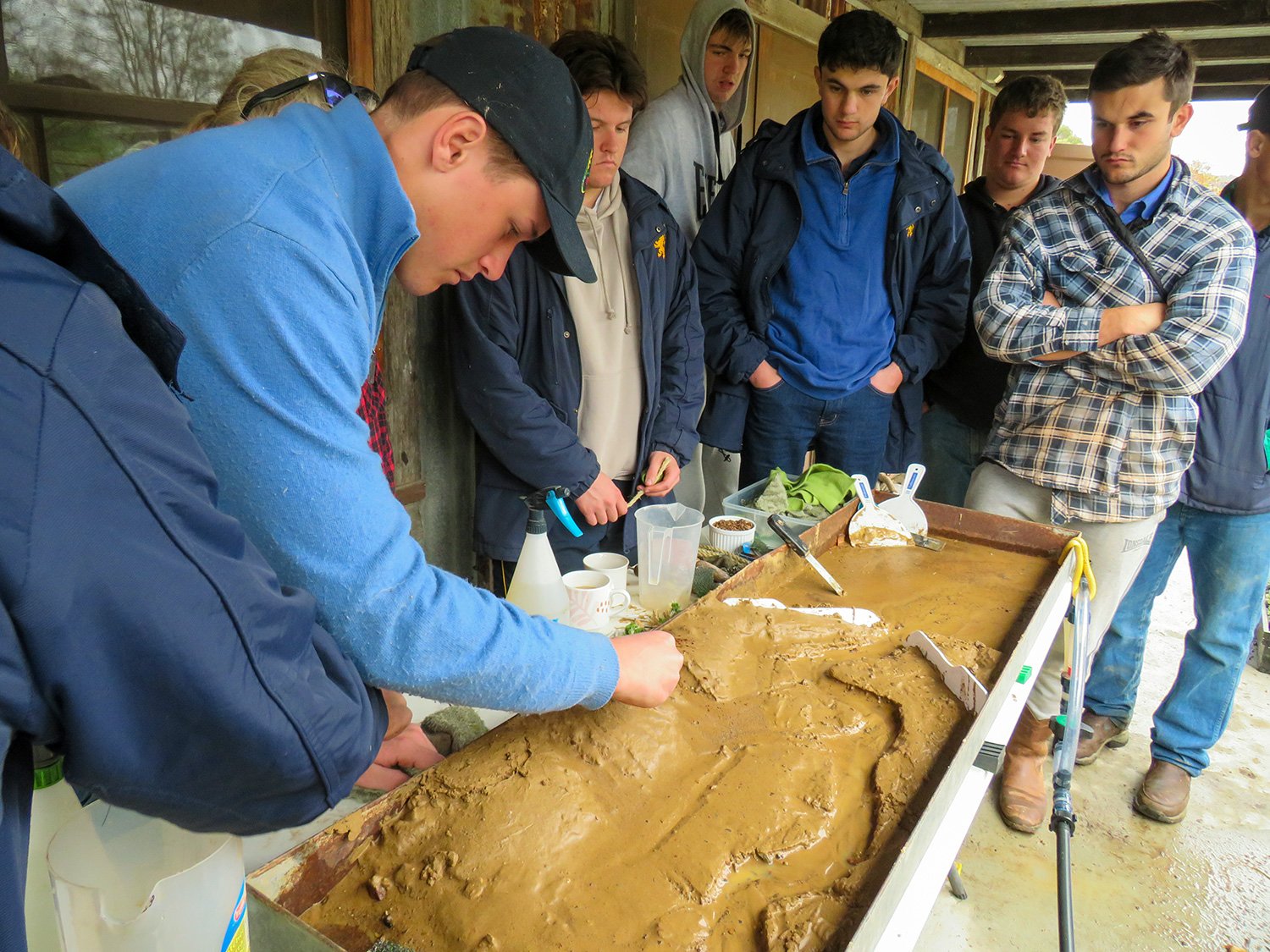
Landscape modelling exercise using Gary’s fine silt prototype.
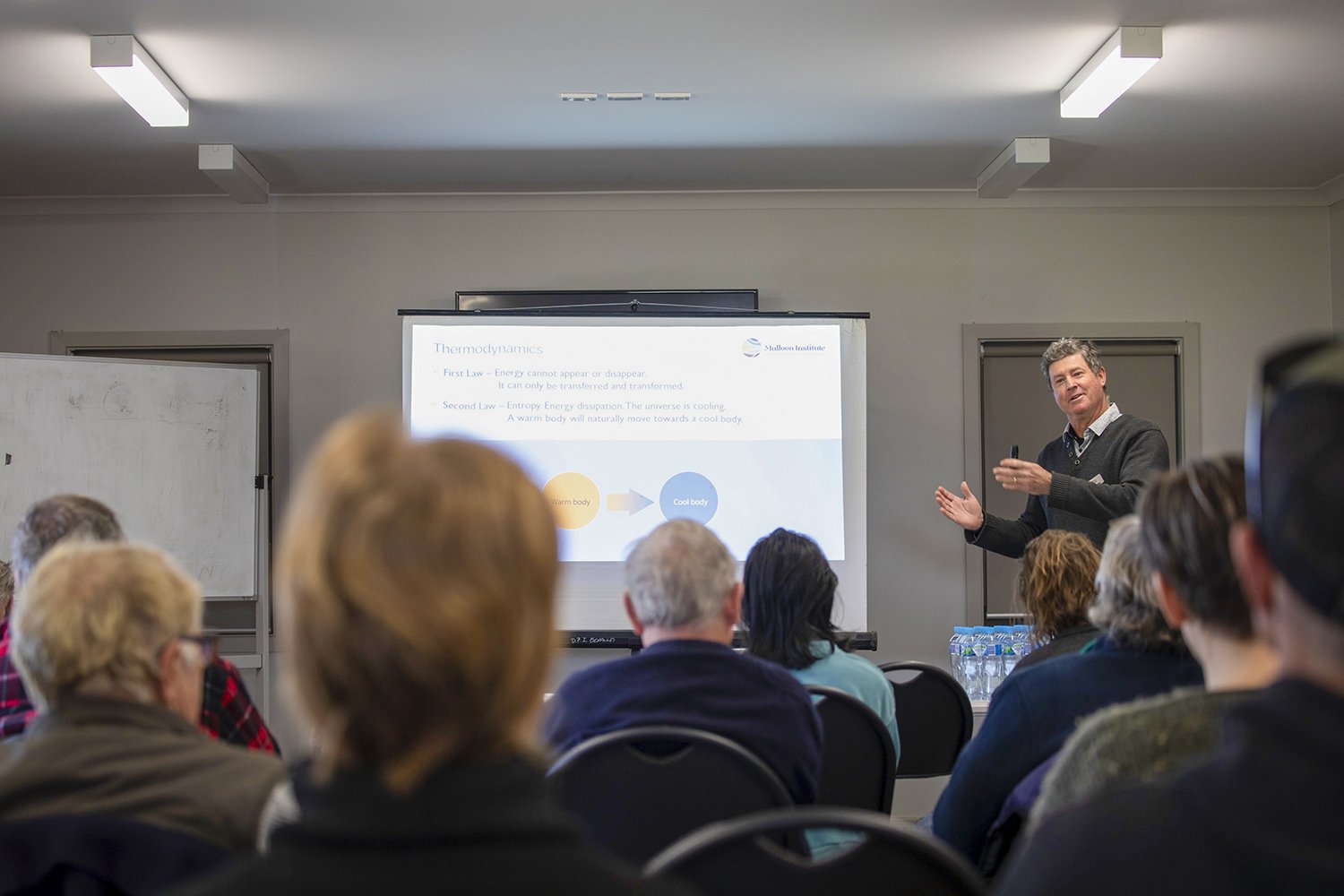
Pete Hazell shares his enthusiasm for the water cycle and its relationship to farming. [Photo: Brigitte Brocklesby]
The Gecko CLaN Network is a community Landcare network that supports 19 Landcare groups in central Victoria from Yarrawonga to Seymour.
The Mulloon Institute’s Peter Hazell and Angus Dunne facilitated an introduction to Landscape Rehydration for the group on Friday 20 May at the Boho fire shed. The sold-out day covered an introduction to the water cycle and landscape rehydration in the morning followed by a session of reading the landscape out on property.
The Goulburn Broken Catchment Management Authority also attended the day, presenting on approval pathways for in-stream works. The Mulloon Institute seeks to engage and work within the regulatory requirements throughout Australia and was grateful for the local CMA’s involvement.
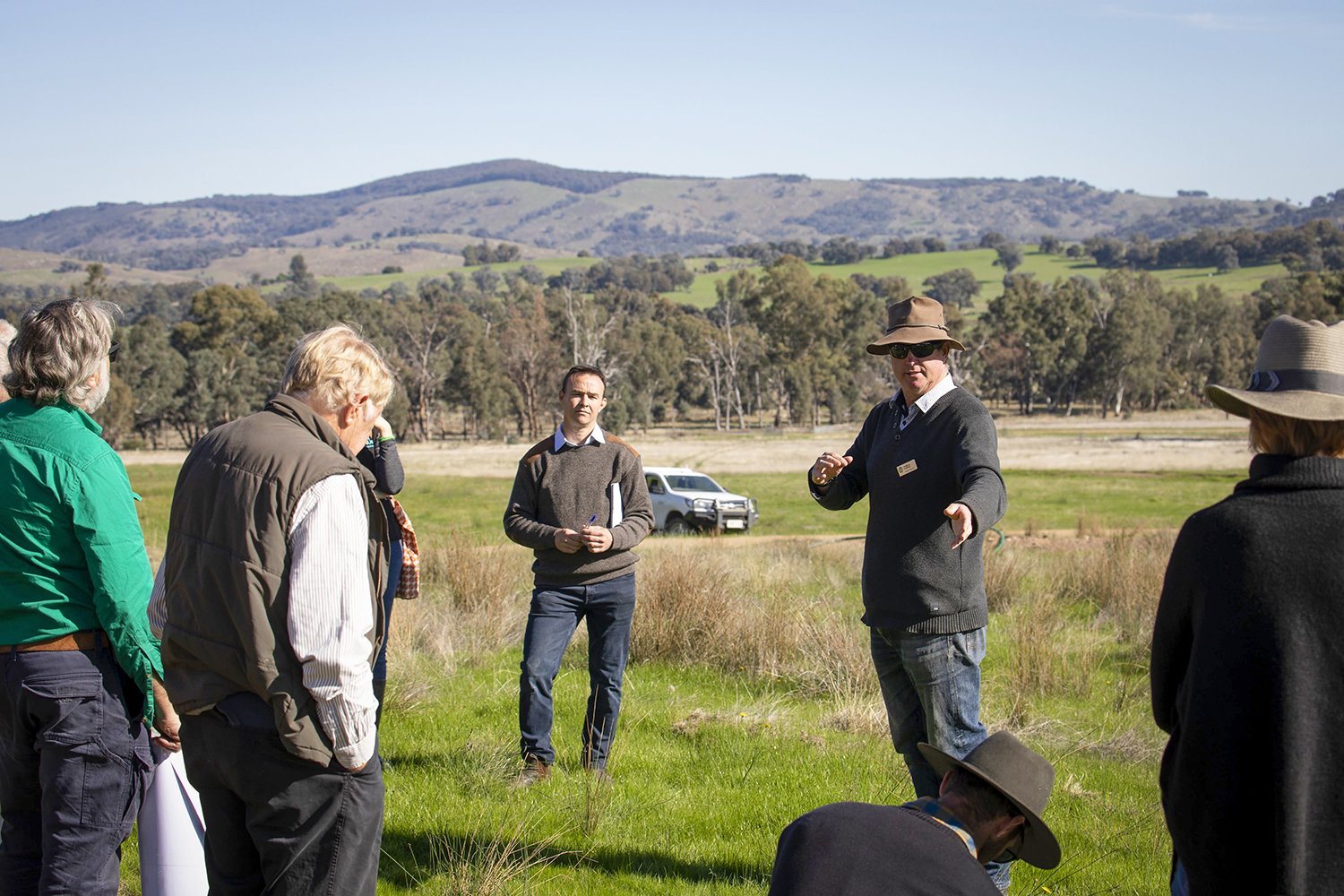
Peter Hazell and the Gecko Clan reading the landscape. [Photo: Brigitte Brocklesby]
The region is home to some of the oldest Landcare groups in the country. The oldest member on the day, another Angus, stood up before lunch and said, “this is what we wanted Landcare to be when it started”. He was referring to the focus on whole-of-catchment health, not just tree planting. Angus issued a challenge to all of the Landcare members in the room to carry on the region’s passion and commitment to this idea. The nearby landholders in Turnip Creek catchment are indeed already embarking on catchment scale landscape rehydration, as Peter and Angus (TMI) witnessed the previous day.
The day was full of energy, with an abundance of questions and conversations at the lunch time break. Participants ranged from long-term land holders to new farmers looking to engage with their Landcare group. It is amazing how much knowledge and experience a community can hold, and often it is TMI’s role to help facilitate these discussions. We are very lucky and privileged to work with various people who want to regenerate their part of country.
This free event was hosted by the Gecko CLaN Landcare Network and is supported by the Goulburn Broken CMA through funding from the Australian Government’s National Landcare Program.
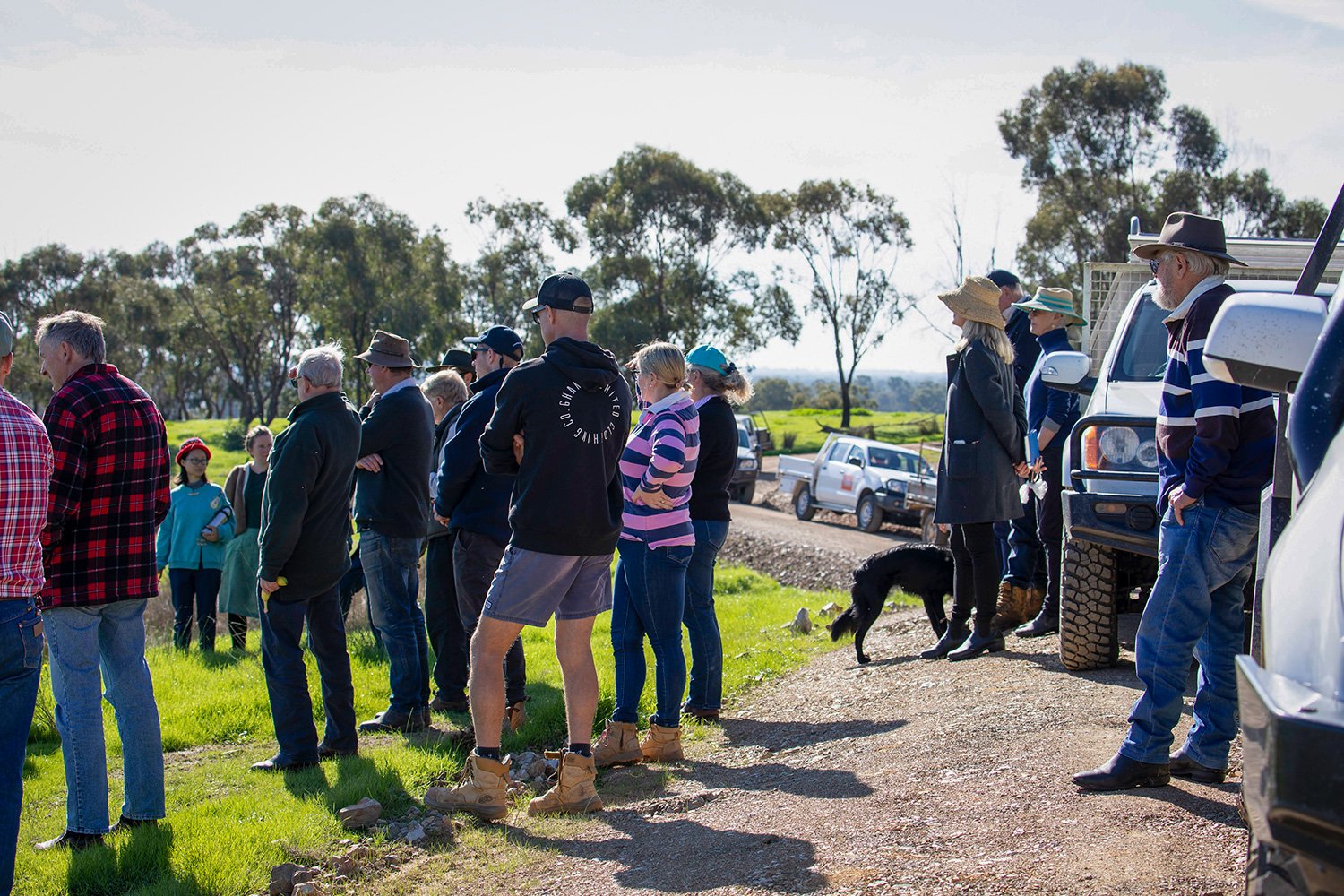
Learning about the hydrological processes in their catchment. [Photo: Brigitte Brocklesby]
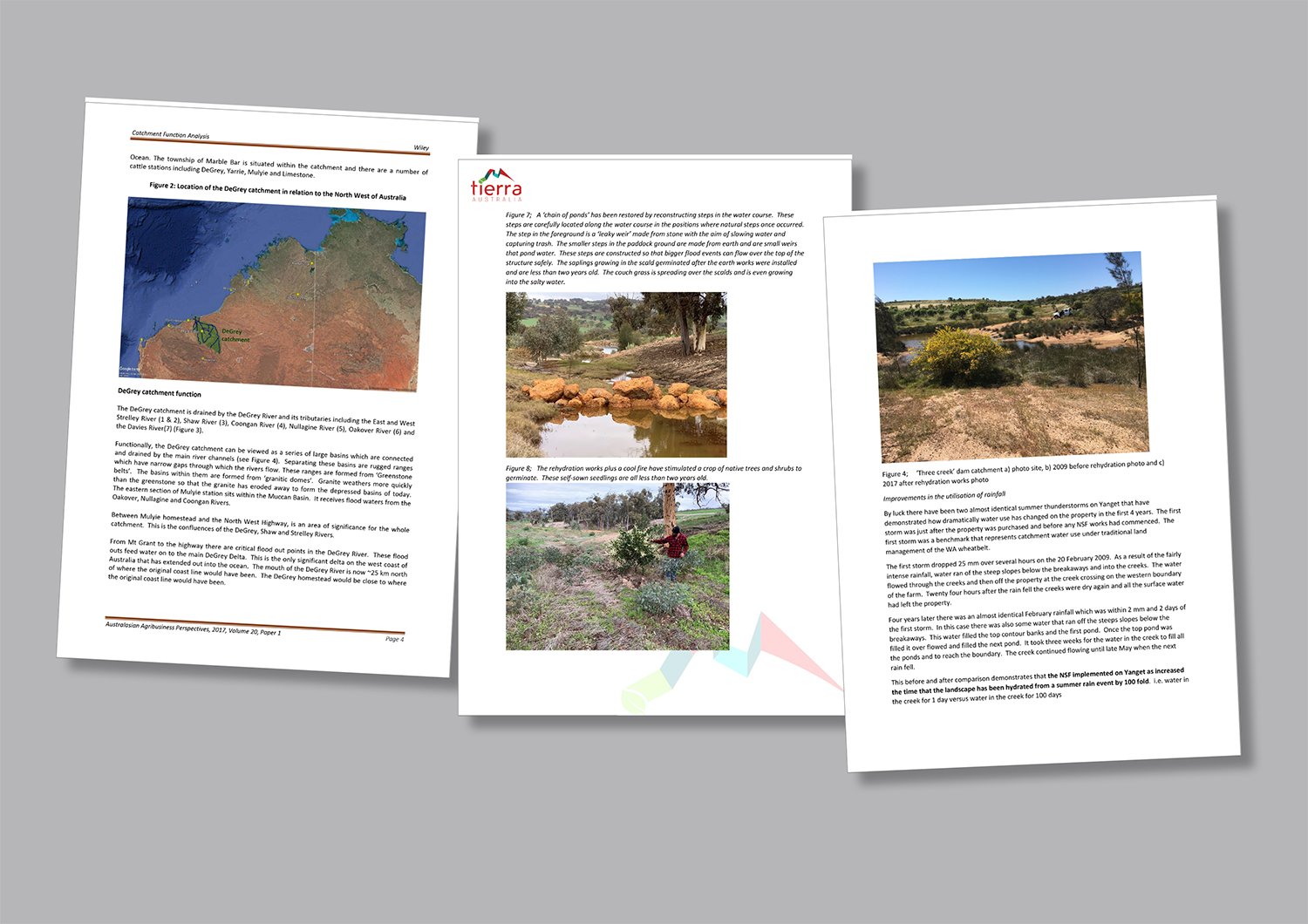
Literature review
The Mulloon Institute is currently conducting a literature review of landscape rehydration in the Western Australian context, primarily examining case studies and published literature within WA, as well as looking at similar cases in areas of Queensland and New South Wales.
Landscape rehydration specialists Tim Wiley (Tierra Australia) and Rod O’Bree (Western Independent Foods) have been extremely helpful in providing case study reports and anecdotal evidence of landscape rehydration benefits, both on-farm and within larger catchments. Published research and field evidence sourced from Rangelands WA NRM, Ecosystem Management Understanding (Dr Hugh Pringle’s EMU), University of Western Australia, Southern Cross University and the Australian Government has also been incredibly valuable for the review.
TMI is collaborating with RegenWA to make the literature review accessible to farmers and industry stakeholders who are identifying, implementing and sharing innovative land management practices that other farmers can adopt. It will form a useful and ongoing resource for landholders to access easily and learn about landscape rehydration works relevant to Western Australia.
The literature review is being published by the Mulloon Institute as part its ‘Landscape Rehydration Trial & Demonstration in the Wheatbelt of WA’ project, which is funded through the WA State Government’s State Natural Resource Management program.
Digital Information Hub
Work is currently also underway on developing a Digital Information Hub to support those interested in landscape rehydration on the ground in WA. The hub will be a central point for landscape rehydration resources including case studies, educational videos and manuals. This space will encourage participants to engage and support each other through their regenerative journey through building a community of practice.
TMI is collaborating on this hub with the Muresk Institute and Perth NRM and we look forward to sharing resources with landholders in the near future.

Green and Golden Bell Frog
JJ Harrison, CC BY-SA 3.0 <https://creativecommons.org/licenses/by-sa/3.0>, via Wikimedia Commons
A NEW landscape rehydration project is set to rebuild habitat along the Molonglo River for a threatened species of frog.
The project, to be run by the Mulloon Institute and funded through a $170,000 NSW government grant, will re-connect the river with its adjacent floodplain, and rebuild habitat for the Green and Golden Bell Frog – the only known population of the species in the Southern Tablelands region.
Mulloon Institute Chair Gary Nairn AO says the funding will allow the Institute to carry out a detailed design of the watercourse interventions required to repair and rehydrate the landscape on Foxlow Station near Bungendore.
“The design is also focused on restoring breeding habitat for the last surviving Green and Golden Bell frog population on the Southern Tablelands, which is a threatened species at the state and national level,” Mr Nairn said.
In announcing the funding the Member for Monaro, Nichole Overall, said:
“The work the Mulloon Institute is undertaking on Foxlow and Carwoola Stations is not only helping create more resilient and productive farms in our local area but providing a lifeline for this native frog species.”
ARTICLE SOURCE:
CBR City News, 17 May 2022, https://citynews.com.au/2022/project-set-to-rebuild-habitat-for-threatened-frog/
ALSO:
Bungendore’s endangered frogs granted a second chance, RiotACt, 24 May 2022, https://the-riotact.com/bungendores-endangered-frogs-granted-a-second-chance/558397
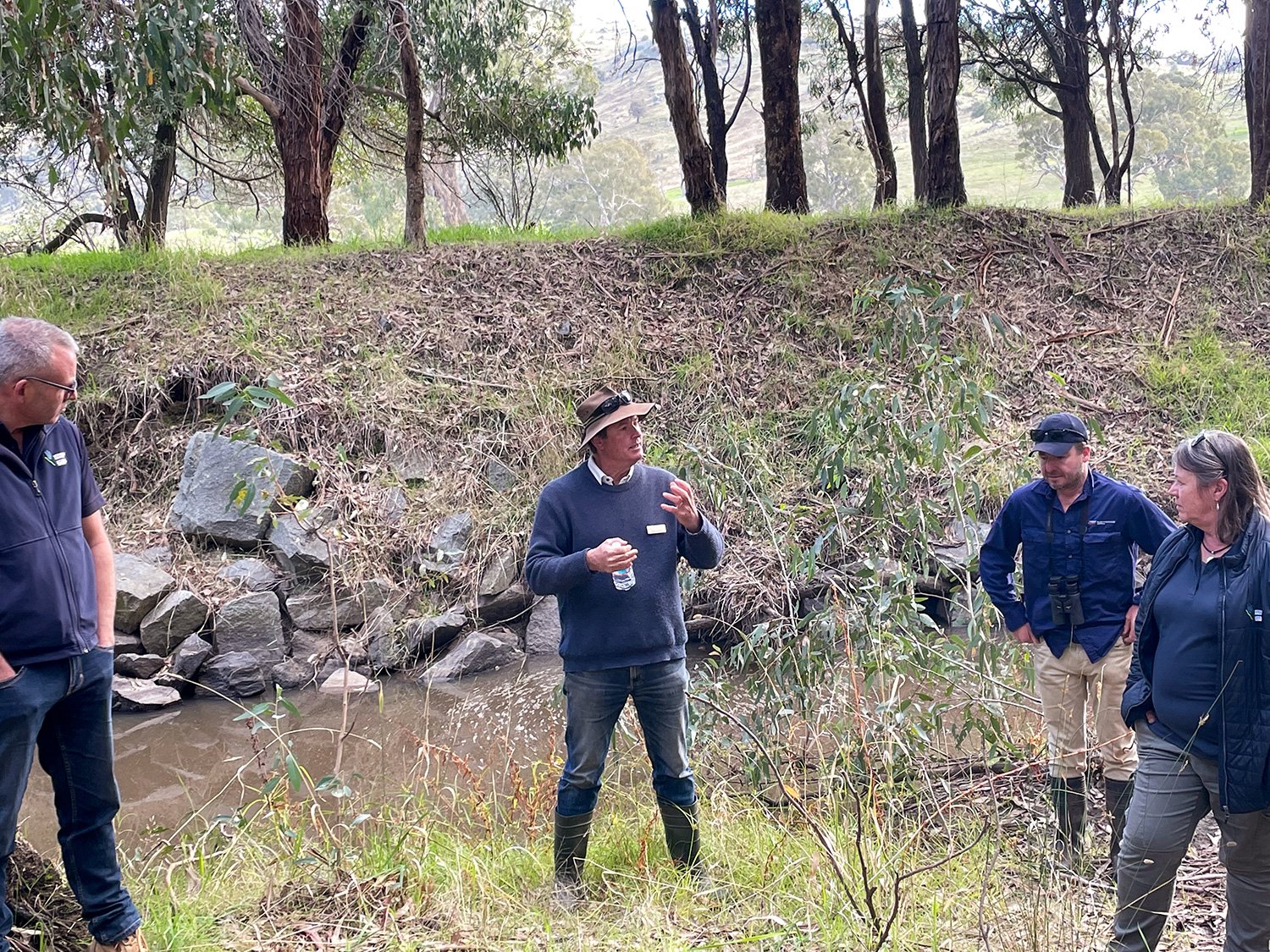
Peter Hazell discussing a rock chute example with the Turnip Creek group.
The Turnip Creek catchment is located between the towns of Euroa and Benalla in Victoria, east of the Hume Highway. The region is home to one of the first Landcare groups in the country, which continues to pioneer agricultural land management.
The landholders of Turnip Creek have been working towards a catchment scale project for close to four years and their commitment, passion and desire to enable change within the group is unmistakable. Along the journey, the group have visited Mulloon Institute and Martin Royd’s property, Jillamatong property at Braidwood.
Earlier this year, Turnip Creek landholders, Bush Heritage Australia and Alluvium formed a consortium with Mulloon Institute to seek funding for a catchment-scale project. Until funding is found, all parties have agreed to contribute to the project on an in-kind basis.
In early May 2022, the group gathered in the region to discuss a catchment-scale project, specifically looking at examples of rock chutes in the catchment and the regulatory requirements. The group was lucky to have Emeritus Professor Ian Rutherford (Alluvium), along with Principal Landscape Planner Peter Hazell from Mulloon, to share their knowledge.
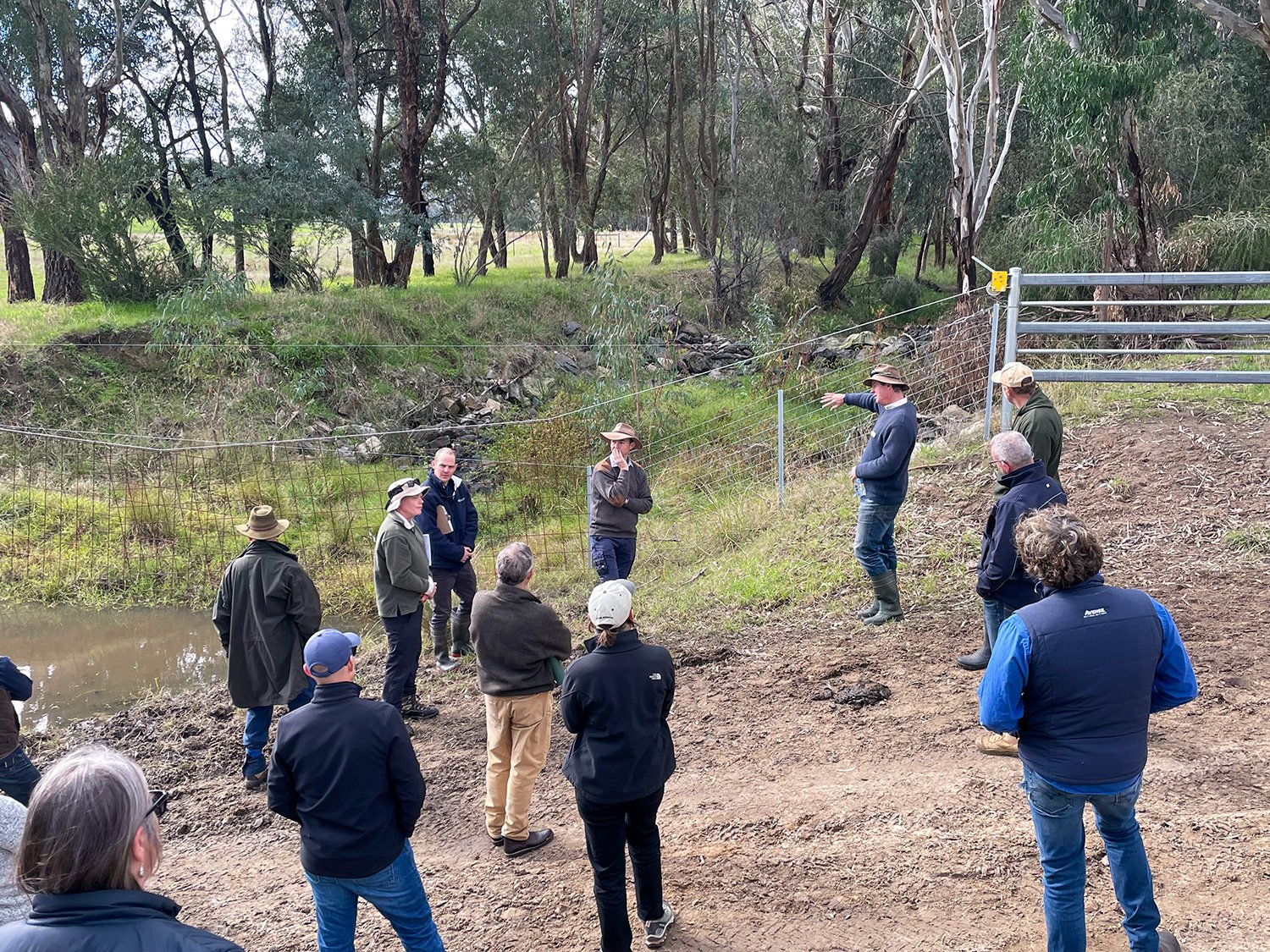
Discussing the impacts of landscape rehydration interventions on the whole of catchment.
Joel Fitzgerald of Bush Heritage Australia facilitated the day and engaged with the local Goulburn Broken Catchment Management Authority, who shared their knowledge and understanding of the region and associated regulations. Rock chutes – which are rock armouring used within a stream, and which were popular with the Soil Conservation Service and Catchment Management Authorities – were a focus of the day. The group inspected three of these structures which were installed into one creek 30 years ago for erosion mitigation. Some of the questions which came up on the day were: how to move beyond erosion control to landscape rehydration; and, what can we learn from rock chutes? The answer to this may be found in restoring the natural systems and cycles, as opposed to a set indicator.
It was clear that the problems being addressed throughout the generations have not changed a great deal. We were also struck by the willingness of everyone to learn and forge a new way forward. The project could represent the first catchment scale landscape rehydration project in Victoria. To quote Thomas Jefferson, “if you want something you have never had, you have to do something you have never done”.
Mulloon Institute practices principle-based management, which means we are seeking to apply the lessons from the Mulloon Rehydration Initiative and other projects around the country to each community. We look forward to learning how these principles apply to the Turnip Creek catchment.
The Mulloon Rehydration Initiative is jointly funded through Mulloon Institute and the Australian Government’s National Landcare Program, with support from the NSW Government’s Environmental Trust.
The Mulloon Institute and HydroTerra are working in partnership with NSW Department of Primary Industries Agriculture to develop a Catchment Rehydration Selection Tool through funding from the NSW DPI’s Climate Smart Pilots Project, Demonstrating Adaptation Program.
The selection tool will help evaluate catchment scale regions across NSW for the suitability of implementing landscape rehydration practices which have been successfully demonstrated by TMI through its Mulloon Rehydration Initiative in the Mulloon Creek catchment near Bungendore, NSW, along with other catchment rehydration projects around Australia.
The Catchment Rehydration Selection Tool provides a spatial output, akin to a heat map, providing high level guidance of areas that warrant further investigation into their suitability for implementing rehydration practices. The selection tool is intended for use by government, industry and private organisations who want to prioritise the allocation of resources for supporting practice-change towards adoption of landscape rehydration, at catchment scale.
A wide range of stakeholders stand to benefit from application of the heat map – including the environment, farming communities, investors, regulators and other government agencies.
The project is structured in 4 stageS:
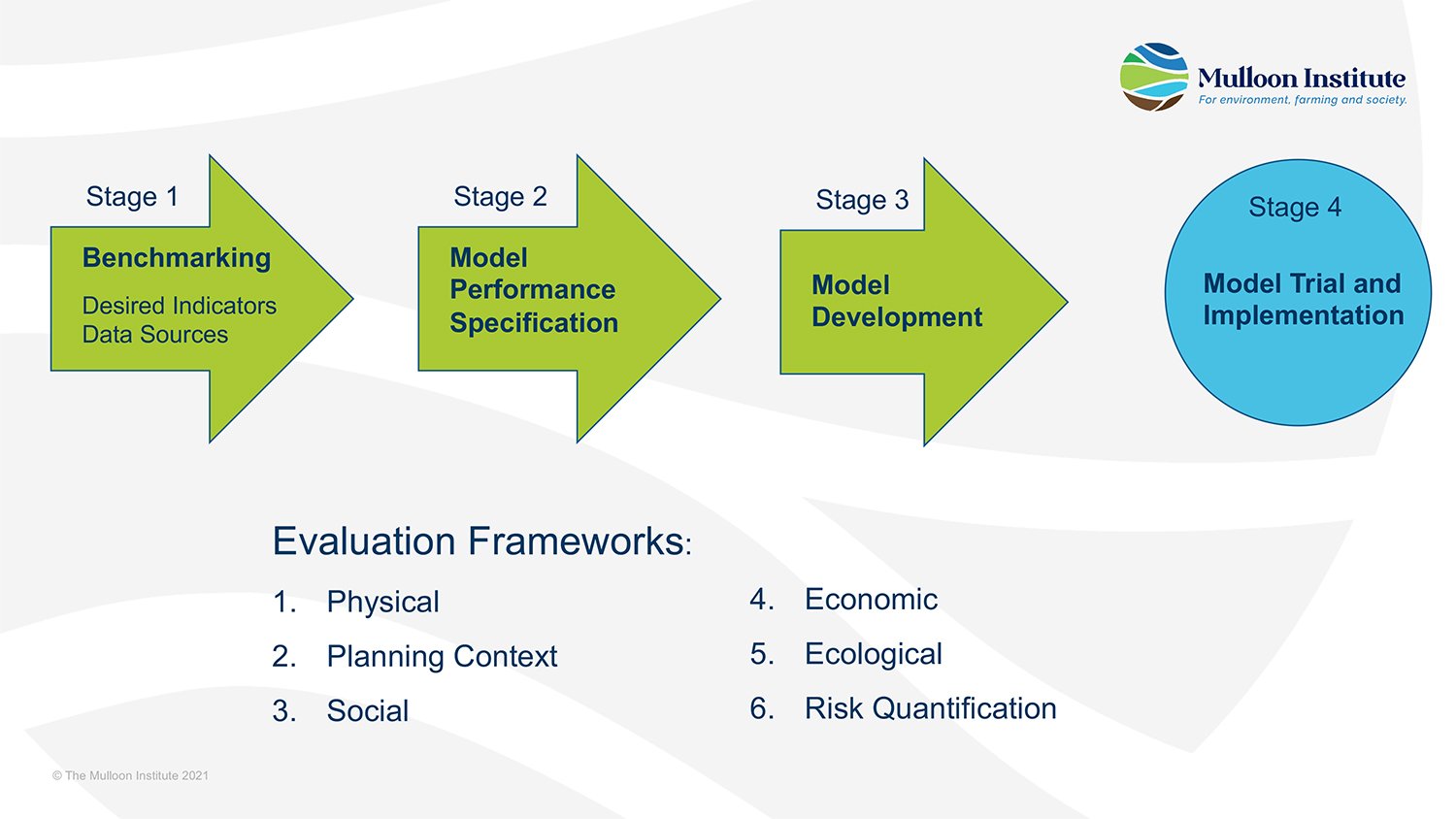
Stage 1 – has determined indicators which define the suitability of catchment areas to rehydration practices, then identified the availability of related spatial datasets for use in the selection tool model.
Stage 2 – has entailed design of a draft specification of the selection tool model – describing how the selected spatial datasets can be integrated to achieve the desired output, aiming to develop a ranking of sub-catchments on the basis of established indicators.
The first two stages have been completed after extensive consultation with professional experts from industry, research and private organisations, ensuring the final model specification is underpinned by robust and reliable knowledge.
Consultations with subject experts will continue in the next stage of model development, to be conducted over coming months.
Based on the success of rehydration practices at Mulloon Creek catchment, significant and widespread benefits are expected from wide adoption of the practices, including farm profitability, improvement in soil health, ecological services and drought resilience.
The Mulloon Rehydration Initiative is jointly funded through the Mulloon Institute and the Australian Government’s National Landcare Program, with support from the NSW Government’s Environmental Trust.

Leaky weir constructed at Palerang, Mulloon Creek
The Mulloon Institute seeks an appropriate environmental, engineering and planning organisation to draft a plain English “Catchment Remediation Code” that can be used by (i) landowners and government departments to construct “Code Compliant” best practice “Landscape Rehydration Works” and (ii) regulators to ascertain whether a structure is “Code Compliant” (and exempt from the need for pre-construction government approvals).
The Catchment Remediation Code will need to fit within the current NSW environment and development regime. It should also provide a model for use in other jurisdictions in Australia (such as Queensland and Victoria).
Submissions are welcomed by 30 June 2022.