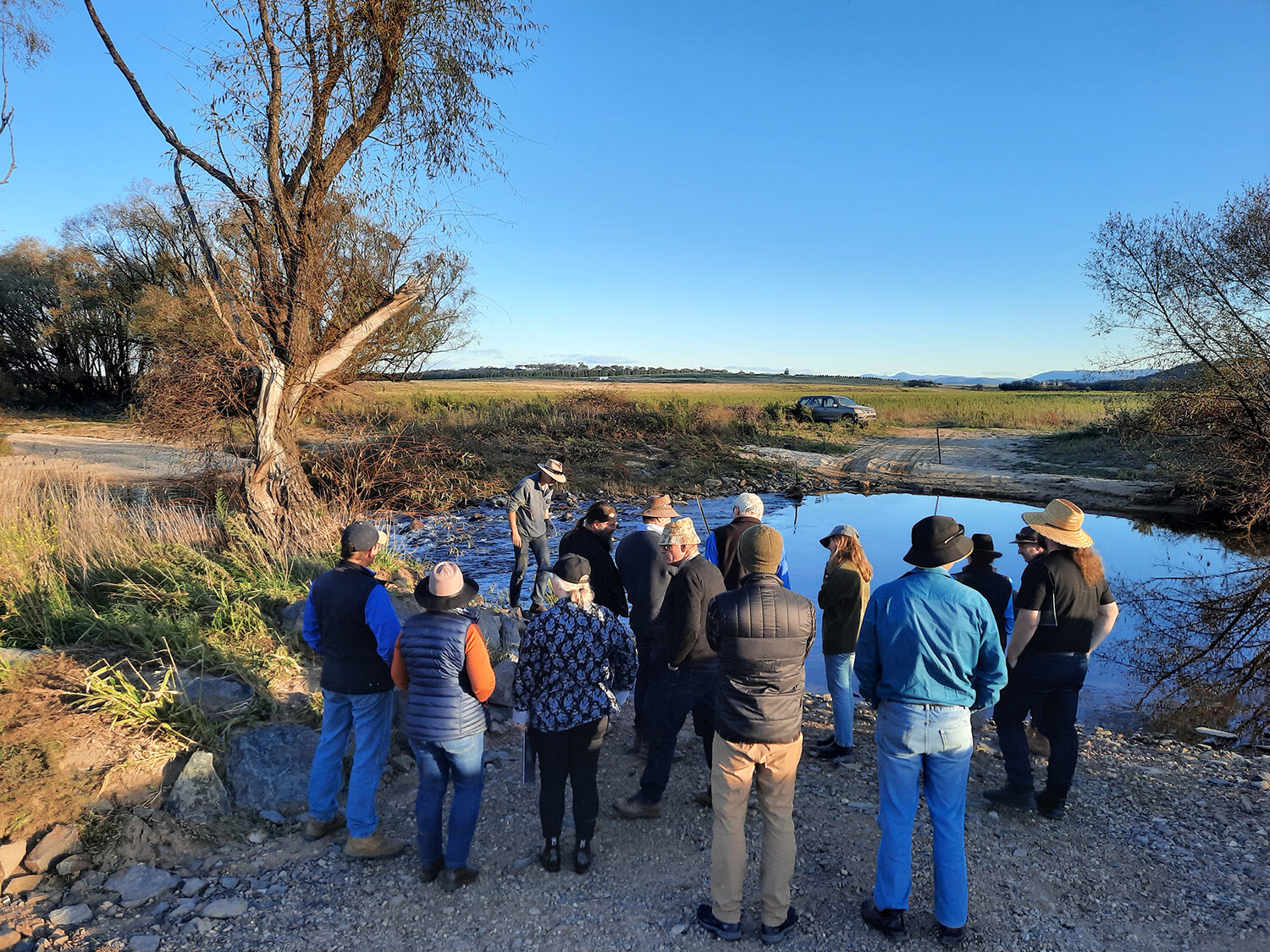
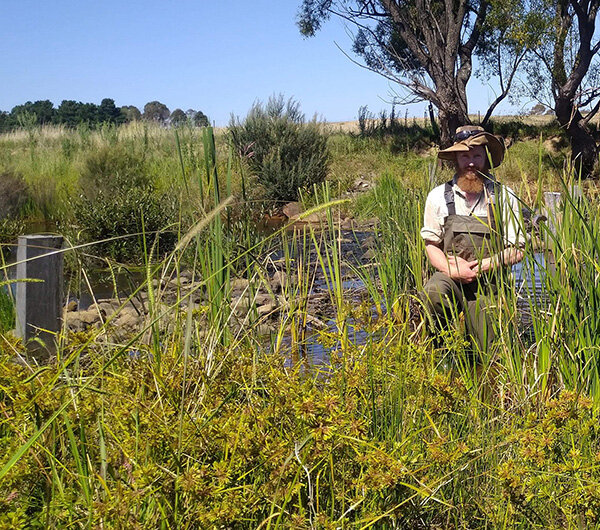
In April 2021, The Mulloon Institute’s Peter Hazell, Bill McAlister and Joe Skuse travelled to a property near Numeralla (east of Cooma, NSW) to catch up with the good people from Back to Country and to work with them in bringing life back to an eroded, fire ravaged landscape. 

Back to Country is an initiative lead by Yuin Elder Uncle Max Dulumunmun Harrison, which provides aboriginal and non-aboriginal people the opportunity to learn about traditional Aboriginal culture and to heal country.

The gully restoration work is part of a larger project aimed at restoring wildlife refuges and corridors after the devastating fires in the summer of 2019/20. The property is owned by Richard and Alison Swain, who care for injured and orphaned animals such as koalas, wombats, wallabies, possums, bats, lizards and birds.

The project was funded through a Wires Landcare Australia grant. Greening Australia donated several thousand trees and The Mulloon Institute donated its time and expertise in gully restoration and landscape rehydration. 

It was a weekend filled with much ceremony and on-ground activity.
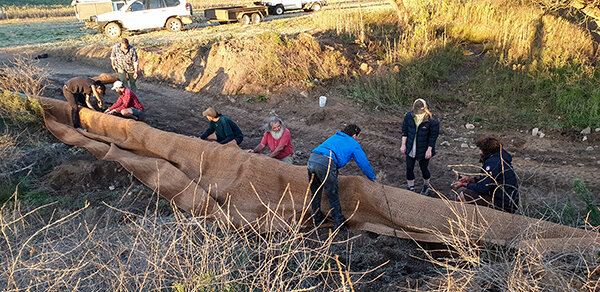
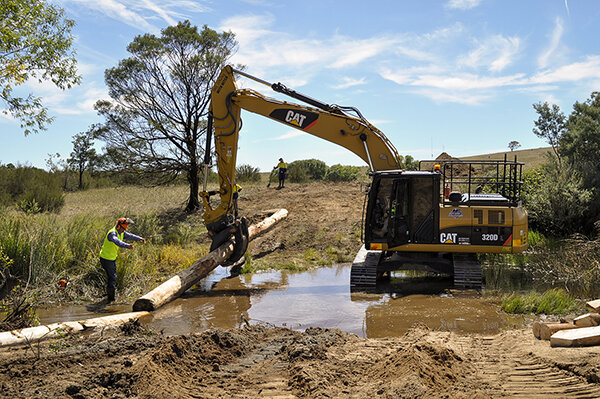
Back to Country crew assisting in the construction of a log sill crossing structure.

Back to Country crew assisting in the construction of a log sill crossing structure.

Back to Country crew – L to R – Richard, Greg, Tyson, Jack, Byron, Nathan, Sky and Joel.

Back to Country crew – L to R – Richard, Greg, Tyson, Jack, Byron, Nathan, Sky and Joel.

On Saturday the Back to Country crew got busy and began constructing a log sill leaky weir crossing across an eroded gully.

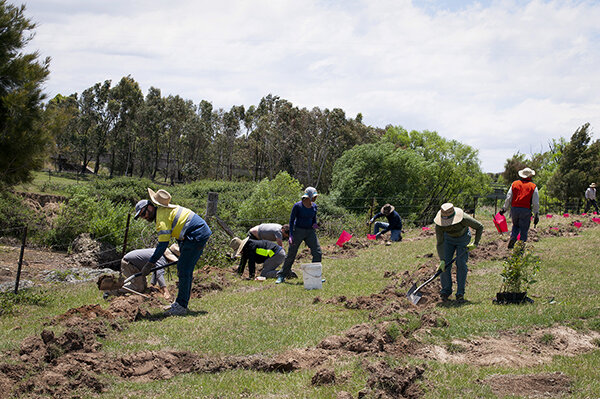
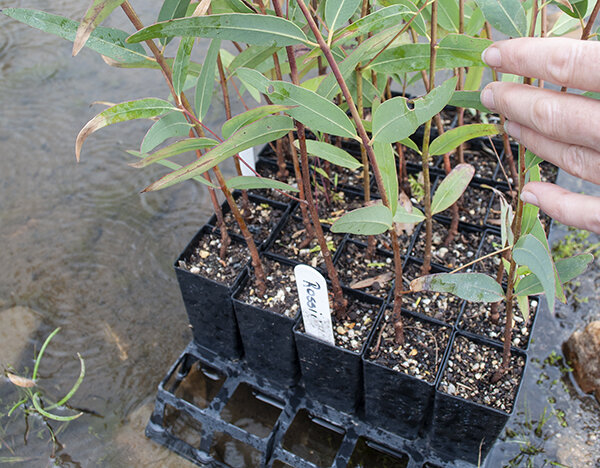
And, on Sunday they were joined by about 20 members of the community as well as Numeralla Landcare where four more rock weir structures were built across the same gully and several hundred native trees, shrubs and groundcovers were planted. .
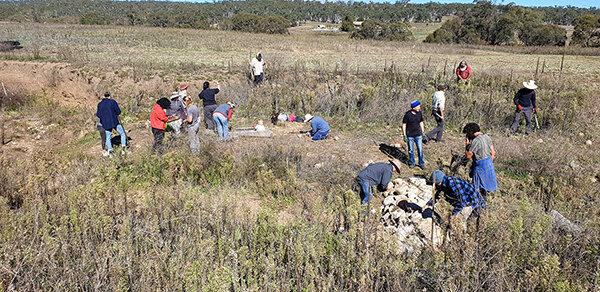
Volunteers building rock weirs and planting trees, shrubs and grasses.

Volunteers building rock weirs and planting trees, shrubs and grasses.

Further up the gully, a small excavator got to work building an earth bank across the gully, which will revert high flows from the gully and back onto the adjacent floodplain.  

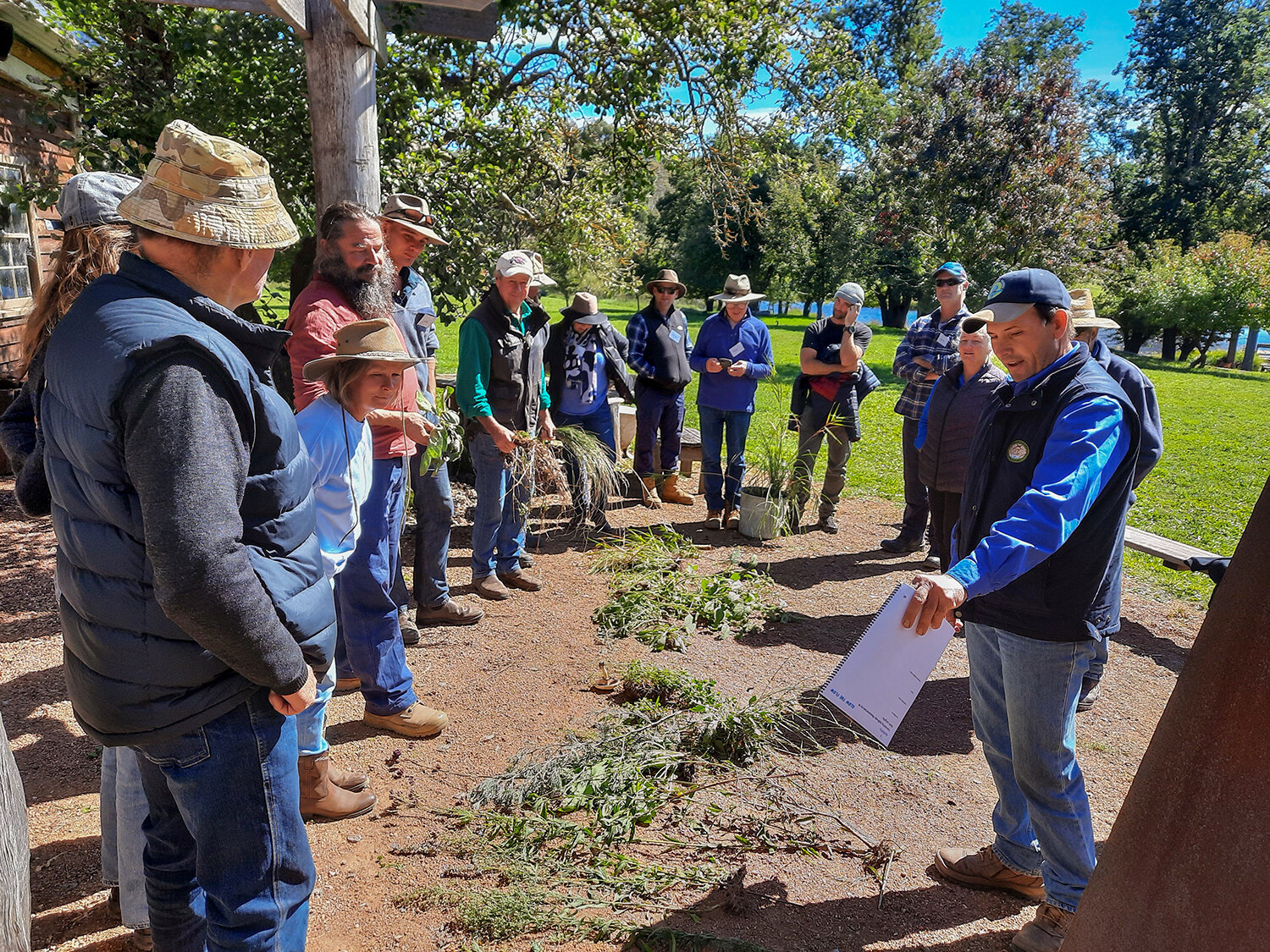
A solid morning’s work was rounded off with a BBQ lunch, which was then followed by a traditional smoking ceremony. During the ceremony, the Back to Country men gifted each of the participants personal plant and animal totems. In a show of gratitude and of deep respect for Mother Earth, participants were gifted the responsibility of looking after some of this country’s most iconic plant and animal species and the ecosystems on which they depend. 
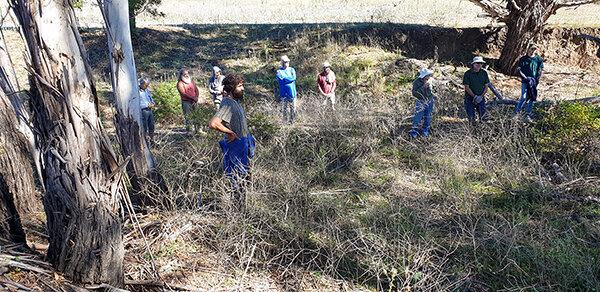
Nathan standing front of a scar tree and explaining the significance of the area in which everyone was standing.

Nathan standing front of a scar tree and explaining the significance of the area in which everyone was standing.

It was a poignant reminder that we are all inexorably connected to the natural world. If we look after her, she will look after us. If we degrade her, we degrade ourselves. 

The Mulloon Institute looks forward to building on this relationship with the men and women from Back to Country as we heal the land together. 
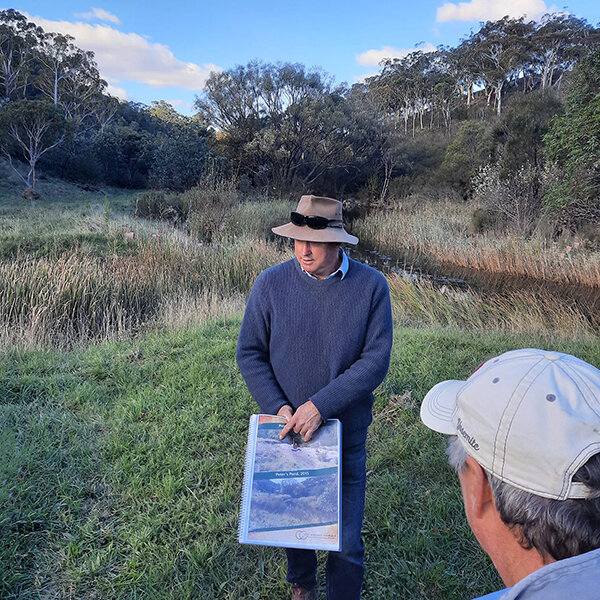
Mulloon Rehydration Initiative Project Coordinator Peter Hazell at Peter’s Pond.

Mulloon Rehydration Initiative Project Coordinator Peter Hazell at Peter’s Pond.

Day two of Tarwyn Park Training natural sequence farming course, learning about contours, weirs, plants and landscape rehydration at the Mulloon Institute. Loving being amongst a beautiful crowd of people keen to repair our landscapes.

On days 3 and 4, we were out in the field, getting across contouring. We used laser levels to mark one out, and then met Glenn the excavator and watched his grader in action. We explored the subtleties of contour creation: the angle of the trench slope, the correct height of the downhill mound, how to avoid cutting too deep (don’t hit clay!) and where to locate the spillway (on the ridge!). We then walked a contour that had been created two years ago at another location of the Mulloon catchment, which gave us a great understanding of how they settle into the landscape. 

“What we have here is a head cut.”

This is the site where erosion creeps further and further up a gully. When water flows at speed over the ‘toe’ of the head cut, it eats away at that spot and causes the surrounding earth to collapse… and so it continues. Stopping that creep is a tricky but necessary project to prevent erosion gullies from deepening and widening: one participant spoke of gullies at their property, “you could fit a double-decker bus in”. We discussed potential tactics for the head cut area: strategically placed rocks that cause the water to bounce between them and thus lose its erosive energy, and vegetation with strong root systems to stabilise the soil. 

Laura Fisher, TMI Project Officer – Research

This workshop forms part of the Mulloon Rehydration Initiative which is jointly funded through the Mulloon Institute and the Australian Government’s National Landcare Program. The initiative is also assisted by the NSW Government through its Environmental Trust.

Last week we had the great privilege to be part of Land to Market Australia‘s ‘Farming Matters’ conference, which had been postponed from 2020 but proved to be well and truly worth the wait!

What an inspiring bunch of people there were to hear from and mingle with. Looking forward to the next one.

EVENT PROGRAM: https://landtomarket.com.au/FarmingMatters/program.php

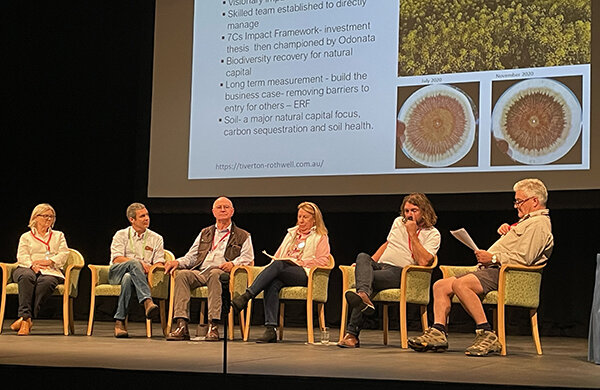
TMI Chairman Gary Nairn spoke on the ‘Investment in Regenerative Agriculture’ panel discussing New Farm Business and Investment.

TMI Chairman Gary Nairn spoke on the ‘Investment in Regenerative Agriculture’ panel discussing New Farm Business and Investment.

TMI Chairman Gary Nairn AO talking about how the Institute demonstrates how to rebuild soil fertility, fix more carbon in the landscape, restore lost biodiversity, improve water quality and availability and moderate climatic extremes.

TMI Chairman Gary Nairn AO talking about how the Institute demonstrates how to rebuild soil fertility, fix more carbon in the landscape, restore lost biodiversity, improve water quality and availability and moderate climatic extremes.

TMI's Science Advisory Council member Walter Jehne presented during a session on ‘Building Natural Capital – Farm Performance Options’.

TMI’s Science Advisory Council member Walter Jehne presented during a session on ‘Building Natural Capital – Farm Performance Options’.

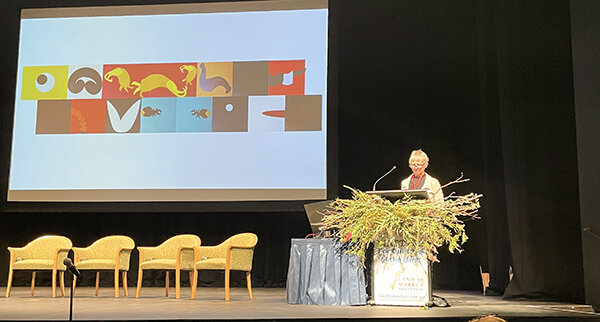
Jenny Bell from Earth Canvas talking about artists and how they can be a valuable part of the Regenerative Agriculture movement.

Jenny Bell from Earth Canvas talking about artists and how they can be a valuable part of the Regenerative Agriculture movement.

MEDIA RELEASE – 18 March 2021

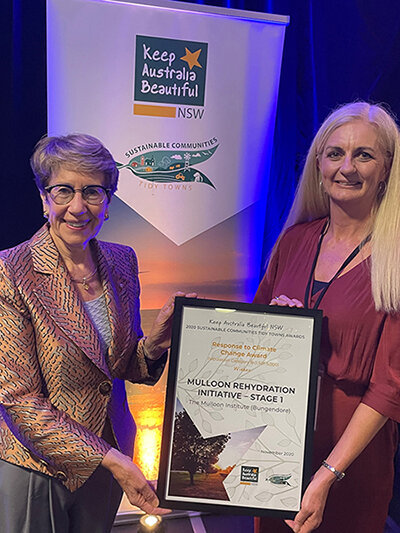
An ambitious project by the Mulloon Institute to rehydrate the landscape, capture carbon in the process and cool the earth has won the ‘Response to Climate Change’ award at the 2020 Australian Sustainable Communities Awards.

The ‘Mulloon Creek Rehydration Initiative – Stage 1’ project is one element of the much larger catchment scale project, which is unique in Australia, not only because it has 20 farmers working together across 20,000 hectares committed to restoring natural landscape function but because of the detailed level of scientific monitoring associated with it. Stage 1 involves 1,000 hectares and three properties.

Her Excellency the Honourable Margaret Beazley AC QC, Governor of NSW with The Mulloon Institute’s CEO Carolyn Hall. Photo: Trevor Hicks

Her Excellency the Honourable Margaret Beazley AC QC, Governor of NSW with The Mulloon Institute’s CEO Carolyn Hall. Photo: Trevor Hicks

CEO of the Mulloon Institute, Carolyn Hall said:

“At a time when the world is looking for solutions to reduce the impact of climate change, specifically global warming, this Award is a great recognition of the important role Agriculture can play, while working in unison with nature, to move the sector from a net emitter of carbon dioxide to a sequester of carbon.”

“Soil can hold three times the amount of carbon than is currently in the atmosphere. Our work in rehydrating the land puts more water into the soil, which improves carbon levels and helps grow more vegetation.”

“This in turn increases transpiration which reduces heat levels in the atmosphere. At a local catchment level, it helps farmers become more resilient to drought, fire and flood”.

The Institute’s work has also been acknowledged by the United Nations Sustainable Development Solutions Network as one of five projects globally that demonstrates how bringing degraded landscapes back to life can benefit both agriculture and the environment.

To help repair the severely eroded Mulloon Creek, the waterway was fenced, leaky weirs were installed and 1000s of native plants were planted. This slowed the water flow and rehydrated the floodplain, allowing the riparian area to return to a series of wetlands that are now full of life and biodiversity and able to provide habitat for native plants and animals.

The floodplain has been reconnected with the creek and can once again function like a sponge storing water, growing more pasture and crops and ensuring Mulloon Creek has water even during dry times.

Several threatened and vulnerable species are benefiting from the project, including the Scarlet Robin, Diamond Firetail, and Dusky Wood Swallow, with other species such as the locally extinct, Yellow-spotted Bell Frog being reintroduced to the area by Taronga Zoo.

Installing a leaky weir along Mulloon Creek.

Installing a leaky weir along Mulloon Creek.

The Response to Climate Change Award recognises actions taken to tackle climate change, through:

  • Providing real and practical solutions to meet the challenges of climate change in their area;

  • Planning long term for the management of climate change events, which includes partnerships, collaboration and community engagement;

  • Educating communities and building capacity about the causes and effects of climate change and what individuals can do to take action;

  • Acting to combat existing climate change events and improving infrastructure etc to improve an areas resilience.

The Mulloon Institute’s ultimate goal is to rehydrate and rehabilitate 2.5 million hectares of agricultural land and to improve the resilience, productivity and profitability of over 5,000 farming families through its works, advice and support.

This Stage 1 project is jointly funded through The Mulloon Institute, the Australian Government’s National Landcare Program, the Australian Government’s 20 Million Trees program, the Australian Government’s Green Army, the NSW Environmental Trust’s Restoration and Rehabilitation Fund, the NSW Environmental Trust’s Saving our Species – Scarlet Robin program, and South East Local Land Services’ Rural Landscapes Program.

These awards are coordinated by Keep Australia Beautiful NSW.

Volunteer tree planting efforts in the riparian zone.

Volunteer tree planting efforts in the riparian zone.

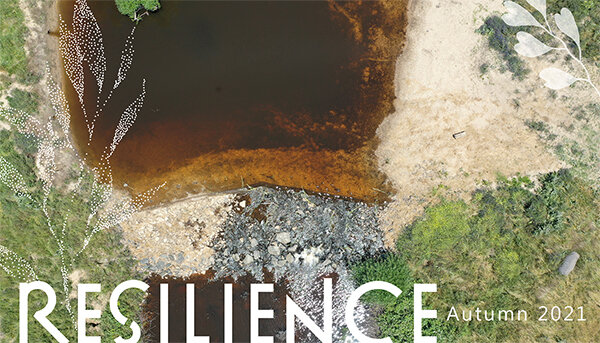
2021-Resilience-Autumn-600px.jpg

The latest news from Mulloon: https://conta.cc/3kLrxEo

stream.jpg

HydroTerra has been working with TMI’s Mulloon Rehydration Initiative (MRI) for the past few years on a project that aims to rebuild the natural landscape function of the entire Mulloon catchment (near Canberra) and boost its resilience to climatic extremes. 

HydroTerra’s long-term integrated monitoring program has helped quantify the benefits of the MRI’s approach to catchment hydrology manipulation, which has brought about more reliable stream flows, improved ecosystem functioning, enhanced agricultural productivity and improved drought resilience.

The following video provides a summary of HydroTerra’s work with TMI:  HydroTerra V1.mp4

With the foundations of a successful alliance in place, in 2020 TMI and HydroTerra formalised our partnership, establishing an MOU to collaborate. Weekly meetings are a great time to “chew the fat” and explore opportunities. With a mantra to “think big”, the meetings are not only exciting, but they have resulted in a raft of opportunities for both parties. One of the opportunities we are currently pursuing is the DPI NSW Climate Smart Pilots – Demonstrating Adaptation Program.

HydroTerra, in conjunction with TMI, has recently scoped and submitted a project to the Department of Primary Industries NSW (DPI) as part of the Climate Smart Pilots – Demonstrating Adaptation Program. The project focuses on developing an evaluation and monitoring framework to assess the NSW farming landscape to identify agricultural areas where rehydration practices are most likely to be successful.   

TMI and HydroTerra are ambitious to not only implement this large-scale methodology across NSW, but to have it adopted nationally. Our goal is to identify additional partners to join us to help bring about adoption of sustainable land management practices and to aid primary industries in preparing for climate change.

Source: https://mailchi.mp/hydroterra/hydroterra-news-december-13344064

The Mulloon Rehydration Initiative is jointly funded through the Mulloon Institute and the Australian Government’s National Landcare Program. The initiative is also assisted by the NSW Government through its Environmental Trust.

Photo by Anthony Mulhall

Photo by Anthony Mulhall

Several TMI staff members assisted Dr Sam Patmore in conducting a frog survey in mid-December at various properties that are taking part in the Mulloon Rehydration Initiative. They collected site data and photos while the sun was still up, before heading out again once it was dark (after 9pm, so there were less bird calls) to record the different frogs that could be heard. With all the rain we’d been having at that stage the frogs were certainly quite noisy.

Armed with head torches, pencils and clipboards, staff were deployed in small groups to monitor 38 sites across the catchment collecting audio recordings, along with air and water temperature readings in the field, at night. A suite of previous recordings helped with identification to help get the ears in tune, but it certainly was not a job for the faint hearted!

The Mulloon Rehydration Initiative is jointly funded through the Mulloon Institute and the Australian Government’s National Landcare Program. The initiative is also assisted by the NSW Government through its Environmental Trust.

Useful frog resources *

Explore Australian frog profiles

FrogID Map

FrogID Week

* Courtesy of the Australian Museum

_DSC8752-600px.jpg

The continuing theme of the Mulloon Rehydration Initiative is ‘Plant, Plant, Plant!’ Conditions are perfect for plant growth so our field officer, Max Brunswick has been busy planting out creek structures and their surrounds with a range of vegetation. 

Additionally nature is doing a great job on its own germinating and growing out those pioneer species that invariably come up when the ground is bare and the conditions are right. Some plants – people might prickle at – but in amongst the chaos of growth are plants that will take hold and become part of the new structure of the creek – such as Acacia, tea tree, Poa, Eleocharis, Lomandra and Callistemon. 

Flow along the creek throughout the summer has been excellent and the ponds are all full. Transplanted reeds such as cumbungi have taken hold and are growing vigorously. Floating plants such as milfoil and entire marshwort are colonising the open water zones. Carex grasses are springing up all along the banks. And umbrella sedge is prolific. 

It is a great time for nature to take over and do the work, while the humans get busy with the paperwork required to undertake the next stage of creek works, which are due to commence in the Spring.

The Mulloon Rehydration Initiative is jointly funded through the Mulloon Institute and the Australian Government’s National Landcare Program. The initiative is also assisted by the NSW Government through its Environmental Trust.

Max Brunswick in his element

Max Brunswick in his element

Powlathanga Workshop 1-crop-600px.jpg

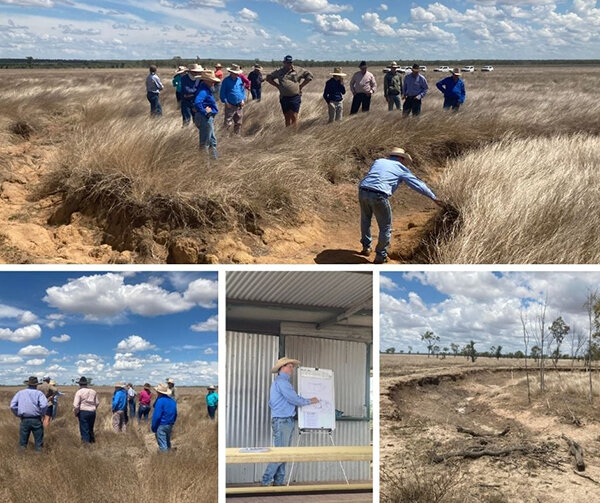
In December last year, Central Highlands Regional Resources Use Planning Cooperative (CHRRUP) ran a landscape rehydration workshop at Powlathanga Station near Charters Towers. The workshop was presented by Sam Skeat from The Mulloon Institute and was attended by a mixture of graziers and government and NRM organisation staff who learnt a lot about the causes and impacts of erosion, identifying landscape features and water flow and techniques to minimise erosion. 

The workshop is part of the Regenerative Grazing Tools for Burdekin Soils and Pastures project that is supported by NQ Dry Tropics and funded by the Australian Government’s National Landcare Program. Keep an eye out for more of these workshops in 2021, including examples of completed landscape rehydration works.

Sam has also been conducting property visits in the region to discuss landscape rehydration and landscape function for NQ Dry Tropics landholders in the Bowen Broken Bogie following interest from the Flagstone workshop last year. This work is part of the Landholders Driving Change program that is a Burdekin Major Integrated Project delivered by NQ Dry Tropics and funded by the Queensland Government through the Queensland Reed Water Quality Program.

Photos courtesy of CHRRUP’s Facebook page  (https://www.facebook.com/CHRRUPau/)

Photos courtesy of CHRRUP’s Facebook page (https://www.facebook.com/CHRRUPau/)

Hydrological modelling from a section of the Molonglo River Floodplain used to inform the rehabilitation design process.

Hydrological modelling from a section of the Molonglo River Floodplain used to inform the rehabilitation design process.

The Molonglo River floodplain was once an intact valley floor with a discontinuous braided watercourse containing a complex of wet and dry grasslands, ponds and wetlands. 

Green and Golden Bell Frog Image: G. Little, Australian Museum

Green and Golden Bell Frog
Image: G. Little, Australian Museum

Despite the impact of European settlement through agriculture and mining, it remains home to the last known population of Green and Golden Bell Frogs in the Southern Tablelands. One of the key goals of this rehydration project is to increase the frogs’ available breeding habitat with the hope of facilitating an expansion of the population. 

The extensive Molonglo Floodplain Rehydration Initiative in Carwoola, NSW will repair an 11km stretch of the Molonglo River with the goal of rehydrating and regenerating the adjacent 4,000ha floodplain, making it more resilient to drought and climate change. These works will help to re-establish habitat for the Green and Golden Bell Frog through in-stream and floodplain structures, rehabilitated wetlands, revegetation and regenerative land management. In parallel, it is also envisaged that the reinstatement of historical surface and groundwater flows along the floodplain will help to enhance the long-term resilience of primary production in the valley.

Planning, design and the approvals process is well underway, with the design process involving working closely with the supportive landholders of Carwoola and Foxlow, incorporating the long-term monitoring and management recommendations of frog experts Will Osborne and Sam Patmore, and drawing on hydrological modelling by Tim Morrison of Catchment Simulation Solutions to inform structure placement and size to achieve a more regular flood frequency, suited to frog breeding requirements. 

Special acknowledgement goes to the team at Catchment Simulation Solutions, Tim Morrison Senior Waster Resources Engineer and Prawi Woods Water Engineer, who have assisted with the development of spatial hydrological modelling to inform how our work can contribute to the hydrological regime required by the Green and Golden Bell Frog and to assist stakeholders in seeing where water flows across the floodplain, pre and post proposed interventions.

Learn more about the Green and Golden Bell Frog thanks to the Australian Museum.