Click the image above for a larger version.

Click the image above for a larger version.

A series of small wetlands have been implemented under Cam Wilson’s supervision at Greenhills in the Southern Highlands of NSW. 

The works, some of which can be seen in the panorama above, are designed to complement the existing landform, with the series of earth banks transforming an eroded channel into diverse aquatic habitat, and redistributing surface flows and groundwater storage across the old swampy meadow via a number of extended channels and level sills. 

With plenty of perennial grasses spread back over the banks, groundwater already filling the holes, and frogs, yabbies and dragonflies present on site, it should settle in and explode with life in no time. 

Thanks to landholder Tony Mott for inviting us to play a part in this ambitious property-wide project, and Charlie Brewer for the skilled earthworks.

CLICK HERE for a larger version of the image.

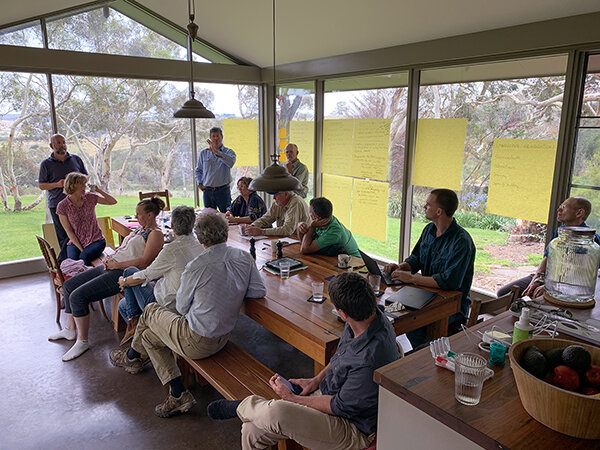
Farmers, ecologists and educators with TMI staff having a lively brainstorm at the Homestead.

Farmers, ecologists and educators with TMI staff having a lively brainstorm at the Homestead.

In recent months, TMI has taken some exciting steps towards advancing landscape rehydration education in Australia. 

The ‘Landscape Rehydration Capacity Building’ project intends to develop learning resources and professional training programs suited to students, landowners and professionals. It has been made possible by an Environmental Education grant awarded to TMI by the NSW Environmental Trust in 2020.

In February, we took a deep dive into the fundamentals of landscape rehydration by hosting a two-day ‘education blitz’. An experienced group of farmers, ecologists and educators joined members of the TMI team for a lively brainstorm around what the curriculum might contain and how it should be delivered. 

Among this group were representatives from two catchment communities in NSW: the Capertee Valley and Holbrook. Both communities are keen to explore how landscape rehydration can achieve good outcomes for farming, biodiversity and water quality in their local landscapes. 

In the next phase of the project we will work closely with these communities to pilot aspects of the curriculum and to support collaborative approaches to improving water cycling in their catchments. More news on this project in the coming months! 

IMG_3217-crop-600px.jpg

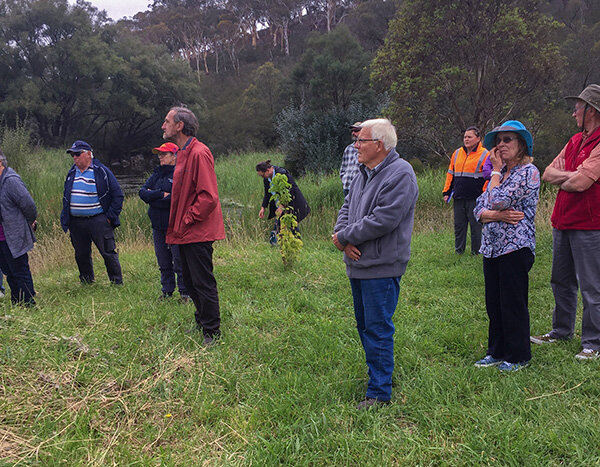
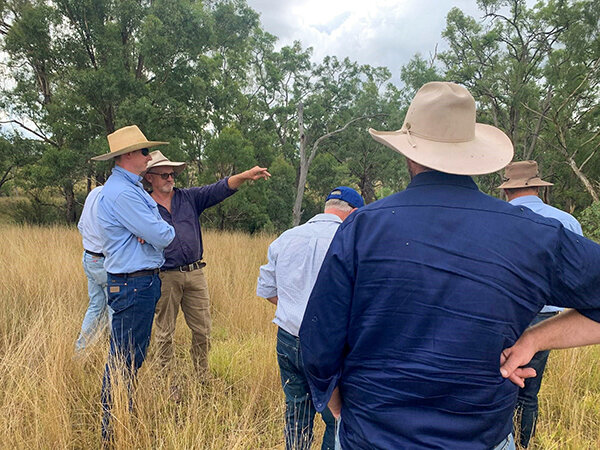
Eighteen community members from the Goulburn based group Community Voice for Hume attended a ‘Water Resilience in the Landscape’ workshop in February, including farmers, landholders and other interested parties.

Community Voice for Hume* aims to promote the adoption of Regenerative Practices to help the farmers and residents of Hume to adapt to farming and rural life, in times of drought and rising temperatures in a way that will improve the environment, create new jobs and build the community.

The day included a theory discussion about the carbon and water cycles, regenerative agriculture and landscape rehydration.

Participants were introduced to the catchment-scale Mulloon Rehydration Initiative and were taken on a walk to Peter’s Pond and Peter’s Weir, the Step-Diffusion rehydration earthworks on hillslope and the practical serrated tussock weed trial.

Discussing ecological concepts in the field is a great way to understand the principles the Mulloon Institute are applying on-ground. 

If your Landcare group, organisation or school are interested in a similar workshop or a tour of Mulloon Creek, please contact us via info@themullooninstitute.org

The Mulloon Rehydration Initiative is jointly funded through the Mulloon Institute and the Australian Government’s National Landcare Program. The initiative is also assisted by the NSW Government through its Environmental Trust.

* Community Voice for Hume will be the launching the ‘Goulburn Mulwaree Grazing and Farming Group’ on Thursday 18 March 2021. More details HERE.

IMG_3216-600px.jpg

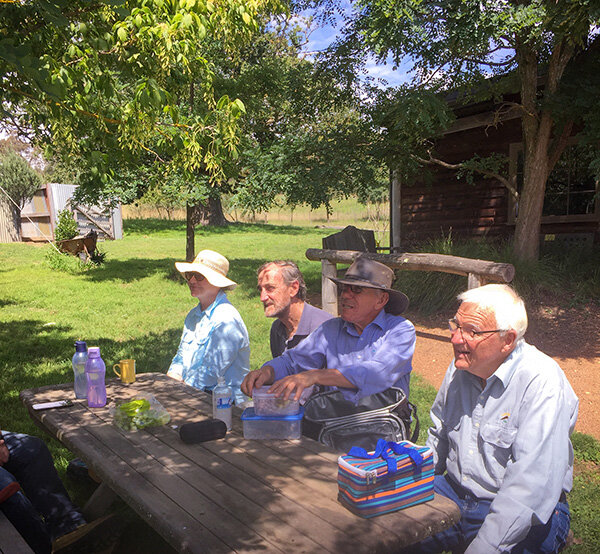
Peter and Sam explaining landscape patterns to particpants at the Roseberry Creek workshop.

Peter and Sam explaining landscape patterns to particpants at the Roseberry Creek workshop.

During the final week of February, Sam Skeat and Peter Hazell travelled to northern NSW to conduct landscape rehydration workshops for the Roseberry Creek Landcare Group in the Richmond valley near Kyogle, and for the Swan Vale Landcare Group near Inverell.

Both these groups expressed concerns that the chronic erosion of their waterways was at the heart of their problems with water retention and availability, which was affecting their agriculture and the natural environment. 

Despite having received some decent rain since the serious drought of 2019, both groups reported that there was still very little available water. As we so often hear, ‘a big storm might dump 50 -100mm of rain in the catchment and the next day it is dry again. There doesn’t appear to be any moisture retention.’

Sam and Peter discussed the fundamentals of landscape rehydration and illustrated some of the strategies a landholder or a catchment group could use to rehydrate their landscape. While Mulloon could most certainly help in the task of landscape rehydration, it was emphasised that it is up to the communities themselves to set the vision. A vision of a rehydrated landscape that benefits agriculture, the environment and the lives of those who live there, put’s the community in the driver’s seat when organising the actions required to achieve transformative change in their catchments.

Thank you to the Roseberry and Swan Vale Landcare Groups for organising these workshops and for your wonderful hospitality. Thanks also to the network organisations, Border Ranges Richmond Valley Landcare Network (BRRVLN) and the Gwydir MacIntyre Resources Management Committee (GWYMAC) for supporting these Landcare Group initiatives.

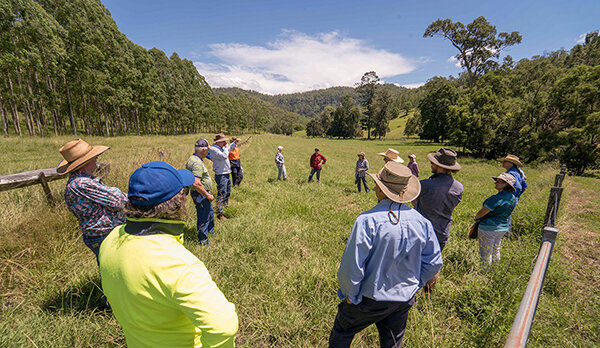
Sam Skeat listening to questions and observing at Swan Vale workshop.

Sam Skeat listening to questions and observing at Swan Vale workshop.

_DSC8792-crop-600px.jpg

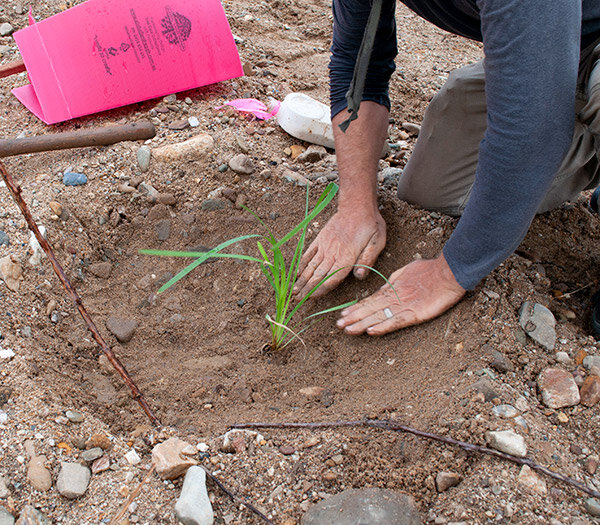
We’re currently seeking volunteers to be involved in the Mulloon Rehydration Initiative by helping transplant riparian vegetation and plant native tubestock to support new structures in the streambed. 

This is a great opportunity to be involved in our award winning initiative and learn more about the hydrological and engineering principles at work. This is physical field work and you’ll need to be prepared for the great outdoors and bring a packed lunch.

Are you available to volunteer on Tuesdays, Wednesdays or Thursdays from 9am to 3pm? Then please contact our Volunteer Coordinator James Diack via james@themullooninstitute.org or 0438 211 155.

The Mulloon Rehydration Initiative is jointly funded through the Mulloon Institute and the Australian Government’s National Landcare Program. The initiative is also assisted by the NSW Government through its Environmental Trust.

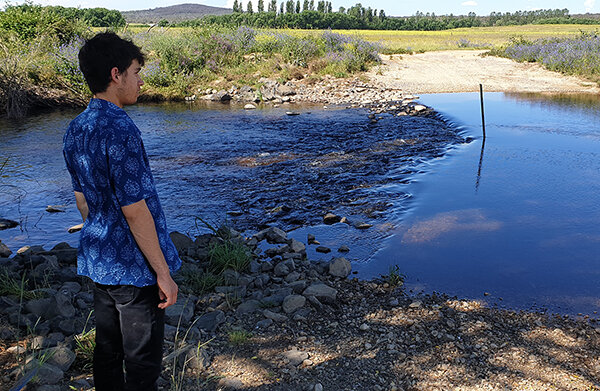
Krishna standing at DM4-crop-600px.jpg

I’m Krishna Nagarajan and I am a first-year student at the University of New England. I study a Bachelor of Rural Science and undertook seven weeks of practical experience with The Mulloon Institute (TMI) in November-December 2020.

I am a nature-lover by background and thus was interested in natural resource management. I see the approaches used in regenerative agriculture as practical ways to positively manage land. I can’t quite remember when I first heard about ‘leaky weirs’, but I wanted to see them in action. They seemed an interesting adaptation of a dam and matched what I had seen in nature. 

org_96a80230fe536556_1606876188000-600px.jpg

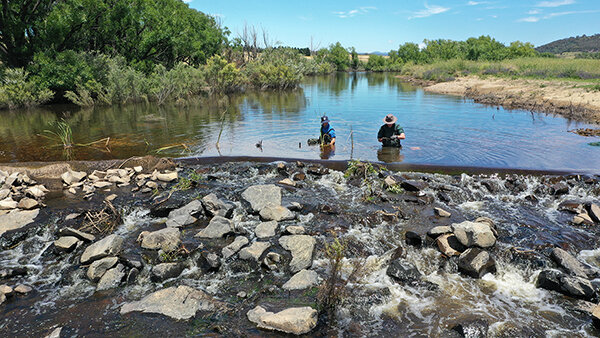
I spent most of my time assisting TMI with the Mulloon Rehydration Initiative. I worked on and around the leaky weirs on the Duralla property. This involved planting reeds along the weir and upstream flanks, as well as adding sod and grass seed to the sides of the weir and its banks. I helped the research team install water monitoring equipment throughout the catchment. I also gained experience with Mulloon Creek Natural Farms (MCNF), cleaning the chicken sheds, doing the daily shed checks and collecting eggs. 

I lived with Peter Hazell and his family, and was under the guidance of Max Brunswick for my work on the leaky weirs. Tony Bernardi oversaw my work with the research team, and I worked on various activities alongside Damon Mudge. At the farm, I was given direction by Roberto Garcia and Maria Bidirinis. 

I think what I enjoyed the most was the variety of jobs to do – every day I was learning something new or improving at a skill. Developing the technique to plant a reed or start a high-pressure water hose provided a new challenge every day. I learnt the most from my discussions with the TMI and MCNF staff. These gave me an understanding of why decisions were made and the thinking behind the tasks I was doing. I found using a sledgehammer to put in star pickets a stretch for me. I’m sure I would’ve got better at it, but I was relieved when we used the rammer the next day.

org_0ca1040cb13be9fe_1606876264000-crop-600px.jpg

My time with TMI has given me the practical experience of rehydrating a landscape, alongside MCNF running as a regenerative farm. I could see how the success of the Mulloon Rehydration Initiative and the productivity of the farm were connected. My experience with TMI has continued my passion for regenerative agriculture and excited me for the work opportunities I will engage in after uni. The model of a regenerative farm facilitating the regeneration of a catchment excites me about the possibility of positive change in our landscapes.

If students are looking for an approach to agriculture that enhances the natural resource base, then I would recommend completing work experience with The Mulloon Institute. A student can learn much, as I did, by participating in TMI’s vision of restoring landscape function.

The Mulloon Rehydration Initiative is jointly funded through the Mulloon Institute and the Australian Government’s National Landcare Program and is supported by various affiliates.

L-R:  NSW Farm Writers president Kaaren Latham with guest speakers Carolyn Hall and Gary Nairn AO. [Photo courtesy of The Land.]

L-R: NSW Farm Writers president Kaaren Latham with guest speakers Carolyn Hall and Gary Nairn AO. [Photo courtesy of The Land.]

Did you know that soil carbon is the single biggest terrestrial carbon pool on earth and is estimated to contain 2300Gt of carbon to a depth of 3 metres. The atmosphere only contains 820Gt and above ground biomass 610Gt. Total emissions from fossil fuel burning and cement manufacture were 8.99Gt in 2019 so it is possible to absorb the world’s annual anthropogenic emissions in soils.

TMI’s Chairman Gary Nairn AO and CEO Carolyn Hall were invited to speak about this in February at a Farm Writer’s Association of NSW lunch in Sydney and in particular relate it to the role of regenerative agriculture and our work to repair and rehydrate landscapes. Gary also commented that the National Farmers Federation (NFF) target of agricultural output of $100 billion by 2030 will be unattainable unless agriculture changes.

The first change is fixing water. 50% of rain that falls is lost through evaporation or runoff. There is too much bare agricultural land that accelerates runoff and evaporation resulting in erosion and loss of soil. Our waterways have become drains so when we get some rain it is generally gone before it can be utilised by the adjoining properties. Consequently, the water cycle is broken, and combined with the loss of vegetation, is the greatest contributor to warming the planet.

Fortunately more and more farmers and landholders are understanding the opportunities that exist and are seeking TMI’s help to get started on their properties and in their catchments. We have the happy situation that our resources are being stretched as we respond to urgent needs from all over the country. Increasingly people are realising the urgency of fixing this problem so we will be seeking financial support to better serve this need. 

While we have been successful with some modest government support in various locations, we hope to attract more corporate, philanthropic and individual financial support between now and the end of the financial year. A reminder that all donations to TMI to get this work done are fully tax deductible.

Related stories

National Farmers’ Federations’ $100 billion target, NSW Country hour, ABC Rural, featuring TMI’s Gary Nairn, 26 February 2021

Regen Ag focus as NSW Farm Writers gather, The Land, 1 March 2021
Since my ‘Summer Resilience’, TMI Board Directors Diana Cavanagh and Martin Royds decided to move on and have resigned from our Board.

Diana Cavanagh

Diana Cavanagh

Diana has been a Director since replacing her father, our Founder, the late Tony Coote AM in 2018. We have benefited greatly from her guidance in helping Mulloon continue to fulfil Tony’s vision. Her recollections of early days at Mulloon Creek have helped us all better understand the changes that have occurred over the decades.

We have appreciated her commitment to landscape repair and her sustained and ongoing dedication to the team at Mulloon Creek Natural Farms (MCNF).

Martin Royds

Martin Royds

Martin has been involved with MCNF and the Institute over many years and was a member of our former Advisory Council before joining the Board. Martin also stepped in to assist MCNF as interim farm manager following the departure of Michael Fitzgerald and kept things rolling until Jim Steele was appointed.

We are very grateful for the contribution both Diana and Martin have made during a time of change and growth. We look forward to their ongoing interest and support of our activities as we work on the many degraded catchments across the nation. Martin’s expertise on regenerative agriculture, his widespread collaboration with practitioners and his standing in the industry is very well recognised. Martin will provide input into TMI’s future projects in an advisory and consultative role.

We will be looking to replace these vacancies as soon as possible and will keep you posted.

Dowerin-Canola-crop-600px.jpg

We have been successful in several funding rounds recently which will help towards rolling our landscape rehydration work out across Australia.

Western Australia 

Thanks to the Government of Western Australia’s ‘Community Stewardship Grants 2020’, we will be undertaking a series of workshops on site assessments, detailed design preparation and the construction of landscape rehydration structures at four different properties in South West WA, including one at the Muresk Institute near Northam in the Wheatbelt. We will be working closely with WA hydrologist Lance Mudgway on these workshops and a number of local NRM groups.

North Queensland

Sam Skeat has been successful in winning a grant for the design and construction of a demonstration site in the Triple B catchment encompassing Bowen, Broken and Bogie. This builds on the work already done with NQ Dry Tropics and is made possible through a grant allocation from the Great Barrier Reef Foundation to NQ Dry Tropics. The project will create a sediment saving demonstration site and landholder education within the Triple B catchment.

New South Wales 

Closer to home, the Forestry Corporation of NSW has been successful in receiving funding for work to remediate the sensitive Montaine Peatlands Endangered Ecological Community in Bago State Forest. The remediation program will include development of a monitoring plan which will be overseen by TMI’s Science Advisory Council.

Board-Gary-Nairn.jpg

TMI’s Chairman Gary Nairn AO spoke on the NSW Country Hour on Friday 16 February 2021 about how farming needs to change to meet the National Farmers’ Federation‘s $100 billion target.

Gary features from 15.40 minutes onwards.

Listen to the program here:
https://www.abc.net.au/radio/programs/nsw-country-hour/nsw-country-hour/13174472