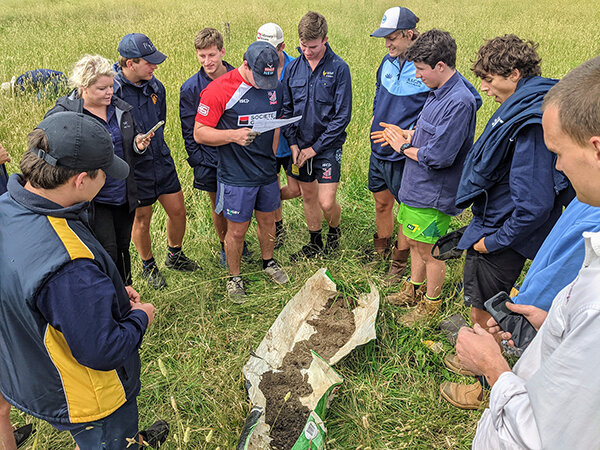
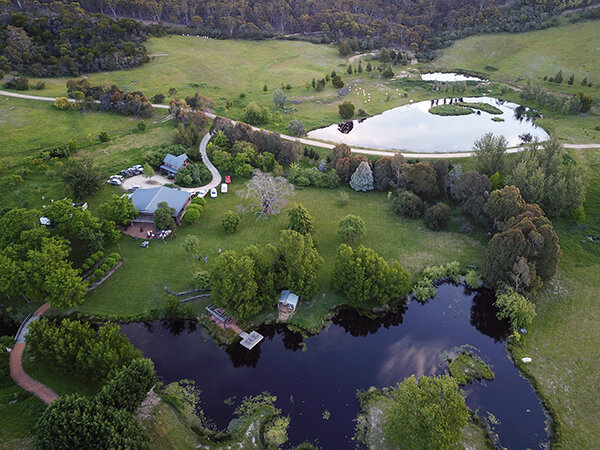
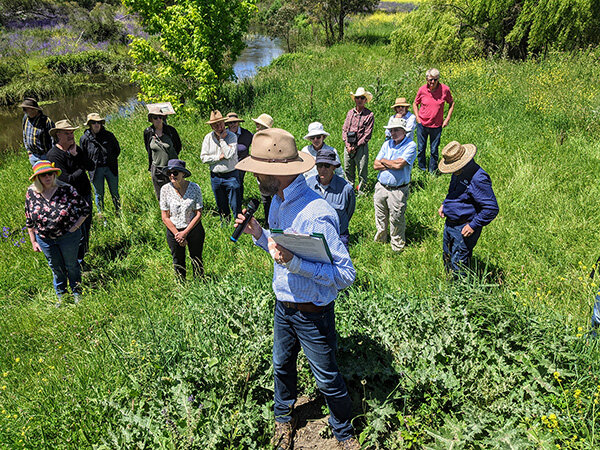
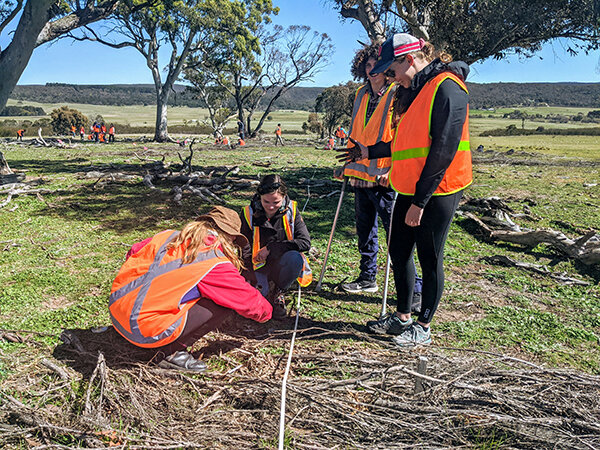
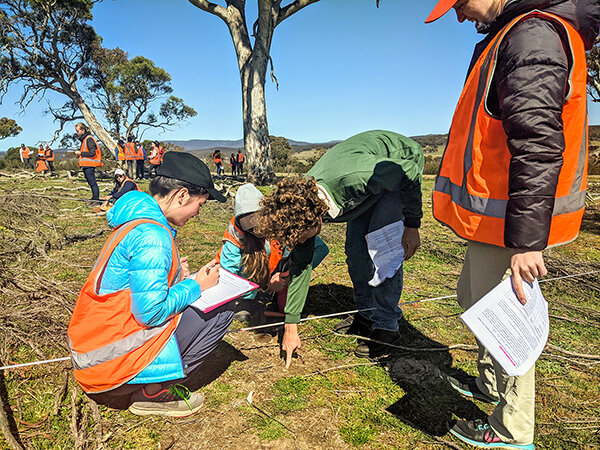
The students were given an insight into the property and catchment scale operations undertaken by TMI that help reinstate nature’s way of managing water in the landscape, and the principles of managing the land to improve soil and plant growth. The students were taught how to assess a range of soil profiles for physical and chemical characteristics, and understand what makes a good soil that acts like a sponge to infiltrate and retain water for plant growth. Additionally, they learnt about the importance of soil microbes for nutrient cycling and their symbiotic relationship with plants. The students were also treated to an informal lecture by expert regenerative farmer, Martin Royds from Braidwood, and a tour of his Jillamatong property.
As a graduate of TSC, landscape planner Joe Skuse was able to give an insight into his journey from studying at the college, then his Bachelor of Environment Sustainability from ANU, which has provided a career pathway to TMI.
Thanks to The Scots College’s Coordinators Kym and Duncan McMaster, and teacher Daisie Thomas for their continued interest and support to bring students to Mulloon Creek Natural Farms. Education and training for the next generation of farmers, agronomists, and land managers is paramount to Australia’s food fibre and environmental future. Thanks also to our major partners, ANU for the use of their soil sampling equipment.
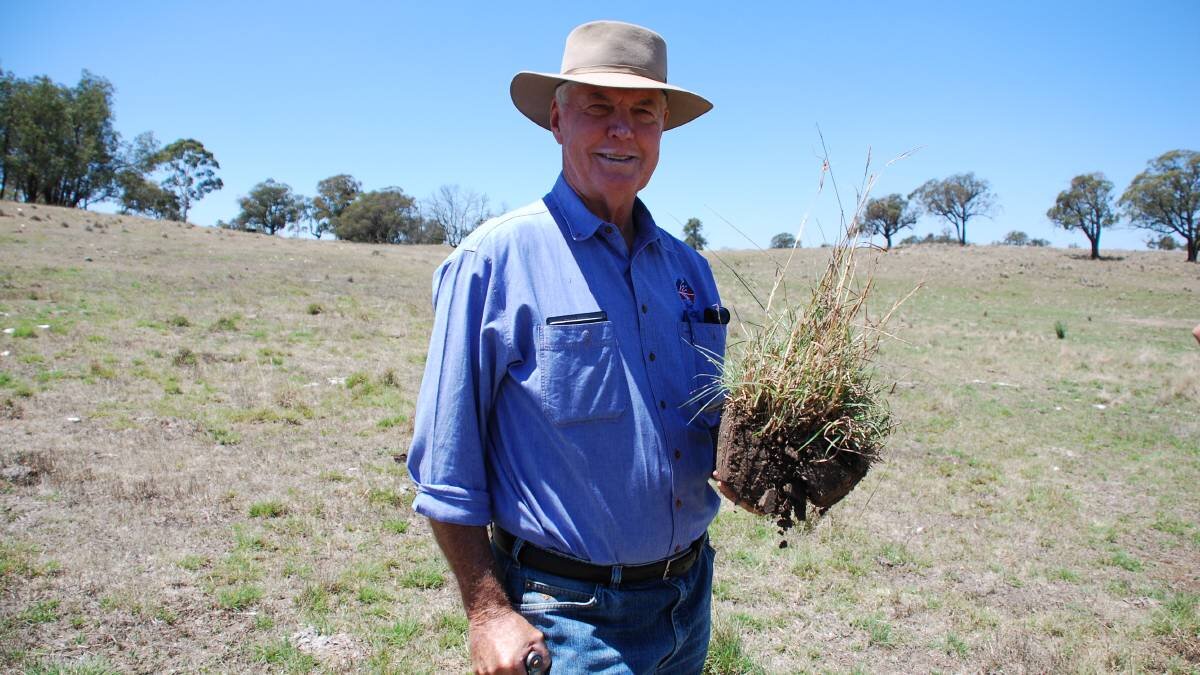
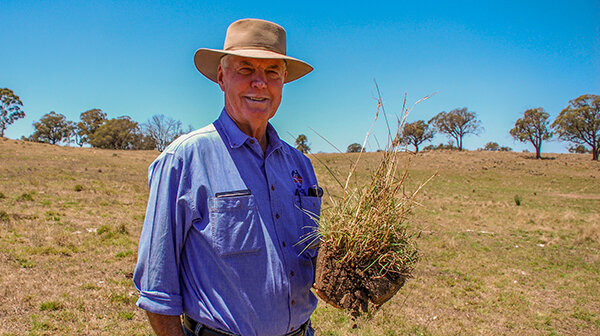
Soil health awareness raised by ex-Governor-General
Date published: 22 February 2021
excerpts from The Land, 13 February 2021
Despite being a decorated career soldier and later Governor-General of Australia, Michael Jeffery probably made his biggest mark as a fierce advocate for improving and protecting our fragile soils.
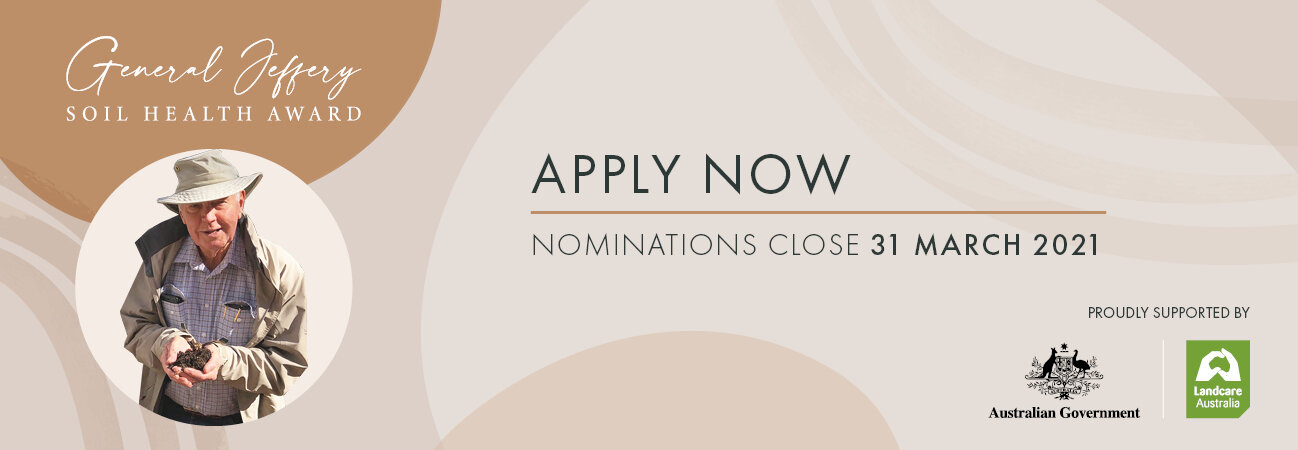
His commitment to the Australian landscape was acknowledged on World Soil Day (5 December 2020) when the General Jeffrey Soil Health Award was launched.
The award will be presented to any individual farmer, land manager, extension specialist or educator who is making an exceptional contribution to soil health in Australia.
The award is supported by the Office of the National Soils Advocate within the Australian Government Department of Prime Minister and Cabinet.
The recent passing of our Patron, Michael Jeffery, is a great loss to the nation. General Jeffery’s service to Australia has been outstanding including a very distinguished military career followed by his service to Western Australia as Governor and then to the nation as Governor General.
I was privileged to have a Governor General/Minister relationship with Michael Jeffery during my time in the Australian Parliament and then while chairing a subcommittee of Soils for Life. I was delighted when he agreed to become the Patron of The Mulloon Institute and he has been an inspiration to me, the Board and our employees over the past few years.
General Jeffery leaves wonderful legacies with many organisations and none more so than those of us that shared his passion for healthy soils. He very much understood the role of soil, water, plants and animals in repairing and rebuilding our landscapes and their role in regenerative agriculture. The Federal Government also acknowledged his leadership in this area when they appointed him Australia’s National Soil Advocate and more recently instigating the Healthy Soil Award in his name.
Michael Jeffery will be greatly missed by many Australians. We at The Mulloon Institute send our condolences and warm regards to his wife, Marlena, and his family at this sad time. We have lost a great Australian, but we will be inspired by the legacies he leaves.
Regards, Gary Nairn AO The Mulloon Institute – Chairman
Egg operations
Date published: 14 December 2020
Earlier this year at the height of the drought, the health and well-being of our pasture-raised, free range chickens at Mulloon Creek Natural Farms risked being compromised due to the increasingly poor quality of potable water available to our chickens.
With the health of our chickens always being our number one priority, a large number of younger birds were vaccinated to ensure their health was not put in jeopardy. It has since come to light that that vaccine falls outside the regulator’s organic certification standards. We immediately contacted the regulator seeking their advice and they have now informed us that we will not be able to market our eggs as ‘organically certified’ for the period until all the birds are sold, which will likely take up to 16 months.
This does not impact our biodynamic pastures or the way we produce our eggs, just our ability to market our eggs as ‘certified organic’. Any questions please contact our Mulloon Creek Natural Farms’ General Manager Jim Steele.
The Mulloon Institute held its Annual General Meeting in November 2020 at the Barn on Mulloon Creek Natural Farms, with a decent turn out considering the restrictions due to COVID-19.
It was great to do something face-to-face again and it gave us the opportunity to connect with many of our members and supporters.
We also took the chance to extend our thanks to long-serving Director, Richard Allsopp.
Richard, being the nephew of our Founder, Tony Coote, has been involved with TMI from the very beginning. His work on the Board and with our farms, and his network of sourcing equipment and vehicles, has been of particular benefit to us. Richard will remain a key adviser to our ongoing work.
With one Richard moving off the Board, we welcomed a new one, Richard Forbes who has worked in Federal Government and in senior corporate affairs and communication roles across a range of industry sectors. He has extensive regional, national and international business experience. He has worked across four continents and has, domestically, spent over twenty years supporting rural and regional Australia. A former farmer in SA and NSW Richard is passionate about supporting the agricultural sector. He was the presenter of the well-known ABC Country Hour program, Head of Media at the CSIRO and worked as an Adviser and Press Secretary to former Deputy Prime Minister and Trade Minister, Mark Vaile.
We also proudly presented the Mulloon Institute’s 2020 Annual Report, in what has been a most challenging and exceedingly dynamic year.
Research Coordinator Luke Peel and Science Officer James Diack from the Mulloon Institute hosted members and friends of the Wollondilly CWA Group on the Southern Highlands, which extends from Ulladulla to Kiama, and from Bundanoon to Mittagong.
The day began with a COVID-safe morning tea in the Barn prepared by the CWA ladies (thanks Bec Hogan, Pat Hughes and Aliki Darlow!) , followed by a brief presentation and then relocating to the field tour at Peter’s Pond.
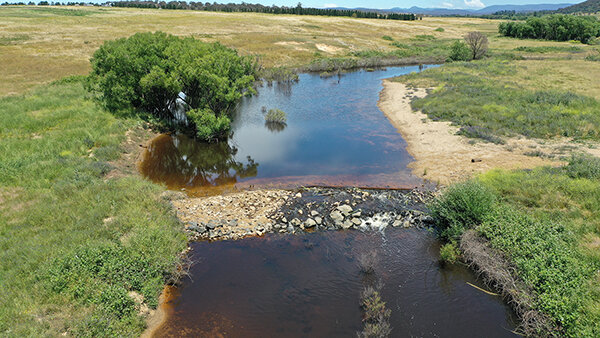
The group were keen to see how leaky weirs have regenerated the system to maintain water levels and flow of the creek. This work has enabled more and diverse riparian and aquatic vegetation to flourish, creating habitat and food for local fauna, reduce evaporation, and filter and oxygenate the water.
In the shade at Peter’s Pond.
Discussion highlighted how the creek and adjacent floodplains interact, particularly following the recent flood in August where a large amount of silt and organic matter was deposited and the floodplain soils were fully recharged. The group heard how this floodplain rehydration will significantly boost the regeneration of the soils and pasture productivity, plus provide groundwater recharge that will continue to keep the creek topped up.
The group were very interested, with a wide range of questions about; the rehydration works, how to work with nature to increase production, land management techniques, soil management including the importance of microbes. A big question was around how to manage weeds. Participants learnt that these pioneer plants (weeds) actually provide a feedback loop that suggests that ‘this ground under repair’. The weeds are in fact helping to manage whatever factor is causing the plants to be present, such as compaction, bare ground, overgrazing, etc. Once the weeds have done their repair work, the land is then able to transition to a more preferred plant species composition.
Discussing the role of weeds.
The next site the group visited was the Step Diffusion site situated on sloping country, which demonstrates how an eroding gully system can be rehydrated and regenerated to increase productivity and environmental outcomes. This site has been transformed by placing leaky contours at strategic locations based on reading the landscape, to slow the flow of water, spread the water laterally to infiltrate and rehydrate the whole system downslope. Too much surface water runoff can cause erosion, loss of infrastructure, plus loss of nutrients and organic material. Water that has infiltrated into the soil moves more slowly downslope through gravity, and promotes plant growth and soil microbe activity. The water does eventually make it to the series of farm dams below, and when it arrives it is filtered clean and provides quality water for use without adding sediment to the dam. Now that their habitat has been regenerated, frogs and birds have quickly moved back into the area, and more diversity of plants have emerged.
Lunch was held in the Barn while two of TMI’s educational and inspirational videos were screened, followed by a presentation by Luke Peel covering many aspects of the Institute’s work on the catchment-scale Mulloon Rehydration Initiative. This was followed by Question and Answer session with many excellent questions and with James and Luke providing examples and knowledge for them to consider.
Presentation in the Barn.
Hopefully participants are now further inspired to consider implementing some of the practical steps towards rehydrating and regenerating on their own properties, which will help build resilience for future climate extremes, even if they only start on a small scale.
A big thanks to Bec Hogan who organised the group tour and for her patience with the original event being postponed twice due to bushfires and then COVID restrictions.
To thank the group for trying for the third time to attend, four boxes of super jumbo eggs (480 eggs in total) from TMI’s certified organic, biodynamic, pasture-raised, free-range eggs from Mulloon Creek Natural Farms were offered as a gift, and all eggs were happily shared amongst the group.
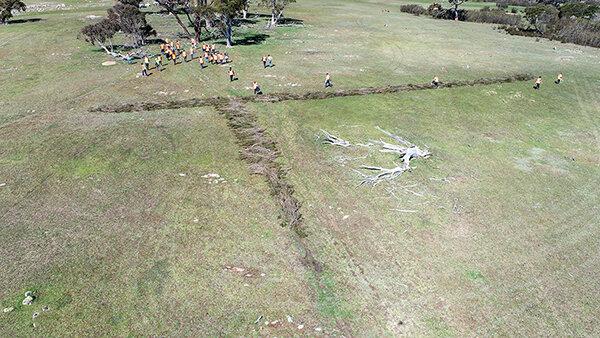
Completed 2020 brush packs placed on contour, with additional brush covering rill running downslope.
The Mulloon Institute hosted the annual ANU Environmental Science Field School at Mulloon Creek in September which was organised by Dr David Freudenberger with assistance from Dr Helen King, Dr Richard Thackway, Mauro Davanzo and others. TMI’s Research Coordinator Luke Peel helped to facilitate proceedings onsite at Mulloon.
Unfortunately, the field school was reduced from the usual three days of fieldwork to one due to COVID-19 restrictions on transporting large student groups, with many students driving their own vehicles to Mulloon.
Students were able to use their recently acquired skills in conducting Landscape Function Analysis (LFA) on existing brush packs installed by the class of 2018. The data students collected is part of an ongoing assessment of how brush packs can be used to regenerate degraded land and assess the level of success. They also used this assessment of past works to provide ideas of what worked and if possible, what could be done better.
Sampling soil in existing 2018 brush packs.
The students selected a new area which happened to be further downslope of 2018 brush packs, where rills had developed and small scald areas due to animal pathways to the nearby water point and long term issues with runoff from upslope.
The brush packs will slow water runoff (de-energised water), help trap soil, seeds and nutrients from upslope which will encourage more water infiltration, reducing the amount of runoff down the next slope step in the landscape, that would further erode the existing rills.
Brush packs were used to cover the rills to protect the soil from rain-splash impact and reduce animal traffic to help the eroded areas repair. The brush packs were almost a metre high, and will drop their leaves adding organic matter to the soil surface and helps trap water, soil and nutrients including seeds. The brush pack allows plants to germinate and grow to maturity as they are protected from grazing animals who prefer not to get poked in the face by the brush.
It’s always good to have ANU students visit Mulloon to apply their scientific skills and see how this relates to practical land rehydration and regeneration techniques that help farmers and land managers repair country.
The Mulloon Rehydration Initiative is jointly funded through the Mulloon Institute and the Australian Government’s National Landcare Program and is supported by various affiliates.
“Luke Peel was adamant that for meaningful, long-term landscape restoration to occur, land managers needed to change their outlook on land management, to see a landscape as it has been and as it could be. This really highlighted to me the critical importance of effective science communication in creating meaningful change.”
“Regenerative agriculture seems like a new way to manage the landscape holistically.”
“I wondered how, at home we might be able to implement some of the techniques being used at Mulloon to protect our soils from erosion and compaction when we return livestock to the paddocks.”
“Initially, my opinion towards conservation was that agricultural land should be ignored or revegetated to become forest. I felt very cynical of the concept of environmentally-friendly agriculture. Coming out of this course, I’ve recognised the importance of working with what has been done and seen that there is true merit in teaching more eco-friendly farming values to landholders.”
“Listening to Luke Peel and have him impart his knowledge and experience on us served to illustrate that policy is not the be all and end all in land management. The idea that farms could work together within a region and increase their land functionality and therefore productivity was not something I had considered before, as so much of my background had centred around policy being the one and only thing that allows for change.”
“Learning about this institute [Mulloon] inspired me to look into studying further into sustainable agriculture as I believe it is the way of the future. I have started looking into sustainable agriculture master’s degrees where I can mix my skills that I have learnt in my undergraduate degree with new skills within the sustainable agriculture field.”
2020 National Heritage Trust (NSW) Awards
Date published: 10 December 2020
We’re thrilled to announce that the Mulloon Institute were winners at the 2020 National Heritage Trust (NSW) Awards, in the ‘Landscape Conservation’ category and the President’s Award, for our ‘Mulloon Rehydration Initiative – Stage 1’.
Mulloon Rehydration Initiative – Stage 1
The Mulloon Rehydration Initiative is a significant example of agriculture and the environment working in unison across an entire catchment to create a more resilient, biodiverse and profitable landscape.
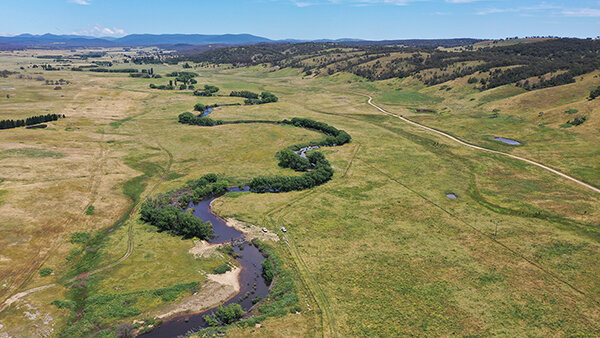
This project spans 1000 hectares across three neighbouring properties with a focus on creek repair and erosion control using small interventions to slow and filter water, preventing further erosion and beginning to rebuild the soil.
It forms part of a broader catchment scale project where the Mulloon Institute is working with 20 farmers across 20,000 hectares to restore landscape function and to introduce regenerative farming approaches. The project has been acknowledged by the United Nations Sustainable Development Solutions Network as one of five projects globally that demonstrates how bringing degraded landscapes back to life can also benefit agriculture.
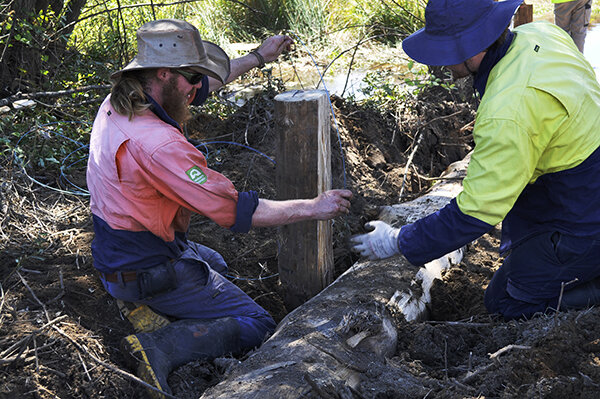
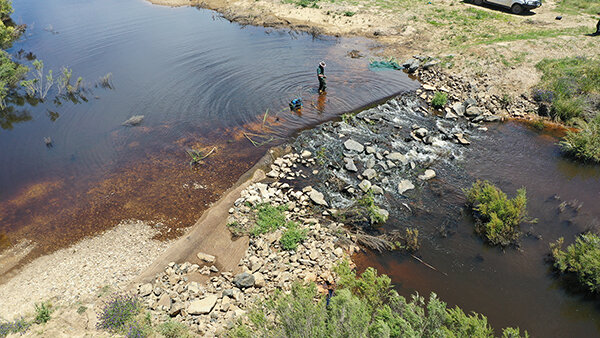
Installing a leaky weir
The Mulloon Institute is working to repair Mulloon Creek which has been severely eroded. The creek has been fenced, leaky weirs have been installed and 1000s of native plants have been planted. By doing this we have slowed the water flow and rehydrated the floodplain, allowing the riparian area to return to a series of wetlands that are full of life and biodiversity and provide habitat for our native plants and animals.
The floodplain has been reconnected with the creek and can once again function like a sponge storing water, growing more pasture and crops and ensuring Mulloon Creek has water even during dry times. All of this is helping to rebuild the landscape’s resilience to drought, bushfire and even flood.
We are overjoyed this project has been awarded a National Trust Heritage Award. This will help us to raise the profile of our work and we aim to use the Mulloon Creek Catchment project as a model to repair and restore catchments across Australia.
The Mulloon Rehydration Initiative is jointly funded through the Mulloon Institute and the Australian Government’s National Landcare Program and is supported by various affiliates.
Time to get planting!
Date published: 10 December 2020
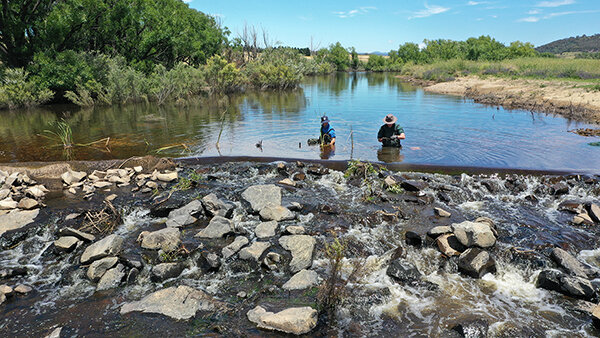
L-R: Krishna Nagarajan and Damon Mudge planting Cumbungi into the pond zone behind one of the new leaky weirs (Duralla, structure DM8) on Mulloon Creek.
With over 35 new leaky weirs now installed in the Mulloon Creek system as part of the Mulloon Rehydration Initiative (MRI), now that the rains have arrived it’s time to plant, plant, plant.
The carefully planned, designed and built log and rock structures form the skeleton of the leaky weirs. The plants and associated biology are what turn the leaky weirs into living, growing, self-sustaining structures. Without the life sustaining force, the leaky weirs would eventually decay, erode and wash away.
On the other hand, once living plants are established on the structures they bind the leaky weirs together, protecting them from high flows, filtering the water, capturing sediments, providing habitat and refugia for animals, helping to rebuild the whole landscape, and most importantly self-regenerating in perpetuity .
TMI Field Operations Manager Max Brunswick has been busy organising plants and getting them in around the leaky weirs. The revegetation strategy is four-fold:
Bare areas around the leaky weirs are mulched, soil and sod are worked into the rock ramp, and a cover crop of pasture seed is broadcast onto these areas.
Macrophytes (e.g. cumbungi and phragmites) are transplanted from ‘nursery zones’ in the creek and into the pond zone immediately above the new leaky weir.
Appropriate native tube stock, purchased from local nurseries, is planted throughout the riparian zone.
With the creek fenced from livestock, natural vegetation regeneration of creek environment begins to accelerate.
Revegetation of Mulloon Creek will continue in earnest throughout summer and autumn. Stay tuned for notifications of volunteer planting days coming up in the new year.
The Mulloon Rehydration Initiative is jointly funded through the Mulloon Institute and the Australian Government’s National Landcare Program and is supported by various affiliates.