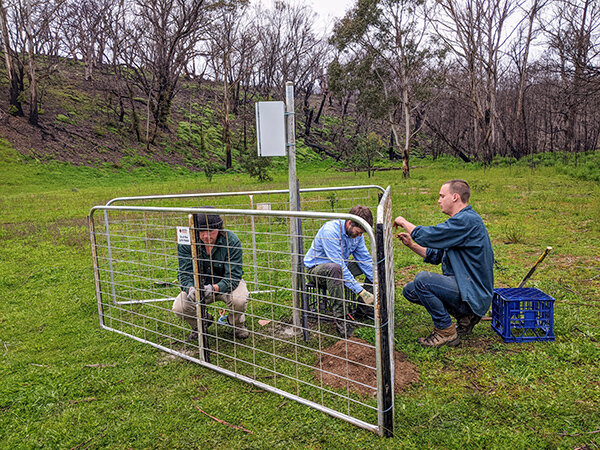
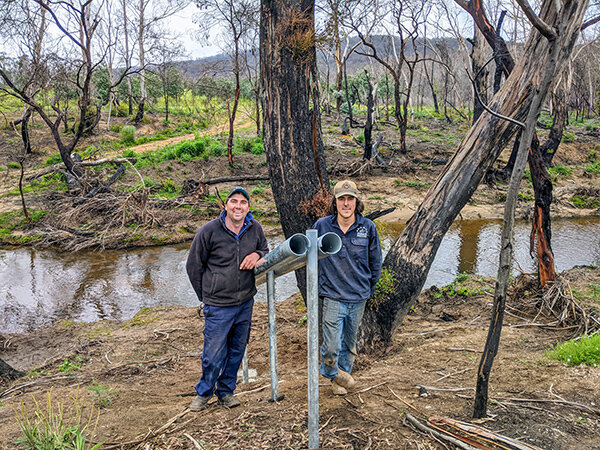
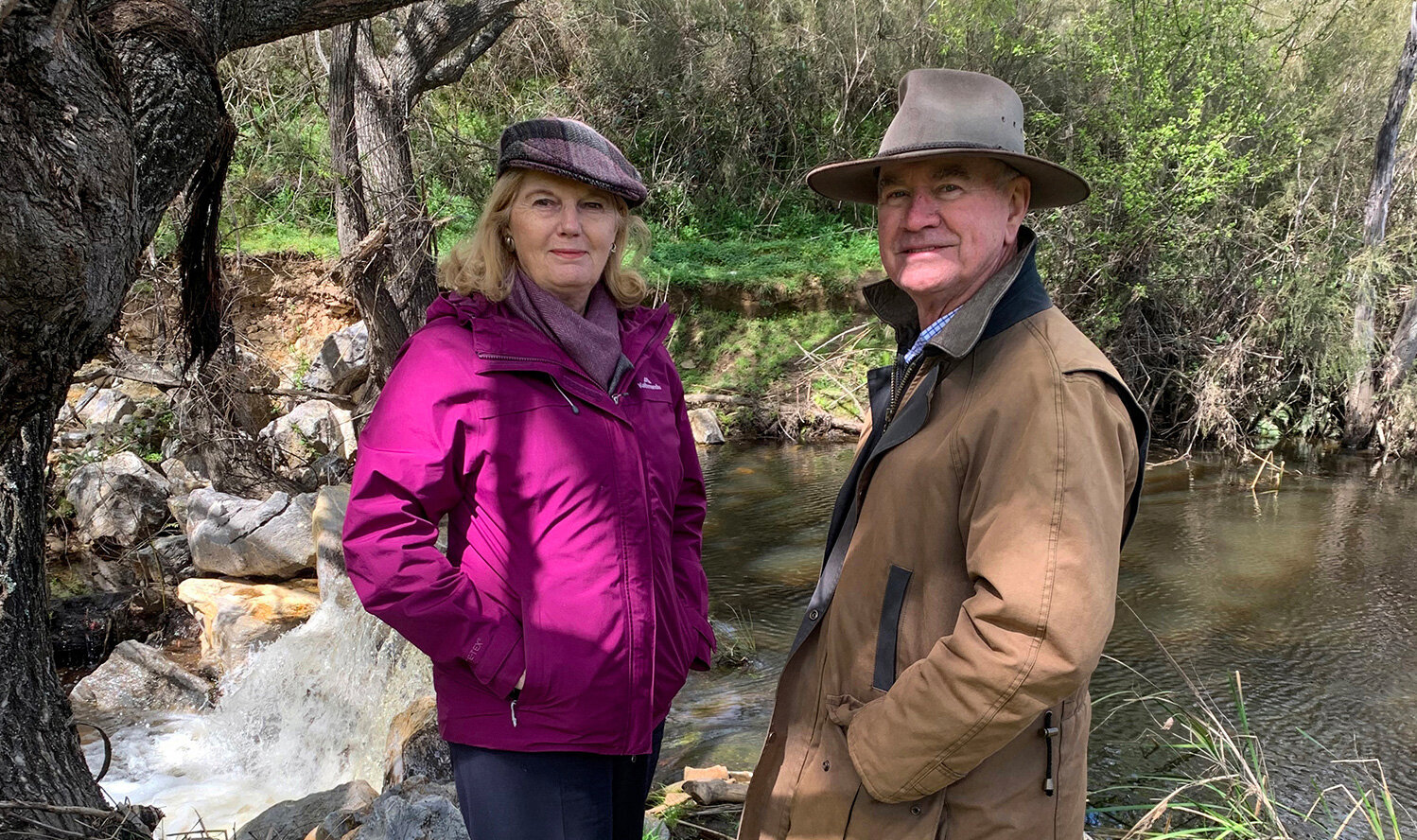
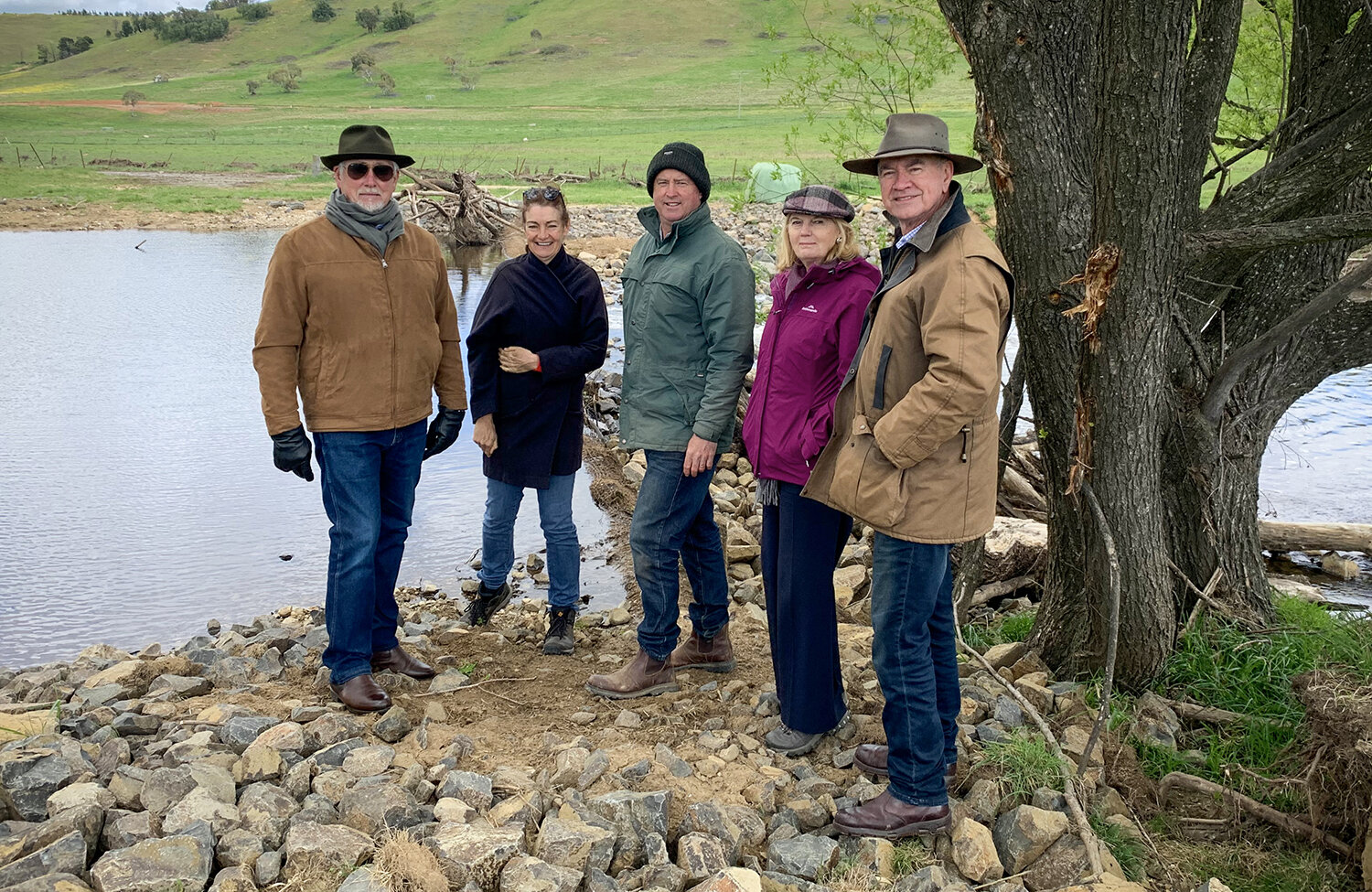
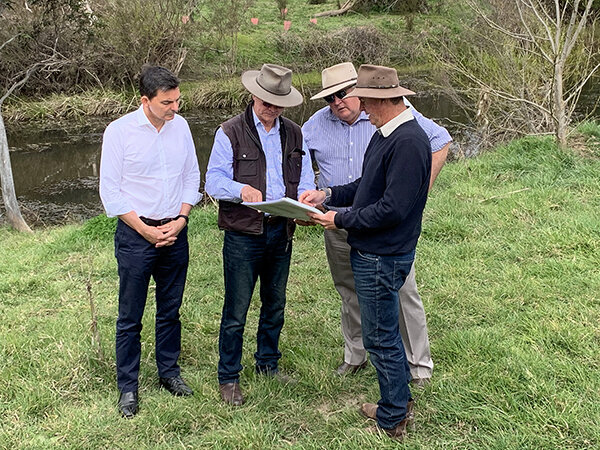
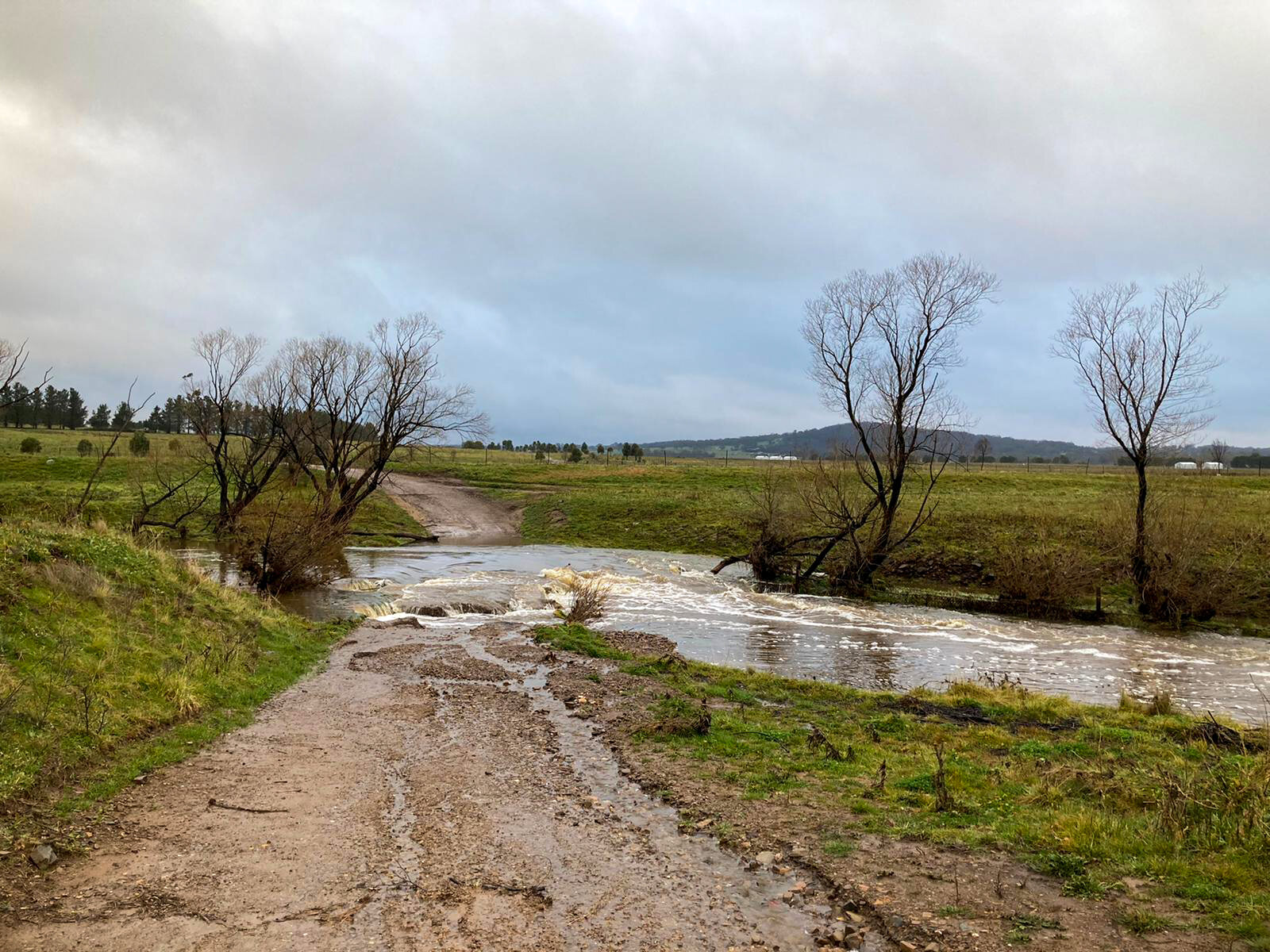
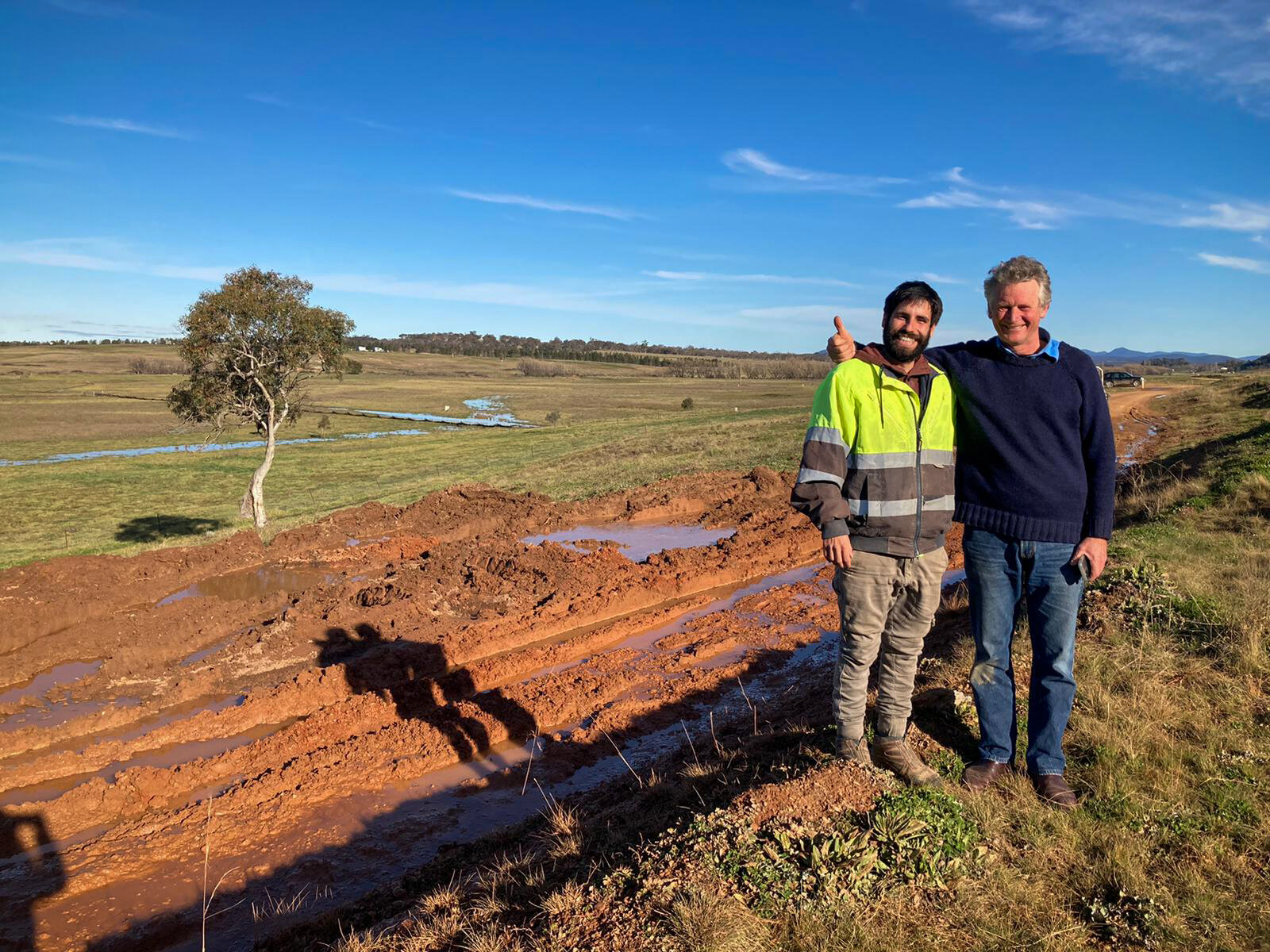
Tony Bernardi inspects the creek while Rhyce Kew and Connor Welch from RSK Welding prepare the stream gauge housing.
A new stream gauge and housing has now been installed on the ‘Landtasia’ property as part of the Mulloon Rehydration Initiative (MRI), in the upper section of Mulloon Creek and the project area.
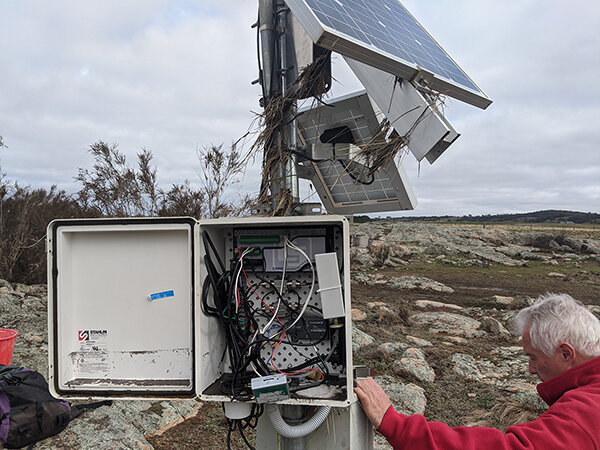
The stream gauge housing needs to protect the instruments from potential debris washed downstream, allow for ease of ongoing maintenance, and keep them secured in the correct location for accuracy.
The logger box for the stream gauge is located away from the creek and the impact of potential flooding and is enclosed to protect it from animals.
The housing will be host to a new set of instruments to measure water level and water quality such as, pH, EC (salt), turbidity, temperature, oxygen reduction potential (ORP), and dissolved oxygen. This will add excellent data to the five existing stream gauges in the lower sections of the Mulloon catchment. All data will be automatically telemetered back to TMI’s partner HydroTerra and made available through their Datastream website portal.
The new stream gauge housing was installed by TMI staff Luke Peel, Tony Bernardi, James Diack, Joe Skuse, Damon Mudge. Huge thanks also to Rhyce Kew and Connor Welch from RSK Welding who supplied the steel components and also provided expert skills in constructing and modifying the housing on-site with guidance from TMI’s hydrologist, Tony Bernardi.
The Mulloon Rehydration Initiative is jointly funded through the Mulloon Institute and the Australian Government’s National Landcare Program and is supported by various affiliates.
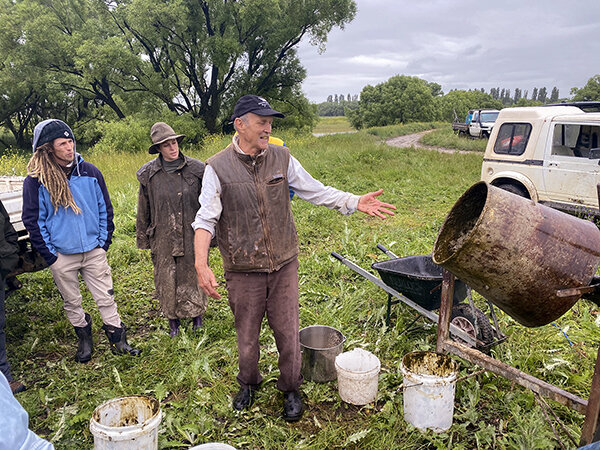
Hamish McKay preparing cow-pat-pit using concrete mixer
Biodynamics educator Hamish McKay continues to work closely with Mulloon Creek Natural Farms and recently provided an inspiring and simple overview and explanation of biodynamics to staff.
This included gaining experience in preparing and applying biodynamic preparations, including BD 500 and 501 and cow-pat-pit, which is a combination of cow manure, ground egg shells, basalt rock dust and biodynamic compost preps – yarrow, valerian, oak bark, nettle, chamomile and dandelion. This is mixed together and then left to mature in a pit for three to four months before use.
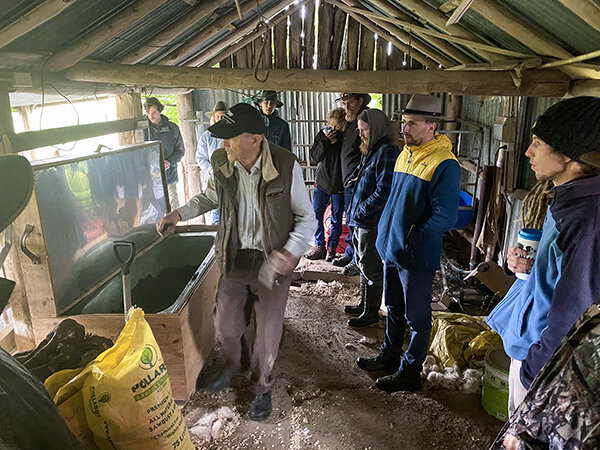
In the Biodynamics shed where the BD500 is stored
These preparations are a great way to get the compost preps out onto the paddock and to help the soil breakdown manure and urine. It is like broad-acre composting and is especially effective when sprayed onto paddocks after a mob departs.
Hamish will be working regularly with the team to continue building their confidence and experience in biodynamics, which reinforces the Mulloon Institute’s commitment to biodynamics and ensures we remain self-sufficient in this area.
Adding compost preps to the cow-pat-pit
Workshop – Regenerating Rural Landscapes
Date published: 10 November 2020
Peter Hazel makes a point
Late in October, representatives from the Mulloon Institute headed south to Gill Sanbrook’s regenerative grazing property ‘Bibbaringa’ near Bowna, NSW. In collaboration with David Hardwick from Soil Land Food, the team conducted a ‘Regenerating Rural Landscapes’ two-day bootcamp.
The course was blessed with a diverse group of participants ranging from Riverina graziers and croppers to local farmers to Southern Highland hobby farmers. Some managers were well versed in regenerative practices while others were totally new to the idea. The confluence of these varied skill sets, backgrounds and regions meant that knowledge shared between participants was just as valuable as knowledge shared by the presenters.
David Hardwick explains the benefits of soil conservation
Over the two days, presentations from Gill, David and Peter challenged the perspective that managers approached their landscape decisions from and developed key tools needed in identifying landscape features and functions. David employed a unique set of activities to demonstrate paradigms in landscape thinking of which his courses are famous for. Presentation topics included building a farm vision, soil conservation and management, working within the limits of a property’s geography and landscape rehydration.
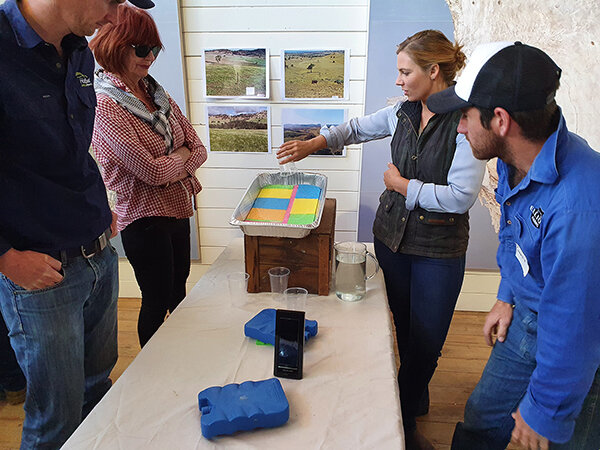
Demonstrating how water flows through a functioning landscape
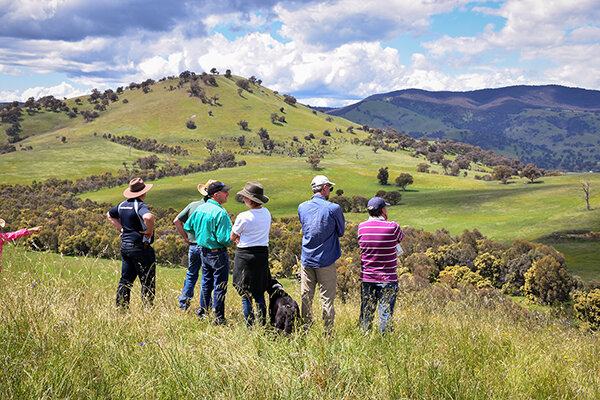
A highlight of the course was being taken up the back of Gill’s property and looking down on the entire farming system. Here the group used their new skills to identify where Gill had engineered her landscape to provide the productive and environmental outcome mix that worked for her enterprise.
Viewing Gill’s entire farming system.
Gill Sandbrook
This was a great introductory course that provides people with a grounding in holistic management, regenerative farming and landscape rehydration. Feedback from the 30 participants was overwhelmingly positive. Managers in the group were eager to go home and apply the skills they learnt to their own farming systems. It was encouraging that people left the course with more questions that they came with. This signals demand for further specialised and in-depth courses as the regenerative agriculture movement grows. Possibilities of future collaboration between the Mulloon Institute and Soil Land Food are being explored as this exciting new partnership moves forward.
A special thanks to Gill for her generosity in hosting the course and sharing her journey through regenerative agriculture.
Thanks to Penny Cooper for letting us use her photos in this story.
Land Studio Program – Capertee workshop
Date published: 10 November 2020
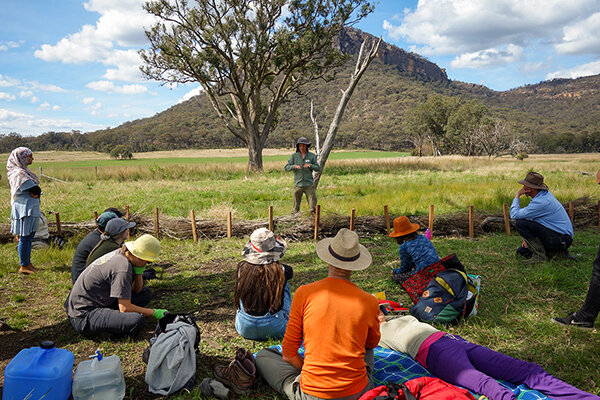
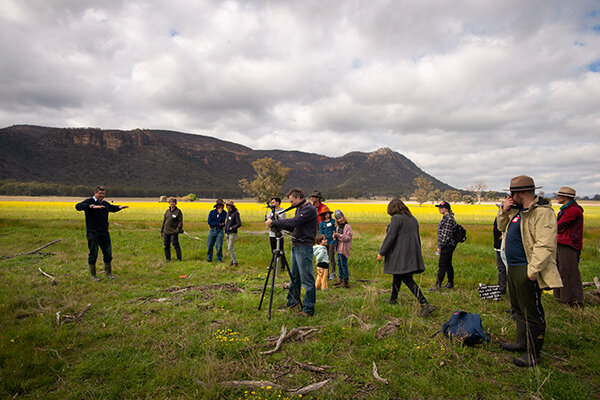
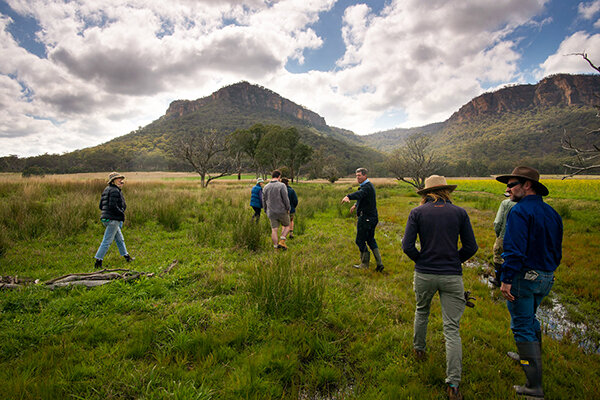
Peter Hazell and Bill McAlister from Mulloon Consulting visited the Capertee Valley in September to take part in the University of Wollongong’s Land Studio Program, which is designed for art students to learn about landscape regeneration and includes a field trip and camp.
Organised by Laura Fisher* and Lucas Ihlein, the program saw Peter and Bill running workshops with local Landcare legend Kerrie Cook and artist Leanne Thompson, to give students an insight into the dynamics of land degradation and restoration.
The workshop is part of the Capertee Valley Hydrology Project which was begun in 2019 by Capertee Valley Landcare, to regenerate the valley environment and raise the morale of the community during times of relentless drought and encroaching fires. This project is being led by local Landcare members Kerrie Cooke and Julie Gibson.
Following the event, Peter and Bill were treated to a tour of nearby alluvial landscapes by landholders Stuart Knox and Terrie Wallace, and a tour of Snowgoose Farm by camp hosts Emily and Stuart Dawson. They also met up with Chalie and Alex Bogle to formerly assess their newly acquired property ‘Hannick’.
The hospitality and enthusiasm of the Capertee community made the trip a great success and Mulloon Consulting looks forward to seeing the restoration work in the Capertee unfold and come to fruition.
*The Mulloon Institute is also now very happy to welcome Laura Fisher to our team to help with the development of our education program.
The National Soils Advocate position works to create an enabling environment to facilitate change, working to improve the sustainable management of Australia’s soils and agricultural landscape.
Penny was appointed in August 2020, succeeding Major General the Honourable Michael Jeffery, AC, AO (Mil), CVO, MC (Retd) who has retired due to ill health.
Joining Penny were her Senior Advisor Sue Bestow and Penny’s husband Dr Stuart McCosker, along with TMI’s Chairman Gary Nairn AO, CEO Carolyn Hall and Project Coordinator Peter Hazell.
L-R: Dr Stuart McCosker, Senior Advisor Sue Bestow, Project Coordinator Peter Hazell, Penny Wensley AC, Gary Nairn AOl.
Dept of Agriculture, Water & the Environment visit
Date published: 24 September 2020
L-R: James Larsen, TMI’s Chairman Gary Nairn AO, Andrew Metcalfe AO, TMI’s Project Coordinator Peter Hazell
Andrew Metcalfe AO and James Larsen from the Australian Government’s Department of Agriculture, Water & and the Environment visited the Mulloon Institute recently to learn more about the important landscape rehydration and landscape restoration work that we do.
Andrew Metcalfe AO is Secretary of the Department of Agriculture, Water & and the Environment, while James Larsen is Deputy Secretary of the Environment & Heritage Group.
Research Coordinator Luke Peel has been watching the recent floodwaters closely as he and Hydrologist Tony Bernardi and their team are part way through the detailed installation of monitoring equipment throughout the Mulloon Rehydration Initiative (MRI).
Reedy Creek logger box – note the flood debris hanging from the solar panels
With most of our hydrological monitoring equipment installed within the floodplain, much of it was directly impacted by the rising floodwaters but overall not too much damage was sustained. There certainly was a decent volume of water moving through the system though, with the Reedy Creek stream gauge recording a water depth of at least 3.8m before the flood peaked and the modem sputtered out. The floodwaters went on to leave a debris line a further 50cm above that.
Partially submerged set of piezometers at Duralla, downstream of the Sandhills Creek confluence with Mulloon Creek.
Groundwater observations
One of the most rewarding and validating things following the flood is knowing that the stream and groundwater aquifers are now fully recharged. But one of the most exciting things was discovering that the floodplain was so well recharged that one of our piezometer wells has been acting like an artesian bore with water flowing out of the top of 40cm above ground level!
We currently have 76 piezometer wells installed within the Mulloon catchment to give us access to the groundwater aquifers to measure changes in water level, temperature, and salt (EC) as the MRI rolls out across the catchment.
Half of these sites will be paired with a soil moisture monitoring system (31 Sentek soil moisture sensors) with six sensors distributed from 10cm sub-surface through to 1.5m, i.e. 10cm, 30cm, 50cm, 80cm, 110cm, and 150cm.
Series of piezometers at varying depths shallow, medium and deep (aiming for underlying base rock).
Interestingly, during their installation more than one aquifer was discovered at some piezometer sites, usually separated by an impervious layer such as heavy clay.
TMI has invested in multiple piezometers at these locations to sample the individual aquifers and hopes to identify which aquifers are connected to each other (across or along the floodplain) and which are connected to the stream by analysing data from the piezometer array. Tracers inserted into the groundwater will also help to assess where this groundwater comes from and goes to.
University of Canberra students testing water quality and depth in piezometers
Collecting this data helps informs us about how water moves through the landscape and helps us develop a conceptual hydro-geological model, particularly for sub-surface water movement. It also generates more questions. Where is the groundwater recharge coming from? Where does it go? How long does it last? Can floodplain pasture roots access this water? Is the recharged groundwater prolonged due to the leaky weirs installed in the creek?
This is a great example of the value of the instrumentation and science being conducted to gain better knowledge of the quantity and quality of water stored or moving through the landscape, and how it benefits local landholders and downstream users, including Sydney residents who eventually drink the water that has passed through the Mulloon catchment.
The Mulloon Rehydration Initiative is jointly funded through the Mulloon Institute and the Australian Government’s National Landcare Program and is supported by various affiliates.
Newly fenced piezeometers to protect their pole and logger box from damage
Climate Stations
Date published: 17 September 2020
Two new climate stations supplied by Environdata are now fully installed and operational at Mulloon Creek Natural Farms, with one on the Home Farm floodplain and the other at Duralla. Real-time data from these stations is available to all through the Weathermation website. Contact us for the login details if you’re interested, via info@themullooninstitute.org
The climate stations have a few extra components measured compared to the standard weather station.
Climate station features
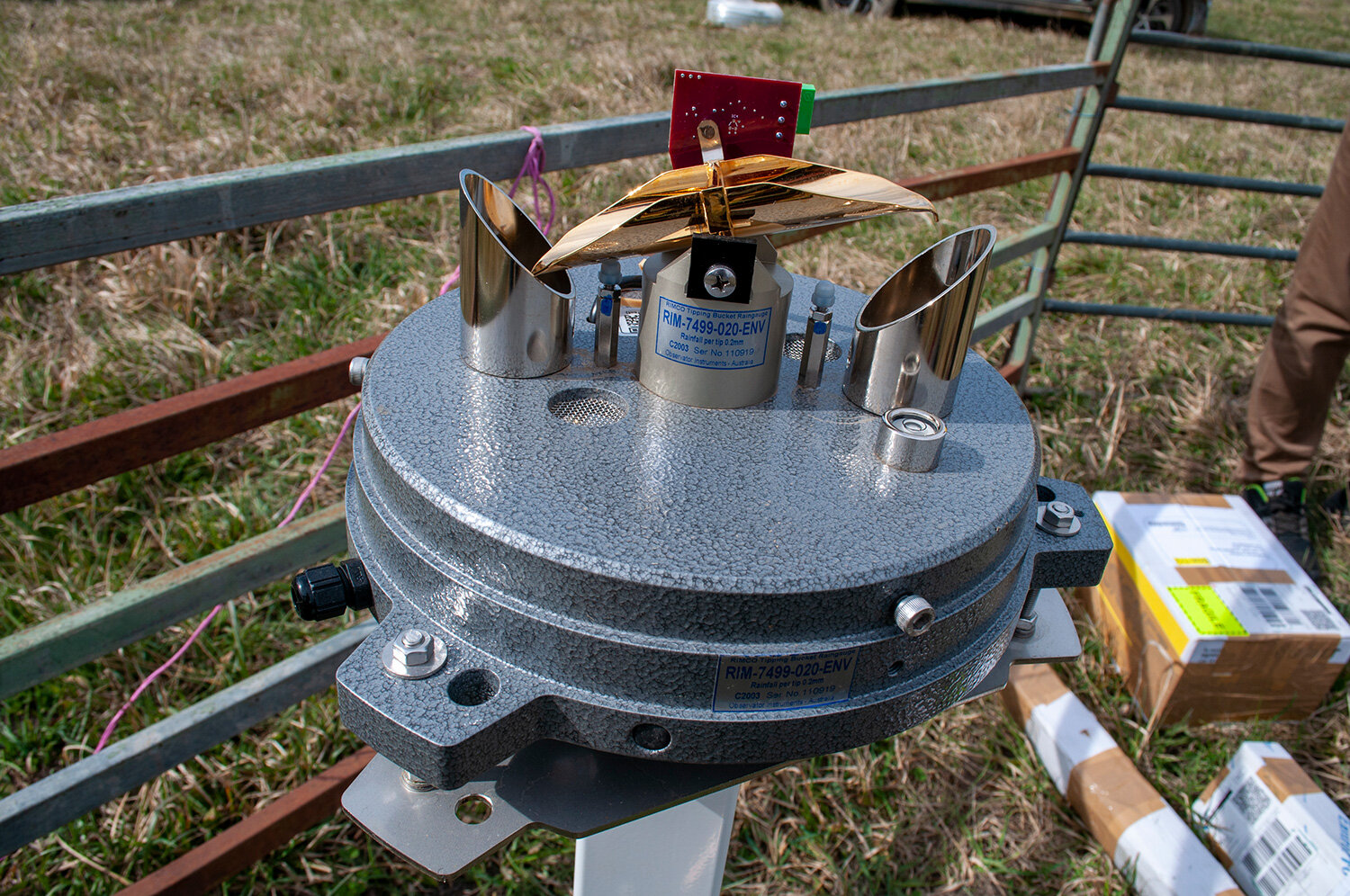
Rainfall – accurate to 0.2mm
Wind speed and direction
Soil moisture sensor at 8, 18, 28 and 38cm depth (also measures temperature)
Soil temperature sensor at 8cm
Soil heat flux at 8cm
Barometric pressure
Housed in white dome-shaped device on eastern arm
Temperature
Relative humidity
Separate pole with glass bulbs on upper & lower side
Incoming and outgoing solar radiation.
Research Coordinator Luke Peel shows CEO Carolyn Hall the insides of one of the climate stations
These individual measurements are important individually, and with appropriate formulas allow us to calculate evaporation, potential evapo-transpiration, and stored energy in the soil. This is important in understanding how the sun’s energy is used to power plants in the context of soil moisture and temperature and prevailing conditions such as humidity, air temperature, wind speed, etc.
The Mulloon Rehydration Initiative is jointly funded through the Mulloon Institute and the Australian Government’s National Landcare Program and is supported by various affiliates.
Interim Farm Manager Martin Royds, along with Poultry Farm Managers Roberto and Maria and the Mulloon Creek Natural Farms (MCNF) team members faced the full front of the recent floods at Mulloon.
With a very sodden floodplain and Hazeldell Road collapsed, feeding 35,000 chickens and collecting their eggs became a monumental task. Bogged vehicles slowed things up as well, but that is all part of agriculture. Unfortunately, you can’t instruct chickens to stop laying until road access is fixed!
The MCNF team did a terrific job soldiering on in such trying conditions!
Queanbeyan Palerang Regional Council were also terrific and were on the job as quickly as possible to undertake temporary repairs to allow trucks to get in and out. It was a long way around to some flocks but somehow it all got done and our eggs made it to market.