Restore Australia is an initiative being progressed by the Global EverGreening Alliance (GEA) which has about $300M from international donors to restore degraded lands across Australia and sequester carbon over the next five years. This is significant funding directed to the Australian landscape and TMI has been privileged to be invited to participate.
Through the development of this project the Mulloon Institute’s Chairman Gary Nairn has also been part of a Technical Advisory Board (TAB) overseeing the structure of the program to be followed.
“During April, the TAB met via zoom on numerous occasions to ensure the project was kept on track to meet a very tight timetable specified by the donors. The process also included a two-day workshop that comprised up to sixty-eight people participating via a zoom meeting. It even included break-out sessions. If I hadn’t participated myself for the whole two days, I wouldn’t have believed it could be done so efficiently. Technology has certainly allowed business to continue albeit in a very different form.” – Gary Nairn, TMI Chairman
Five priority regions have now been selected with coordinating organisations appointed to each region. As a collaborating organisation TMI is working with the coordinating organisations as a more detailed plan is developed for each region. The regions include: the Far North Tropics; the Rangelands west of the divide running from North Queensland to the Victorian border; the Great Dividing Range also from Queensland through to Victoria; bushfire affected regions; and, the South-West of WA including the Wheatbelt. A very large part of Australia will be impacted by this ambitious but badly needed project and it gives TMI further opportunities to work at the catchment scale. It also opens up opportunities to leverage other funding.
The landscape repair and rehydration concept promoted by The Mulloon Institute (TMI), a regenerative agriculture not-for-profit, is now the focus of suggested amendments to the legislative and regulatory process surrounding water and land management in NSW.
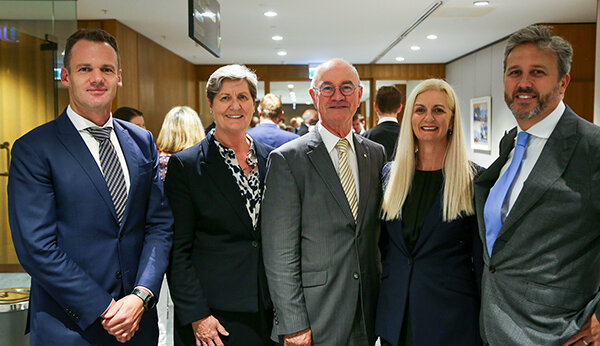
Wilfred Finn (AITHER, The Mullloon Law Committee), Trudy Sheehan (King & Wood Mallesons), Gary Nairn (The Mulloon Institute Chairman), Carolyn Hall (The Mulloon Institute CEO) and Matt Egerton-Warburton (Gadens, Chairman of The Mullloon Law Committee). Photo: Edgars Greste, Grow Love Project
Representatives from TMI, which focuses on regenerating agricultural landscapes, met recently with NSW Planning Minister Rob Stokes and NSW Water Minister Melinda Pavey, as well as Deputy Premier John Barilaro and NSW Agriculture Minister Adam Marshall, to discuss adjustments to the current approvals processes that are hindering farmers from building much needed landscape rehydration structures.
Led by TMI chairman, the Hon. Gary Nairn AO, the initial response from the NSW Government has been encouraging with ministers indicating they will ‘actively’ consider the proposed amendments.
“We have approached the relevant Ministers to highlight the need for changes to be made to the water and planning legislation to enable landscape rehydration works to be done much more easily,” Mr Nairn said.
“We drafted some proposed amendments and we have given them to the Ministers who have passed them on to their departments to consider.”
Chairman of the Mulloon Law Committee, Matt Egerton-Warburton, said the amendments make the approval process easier for landowners to commence landscape rehydration on their property.
“At the moment the approvals that the landowner has to receive from governments and councils is so onerous that they are not conducting these works,” he said.
“When seeking to repair whole catchments (which typically have multiple landowners), current legislation and regulations requires individual approvals for each structure, submissions from each separate landowner in a catchment, different submissions to multiple departments (Planning, Water, Environment, etc) and the commissioning of expensive and time-consuming expert reports.”
“Compliance with these requirements is a significant administrative, legal and engineering process for landowners that costs significant amounts of time and money.”
“At its extreme, approval for one project took 30 months and cost $350,000, but cost less than $100,000 and took only three weeks to construct. Our legislation streamlines this process to expedite the establishment of landscape rehydration works while meeting necessary regulations.
“The limited money and time of our farmers should be spent repairing their landscapes, not trying to understand and fulfil lengthy compliance processes.”
Mr Nairn said legislation and regulations are a complex matter and the TMI recognise that situation has worked hard with the Mulloon Law Committee to put forward workable solutions to this matter.
“We want to slow the water but quicken the compliance process,” he said.
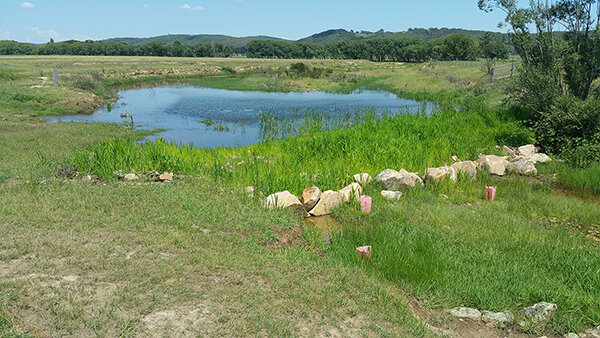
Leaky weir structure at Westview Farm showing results several months after construction. (February 2019) Photo: The Mulloon Institute
Mr Egerton-Warbuton said the proposal is intended to recognise the effectiveness of the landscape rehydration concept.
“We have proposed a solution whereby if the leaky weir and the landscape rehydration works fit within the framework that the government has specified in the amendments and then the property owner can just go out there and build it – the works will be deemed either exempt or compliant development, requiring significantly less approvals,” he said.
“If we get the government on board not only to pass legislation but to produce a user friendly guide for landowners, then hopefully building these structures will be quick, easy and cheap.”
TMI CEO Carolyn Hall noted the proposal is a very significant milestone and TMI are excited by the progress made through the meeting with the Ministers.
“I think for the Institute it would really enable us to pursue our goal of 100 projects with great confidence and the Mulloon Rehydration Initiative itself would become a model to be scaled up and rolled out across the nation.”
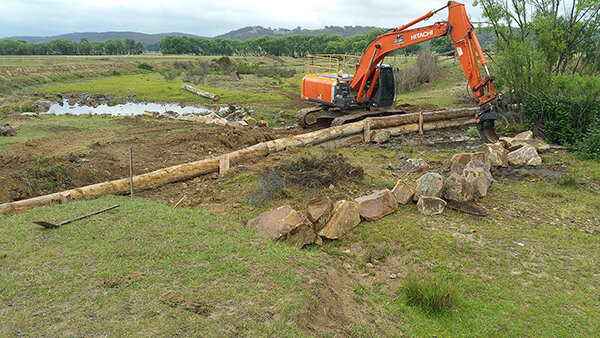
Building the same leaky weir structure at Westview Farm. (November 2018) Photo: The Mulloon Institute
Mr Nairn said TMI were delighted to have received commitments from Ministers Stokes and Pavey to actively consider implementation of the proposed amendments.
“We would like to see a situation where, as long as the works comply with NSW codes, our farmers can just get out there, build these structures and repair their land,” he said.
“We have recently experienced drought, bushfires and floods, so never has effective water management been so crucial for our agricultural industry and sustainable environmental management.
“For farmers and graziers, landscape rehydration is a scientifically backed drought-proofing method for improving their properties and, importantly, allowing for returns to be generated in periods of severe drought, as we’ve recent seen.
“The laws in place protect the environment, biodiversity, water quality and supply.
“We believe our landscape rehydration structures fulfil these mandates.
“We’d like to see the regulations changed to recognise the value of these works and allow compliant projects to proceed with necessary certification attained later.”
The course forms part of SLF’s Regenerating Rural Landscapes program which is a hands-on, action learning based course that introduces the basics of rural landscapes, landscape thinking and the science behind landscape rehydration. The program builds an understanding of how landscapes function so that property design and planning can use ecology to get the best result for productivity, efficiency and sustainability.
TMI’s Peter Hazell presented on landscape hydrology during day 5 of the 6 day course, which also covered:
• Understanding how farm landscapes function
• Understanding the water & nutrient cycles in farm landscapes
• Understanding energy flow in farm landscapes
• Using maps for property planning
• Identifying landscape patches in rural landscapes
• Assessing landscape & patch health
• Identifying & prioritising issues
• Innovations to redesign & improve your property
• 10 steps of property planning to develop a regenerative whole farm plan
Day 6 of the course will also involve The Mulloon Institute and focus on practical planning to improve a farm’s hydrology. Day 6 will happen later in the year, once the Covid-19 pandemic is under some control.
Australia really is the land of droughts and flooding rains. And it is invariably the flooding rains that bring the end to the drought – that’s if the landscape can hold onto some of that precious water, rather than it otherwise scouring everything in its path as it then carries all your precious soil, nutrients and biodiversity out to sea or into the nearest reservoir.
Fortunately for the landholders within the Mulloon Community Landscape Rehydration Project (MCLRP) that have so far had leaky weirs constructed on their places, rather than erosion being the result of four major surges of water through the system in the last month, rehydration of the creek and of the floodplain, and nutrient rich sediment deposition has been the result.
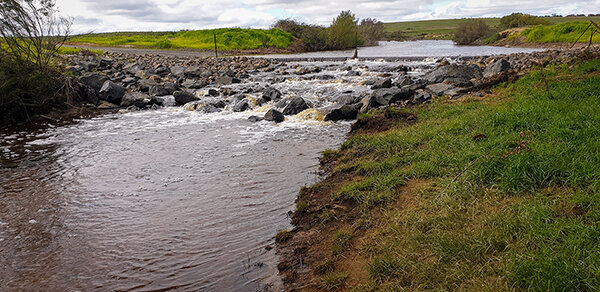
Water flowing over structure DM4C1 at Duralla (Mulloon Creek Natural Farms), one week after a major pulse of water came through, which was only a week after the structure had been completed!
Designed to operate as an interconnected system of leaky weirs that all work together to dissipate the energy of storm surges, what used to be turbulent, high energy flows down the creek all of a sudden became gently flowing ponds and spreading riffles. Suddenly sediment can deposit and vegetation can re-establish. The pattern of degradation has been reversed.
Unfortunately, we are still unable to source logs due to the recent fires, so creek works are unlikely to recommence until the Spring-time. However, we continue to make progress on a number of fronts. Our field landscape regeneration expert, Max Brunswick, is working with each of the landowners in revegetating around the recently built structures. And Landscape Planners, Bill McAlister and Anne Gibson, are busy working on Controlled Activity Approvals for three more properties so that once we do get rolling again we can keep on rolling.
See how the first crossing structure installed at Duralla Farm (MCNF) has been transformed by rain and how the tree plantings are faring at Westview Farm. HERE
View ‘before and after’ pictures of several structures installed as part of the MCLRP. HERE
Duralla & Westview updates
Date published: 3 April 2020
Mulloon Creek Natural Farms
Duralla crossing
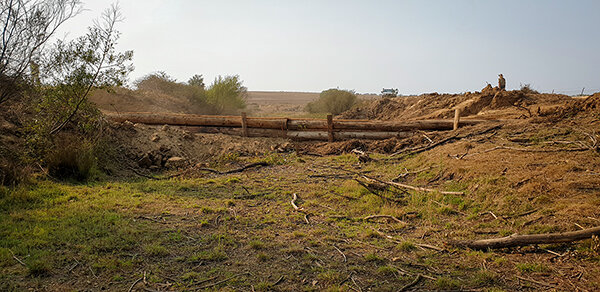
This log sill crossing was completed only days before Mulloon Creek started to flow again earlier this year. It has since endured four major pulses. Despite much erosion upstream from the fires, water quality at this, the second lowest structure built into the creek so far, is very good. There is over 50 reconstructed ponds within Mulloon Creek above this point.
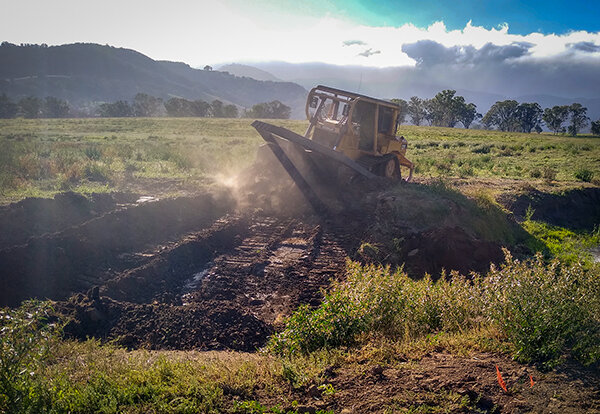
Structure DM4 during construction (February, 2020)
One week after a big pulse of water went through (March, 2020)
Westview Farm
Tree planting
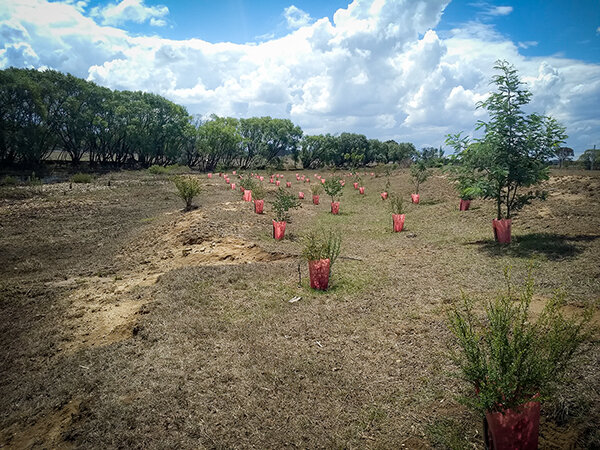
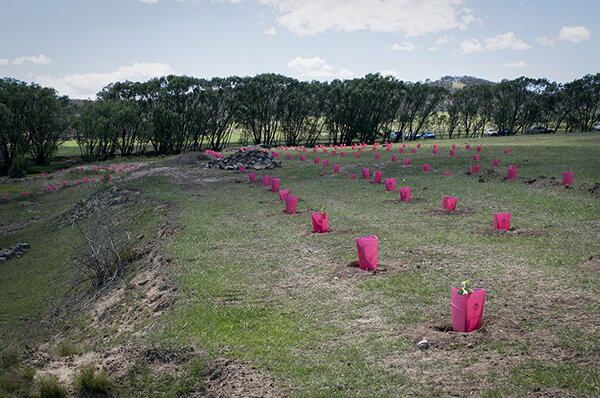
At Westview, the results of the rehydration activities have been exceptional. In December 2018, 500 trees, shrubs and sedges were planted on the banks of the creek. Over 80% have survived the driest period since records began and are now bursting with life since the rains have come again. The leaky weirs installed at the same time have turned a churning, turbulent, torrent of a creek into a series of gently flowing ponds and spreading riffles. The landowners couldn’t be happier with the results.
Tree plantings at Westview (11 February 2020)
On the day they went in (1 December 2018)
View ‘before and after’ pictures of several structures installed as part of the MCLRP. HERE
Global Evergreening Alliance
Date published: 3 April 2020
A major engagement during March has been with the Global Evergreening Alliance (GEA), an international organisation which aims to restore degraded lands worldwide. Up until recently much of its work has been in developing countries primarily in Africa. Its major donors have now committed 150m euro to restoring landscapes in Australia and increasing soil carbon and it would seem that its aims are virtually identical to the actual work of TMI.
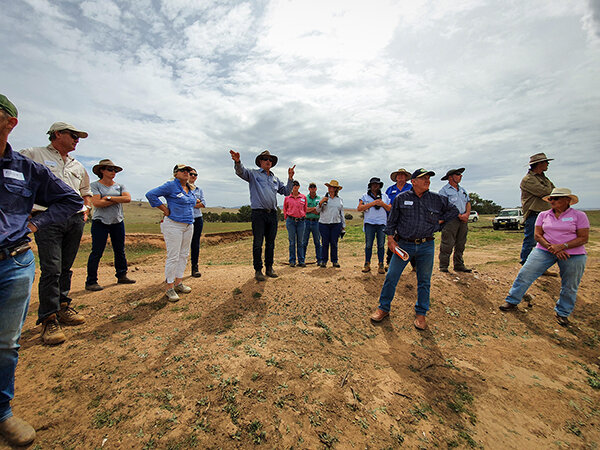
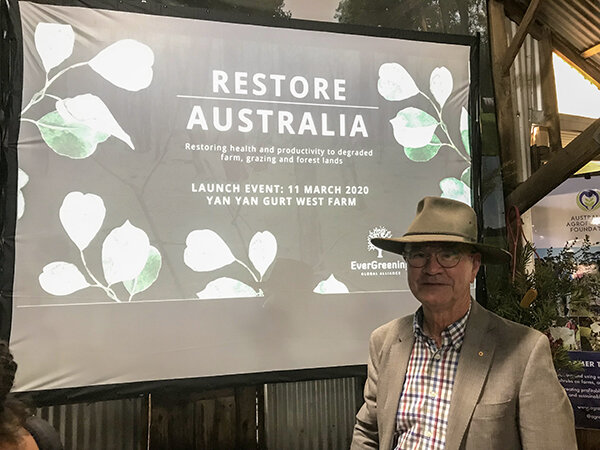
Just days before travel restrictions were recommended, TMI Chairman Gary Nairn attended the launch of GEA’s Australian project, Restore Australia, held on an agroforestry property in Victoria near Dean’s Marsh. Gary’s presentation at the launch highlighted TMI’s achievements, including our whole-of-catchment Mulloon Community Landscape Rehydration Project.
Since the launch a lot has been happening but it has had to be done in a more ‘makeshift’ way due to travel restrictions and social-distancing. As a member of GEA’s Technical Advisory Board (TAB), Gary will be advising on technical aspects of the project. The TAB met via an online Zoom meeting to provide input into a ‘Design Workshop’ scheduled to be held in Melbourne on 30 and 31 March. Obviously travelling to Melbourne was out of the question but thanks to modern technology and our evolving adaptability to constantly changing circumstances the workshop still successfully went ahead.
Over the two-day workshop up to 68 participants were online at any one time, with ‘breakout rooms’ were aspects of the proposed plan could be workshopped in smaller groups. Good planning and individual discipline with respect to ‘muting your microphone’ and ‘putting your hand up to speak’ ensured this ‘makeshift’ alternative to being in the one room worked. The end result was a detailed ‘Logframe’ (short for logical framework) for the Restore Australia project. The TAB will meet again to help bring this work to a point where a submission will be made to GEA’s donors on how the funding will be applied over the next year and next five years. More details on that soon.
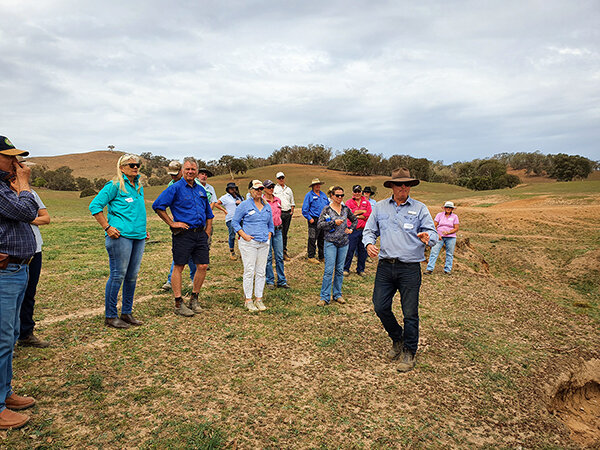
Peter Hazell presented on the ‘Planning Your Farm Landscape’ course run by David Hardwick (Soil Land Food) for Muttama Landcare (NSW).
Detailed onsite planning for physical works was undertaken with Duncan McMaster and Cam Wilson at The Scots College’s ‘Bannockburn’ property near Nowra, NSW which has responded well to recent rain.
Cam Wilson was back at Wombramurra to supervise construction of landscape rehydration measures designed to accommodate the high flows that occur in steep country around Nundle, NSW.
Peter Hazell and Nolani McColl undertook a local site visit to a Northangera, NSW property that was badly impacted by recent fires with burnt bushland, loss of fences and emergency containment lines.
And a farm plan at Bellmount Forest, NSW, which includes detailed design for a gully that was unsuccessfully filled in the past, has provided an interesting challenge for the team.
The MCCC team also enjoyed a day with their Mulloon Institute colleagues undertaking strategic planning and identifying lessons learned from the past year, opportunities for the future and the importance of catchment-scale landscape rehydration projects in guiding future priorities. The day finished with a review of recent works along Mulloon Creek.
We began our training at Martin Royd’s property Jillamatong in Braidwood which demonstrated natural sequence farming in action. Martin was very generous with his time, showing us that by installing leaky weirs he’s rehydrated the landscape, improved production and reinstated a permanent flow of water through the system.
We then spent the next four days on the Home Farm at Mulloon Creek Natural Farms where we learnt to read the landscape. I now know about alluvial fans, floodplains and swampy meadows, runnel’s, contour banks and how our Australian landscape was filled with millions of chains of ponds.
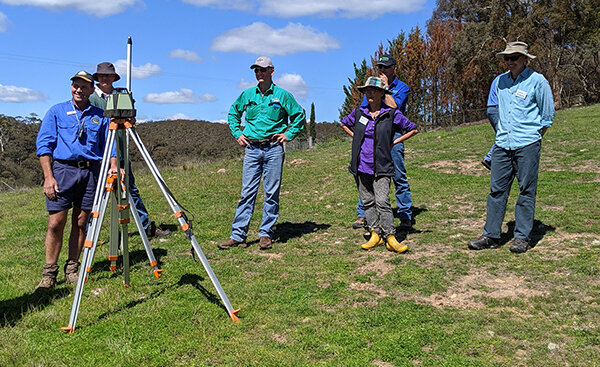
Learning how to use a dumpy level with Stuart Andrews (TPT) .
We learnt the importance of slowing water down by installing contour banks and ponds on the high ground to rehydrate the landscape and redistribute fertility from the accumulation zone, through the productive zone and into the filtration zone.
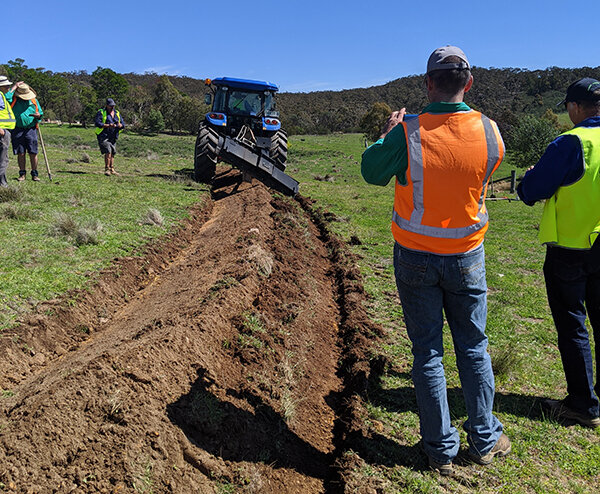
Using a grader blade to install a double contour.
We redefined weeds. They are now repair plants or nursery plants or indicator plants. We discussed their role in landscape repair and acknowledged that Mother Earth probably knows more than we do!
We discussed the role of animals in the landscape – that they should be cared for and managed to help improve the lands fertility. For example, by allowing your animals to be managed into smaller spaces with access to more productive areas as well as higher ground to ruminate and rest so that their fertility is distributed via gravity back down into the productive zone.
Finally we explored the filtration zone where riparian and aquatic plants are used as tools to pick up the nutrients and recycle them, ensuring that the water flowing away is clean. A closed loop is ideal, and if you can collect vegetation from this zone back to the top of the hill, then your animals don’t need to access this special area and you are not exporting your fertility.
Slow the flow… Let all plants grow… Be careful where the animals (stock) go… Remember to filter the flow, is a must know…
> “The stand-out message for me was the importance of slowing down the flow of water, especially after large rain-fall events and that this can be achieved through the installation of structures and the strategic placement of plants.”
— Nolani McColl, TMI Science Officer
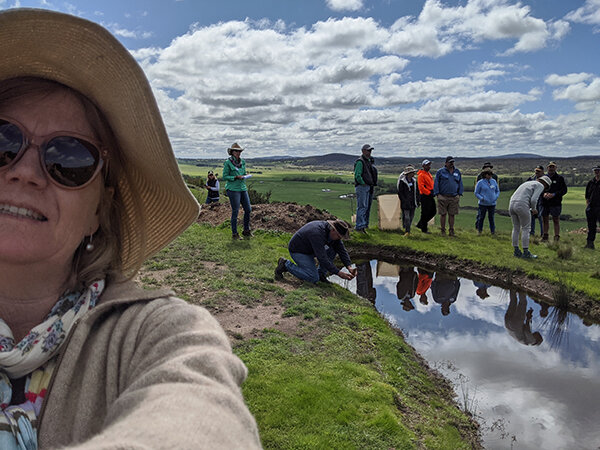
Nolani at the hill ponds installed on contour at Duralla, MCNF
Mulloon’s Covid 19 response
Date published: 23 March 2020
Peter’s Pond, March 2020
As the coronavirus (COVID 19) situation continues to evolve we will monitor the situation and follow the advice from the World Health Organization and the NSW and Australian Governments and continue to take steps to manage the risks posed by COVID-19 while maintaining business continuity.
Our group workshops and field days have currently been postponed until further notice, but we will continue with our plans for our major field day on Saturday 7th November 2020.
The Mulloon Institute and MCCC team has always worked ‘remotely’ and we will continue to do so ensuring that the important work of our Board, the Mulloon Law Committee and our dedicated staff can continue at this time.
We thank you for your support and understanding at this time and encourage everyone to take care.
Regards, Carolyn Hall, The Mulloon Institute – CEO