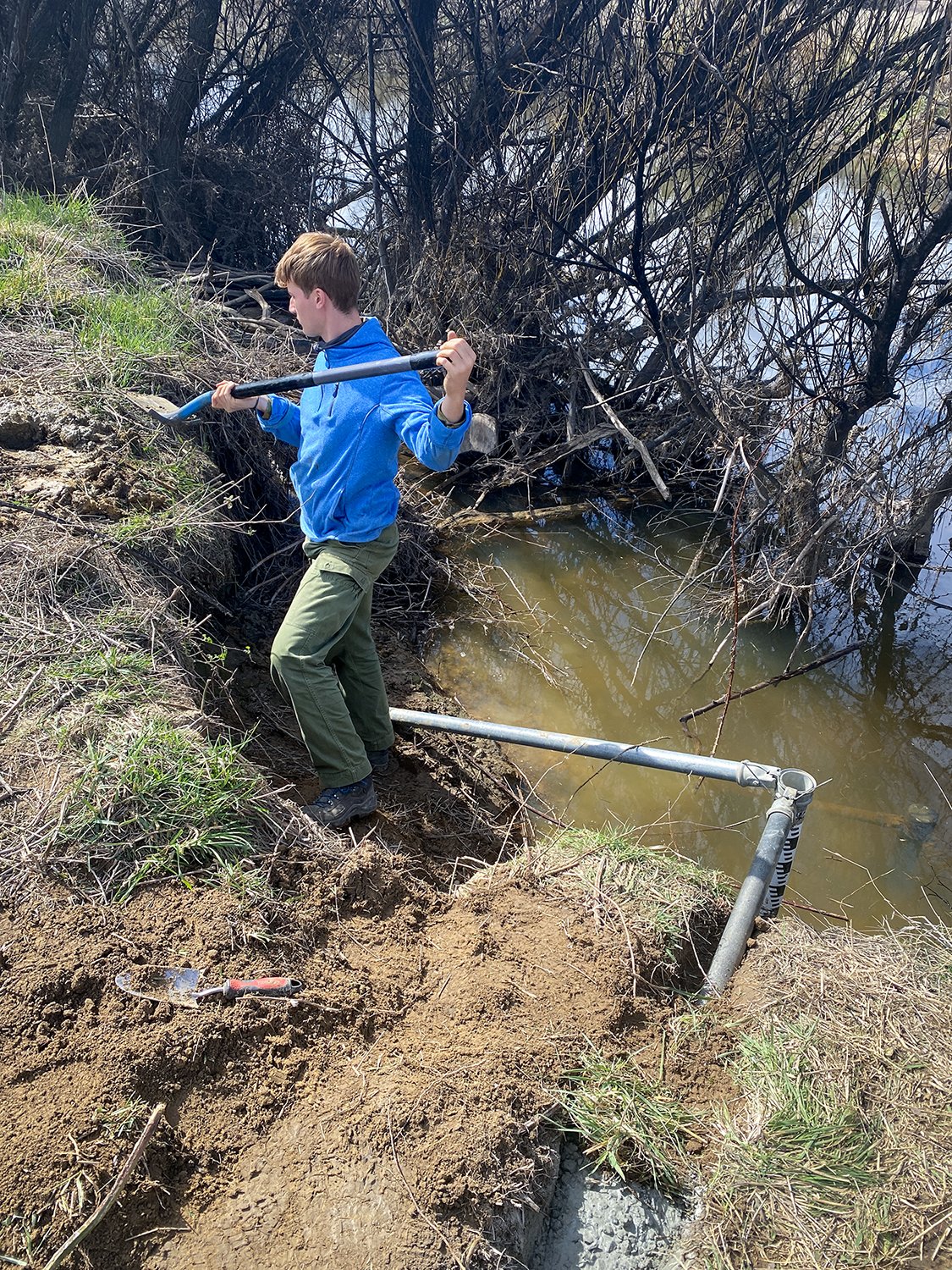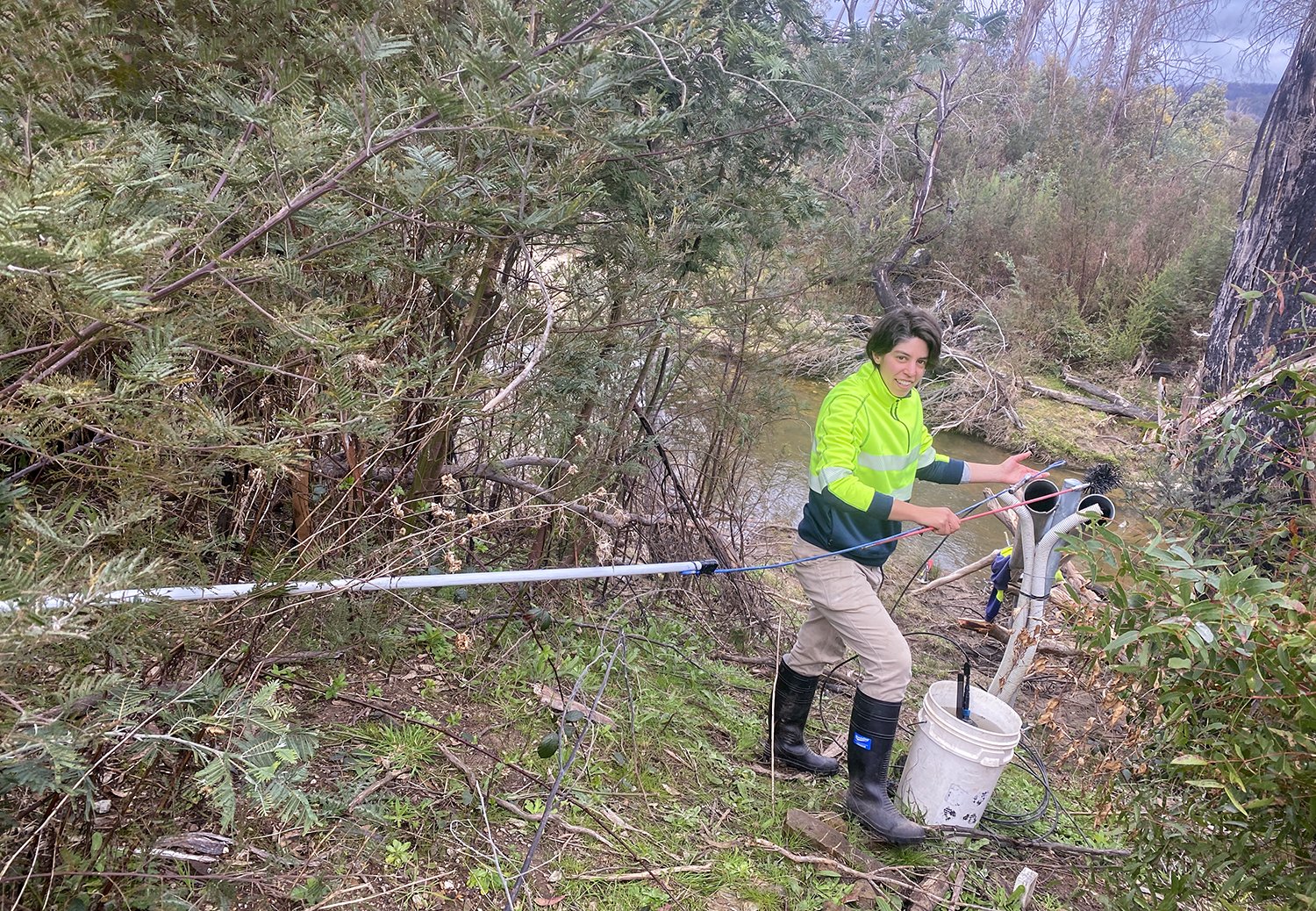
Susie Miechels using the stilling well cleanser extraction tool.

The scientific monitoring team have had another busy period with many monitoring activities in the field, data management, analysis, and reporting for the Mulloon Rehydration Initiative. Tony Bernardi and Susie Miechels have been kept busy with scheduled instrument maintenance and data downloads. While also conducting quality assurance of hydrological data for uploading to DataStream with project partner HydroTerra. And, Dr Paul Cooper (Australian National University) conducted field collections for aquatic macro-invertebrates across the MRI project area to commence the next tranche of sampling over the next 12 months.

Netherlands student, Jochem Meinen joined the science team for 13 weeks as part of his Bachelor in Engineering from the University of Twente. Jochem spent time in the field with Tony and Susie and conducted analysis of groundwater levels and compared with rainfall events and stream water levels.

Thirty-eight groundwater sites, distributed across three transects instrumented with piezometers, were analysed to assess changes in groundwater levels relative to rainfall and stream gauge levels, and assess if and how the rehydration works have had any effect. Many of the groundwater sites have multiple instruments measuring two or three aquifers at different depths indicating that groundwater systems can be complex. Analysis also assessed for connectivity of groundwater aquifers across the floodplains (lateral movement) and connectivity down the floodplain (longitudinal). The analysis produced some interesting insights and further analysis, and investigation is continuing, read the report here:
The Effect of Leaky Weirs on Groundwater Tables in the Mulloon Catchment.
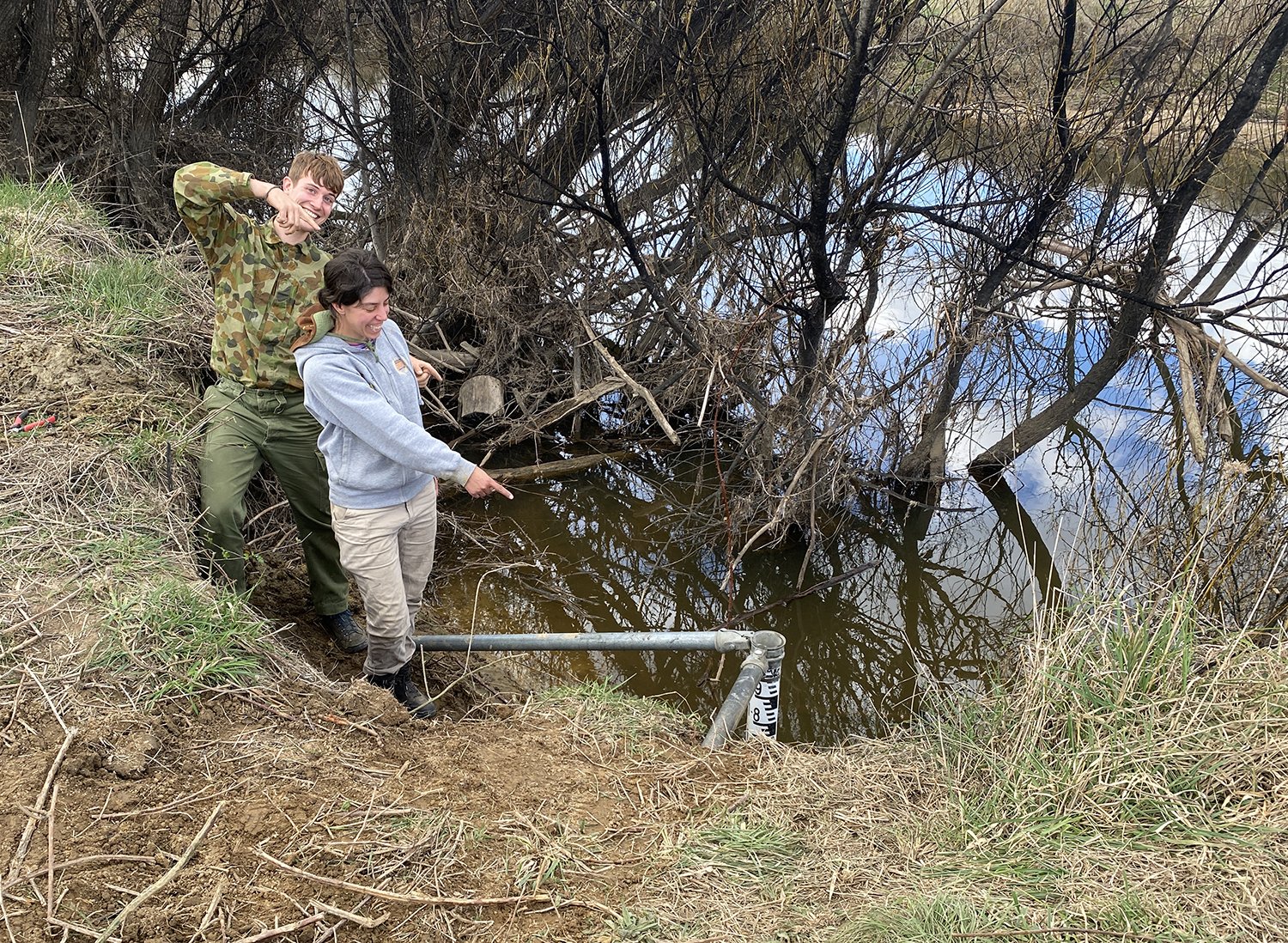
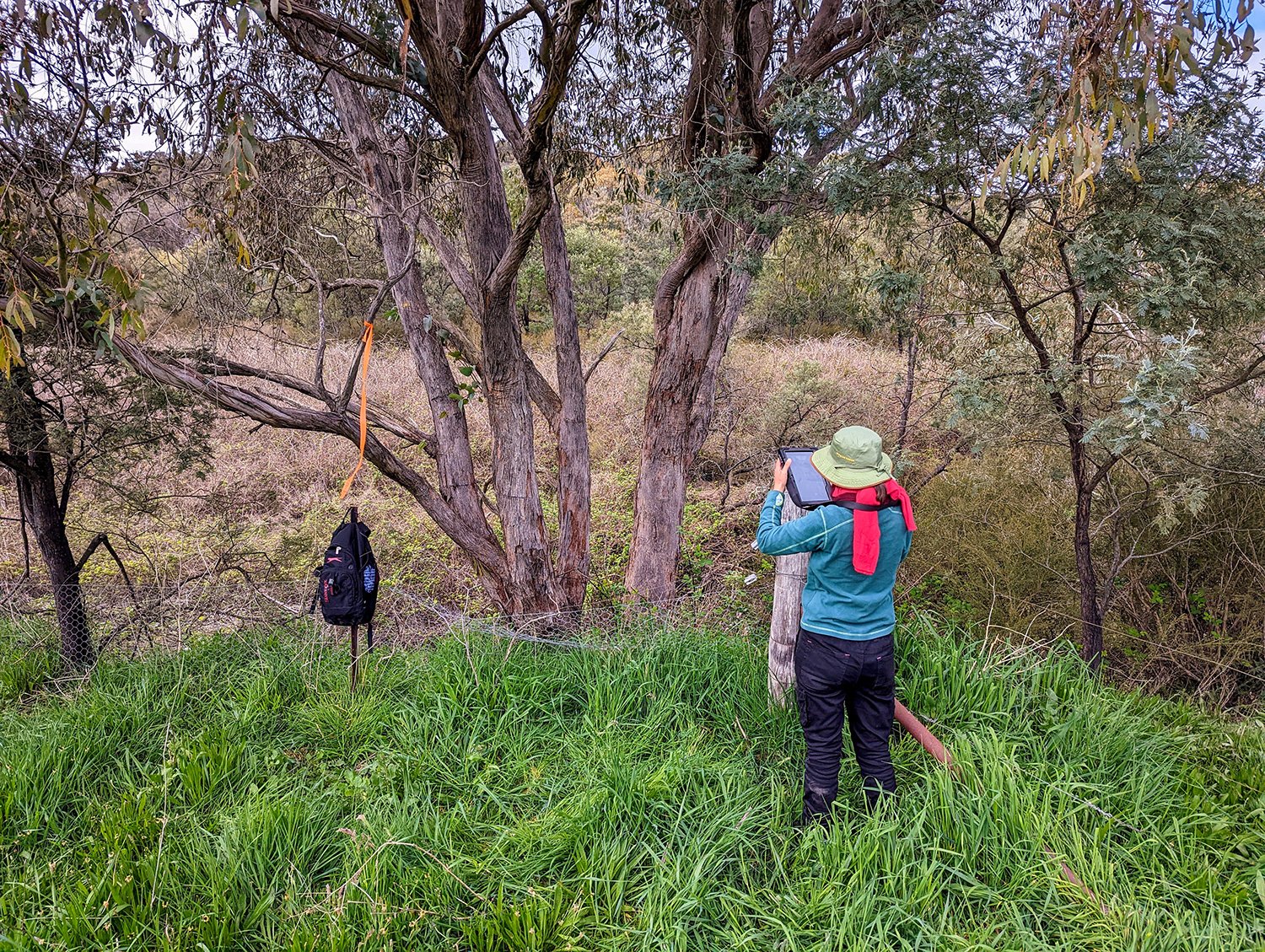
Susie Miechels and Luke Peel conducted another round of Rapid Appraisal of Riparian Condition (RARC) field surveys in October at nearly fifty transects across the Mulloon catchment. The data is collected using a tablet with FastFields for efficient field operations. When next connected to the internet the data is automatically sent to partner HydroTerra for upload into DataStream. The transects consist of four sites and the observations are averaged for the transect. The first and fourth sites of these transects are also frog monitoring sites which were prepped in readiness for the upcoming annual Frog Survey in early November 2022.  

Back in the office, the data from the 2021 RARC survey were analysed alongside previous surveys (2017 and 2019) with many promising trends indicating good increases in habitat, cover and native plants at many of the transects. A good result for many transects considering the surveys traverse the extreme drought period and major flood events. The report can be viewed here: 2017-2021 Mulloon Creek RARC Report.
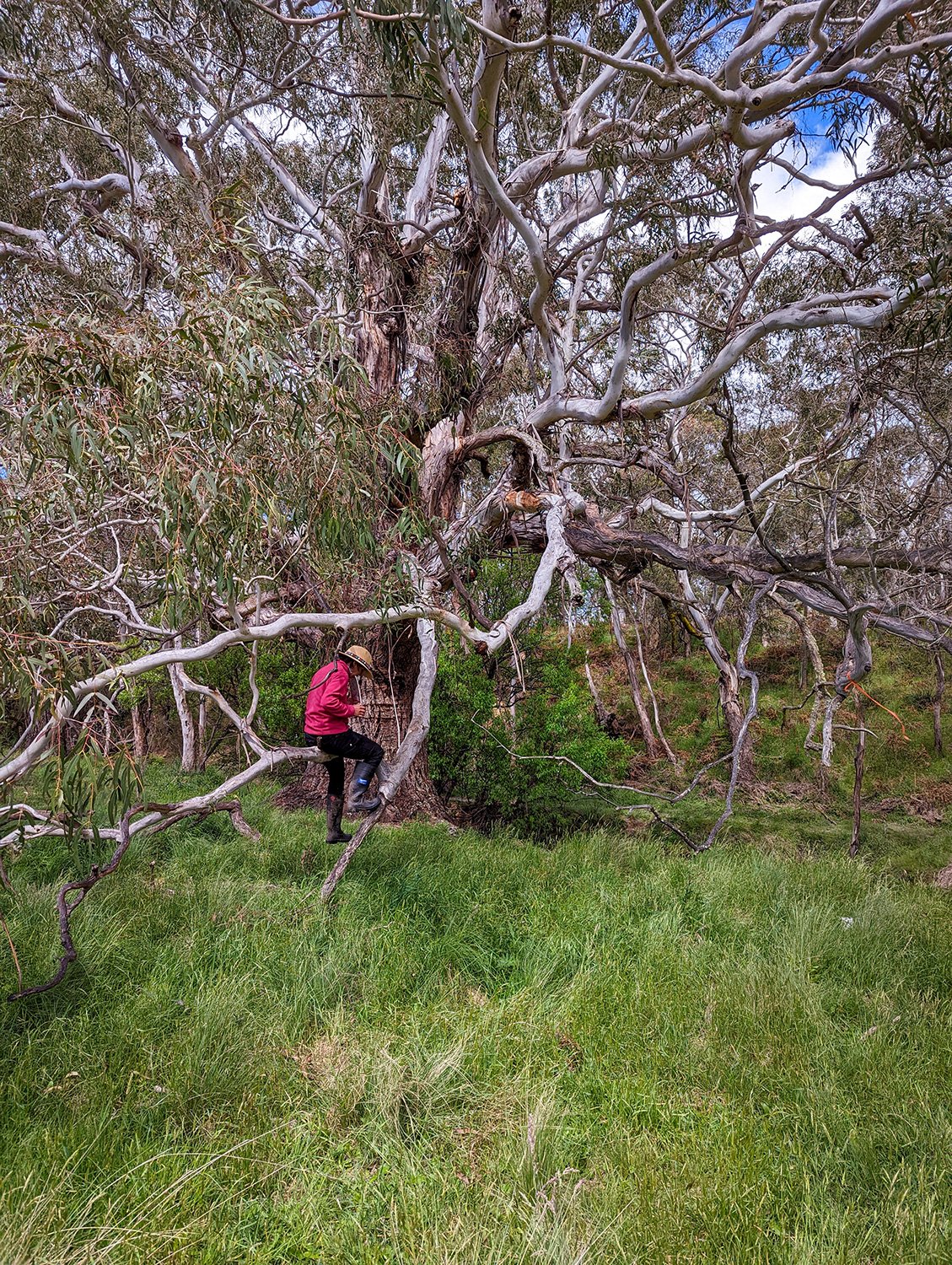
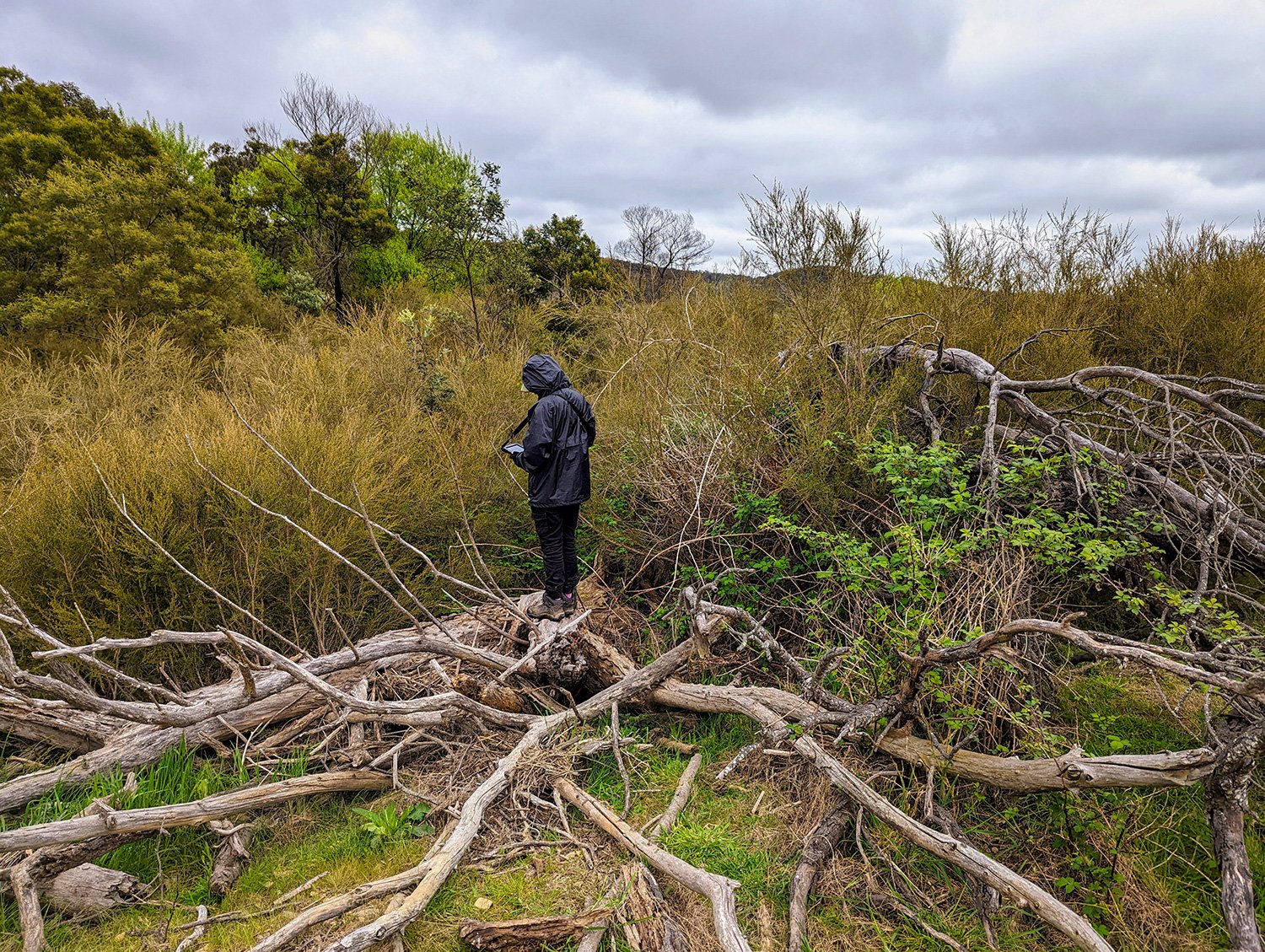
Ben Broadhurst and Rhian Clear from University of Canberra freshwater ecology group have completed the analysis of latest the fish survey conducted in May 2022. This is the second fish survey for the Mulloon catchment with promising results indicating an increase in native fish and a significant reduction of the invasive non-native mosquito fish (Gambusia holbrooki). We look forward to the third fish survey to be conducted in autumn 2023. The report can be found here: 2022 Mulloon Creek Survey.

* The Mulloon Rehydration Initiative is jointly funded through the Mulloon Institute and the Australian Government’s National Landcare Program, with assistance from the NSW Government’s Environmental Trust.


* Graduate and post-graduate study opportunities cover a broad range of scientific projects in flora, fauna, hydrological, soils and production systems. Enquiries should be directed to Research Coordinator Luke Peel via luke@themullooninstitute.org

  • Productivity – farm and natural capital, including soil health​

  • Hydrological – surface & sub-surface water balance & quality​

  • Ecological Function – diversity & abundance​

  • Social Capital – people, adapting to change and adopting new methods​

The Guardian, 16 December 2022

Three experts on why soil hydration matters in combating the long-term impact of droughts and floods.

Australia faces worsening extreme weather events, says the 2022 State of the Climate report, published by the Bureau of Meteorology and CSIRO. Using soil rehydration and regeneration to build resilience in our landscapes could be vital, experts say.

“Extreme climatic events, including both flooding and extended drought, are becoming the new norm,” says Dr Chris Pratt, a soil geoscientist at Griffith University. “Consequently, managing soil landscapes in preparation for these conditions is of crucial importance.

“While the current pattern of higher-than-average rainfall over much of Australia might seem to ease concerns regarding soil rehydration, it actually highlights a broader looming challenge.”

Why hydration is important

Rehydration has the potential to regenerate soil health, Pratt says.

“When we have extreme weather events, like floods, the soil structure is very susceptible,” he says. “In the [February 2022] Lockyer Valley flood [in south-east Queensland], about 30% of topsoil was lost into the bay because of poor soil structure.

“Water insulates landscapes against use, and soil is a good medium for holding onto water. If we degrade soils and deforest our landscapes, the country is physically incapable of behaving normally, soil loses its physical structure, and is more prone to erosion.”

Professor Justin Borevitz, who studies landscape regeneration at the Australian National University’s Research School of Biology, agrees.

“In the height of drought, or when preparing for drought, post-floods, we need to ask: how are we going to keep water in the landscape, slow the flow and make it available for plant roots?” he says.

Through good land management practices, landholders and managers across a catchment can make changes that stop landscapes degrading and improve soil health, Borevitz says.

“In a landscape where you get droughts and floods, land clearing and overgrazing, the country can’t recover quickly from weather extremes. Australia’s soils are very sensitive to weather effects.”

Image credit: Grow Love Project

How natural hydration works

When rain falls onto a soil surface, whether it soaks in or runs off is largely due to topography – the forms and features of the land. Biodiverse vegetation can slow the water flow and enable surface water to soak into the ground, into the deep layers of the soil, and often into aquifers to become part of the water table.

“Hydrologically, the water tables that are 50 metres below the surface take more than a year to fill,” Borevitz says. “Slowing and holding water enables it to flow down into the recharge zone, rehydrating the landscape for groundwater recharge, and becoming a water bank for future years.”

That water bank is available for plants and essential microorganisms in the root zone. Through transpiration, plants such as grasses, shrubs and trees then release moisture into the atmosphere from their stems and leaves, enabling the plants to dissipate heat in direct sunlight, and cool through evaporation.

Landscape rehydration methods seeing results

When earthworks are used to build depressions in the landscape to slow the flow of surface water during and after rain, this enables water to pool and rehydrate the landscape.

The Mulloon Institute’s principal landscape planner, Peter Hazell, says these changes also create cooler landscapes.

“One of the key reasons our landscapes have become so degraded is the loss of soil organic matter, the sponge layer,” he says. “Soil that contains organic matter in the top 30cm can hold four times its weight in water.

Photograph: Mulloon Institute

“We’ve identified that landscapes that are hydrated, and with no gully erosion, or where gully erosion has been reversed, are the greenest and coolest country in the hot months.”

Collaborative partnerships between the business sector and philanthropic and research institutes can create solutions to the challenge of hydrating the landscape and building resilience to the future impacts of both droughts and floods.

The Mulloon Institute’s projects focus on initiatives that rehydrate by slowing the flow of surface water, allowing water to be collected by the landscape and improve soil health. With funding, these projects are beginning to make a difference.

Vitasoy Australia chose to get behind the institute and has pledged $1.25m. It has a vested interest, since it aims to source its raw materials from Australian farmers, rather than import them. David Tyack, the managing director of Vitasoy Australia Products, says: “We believe in supporting Aussie farmers and actively pursue an Australian-first sourcing policy, meaning that if we can source our raw ingredients from Australian farmers, we always do.”

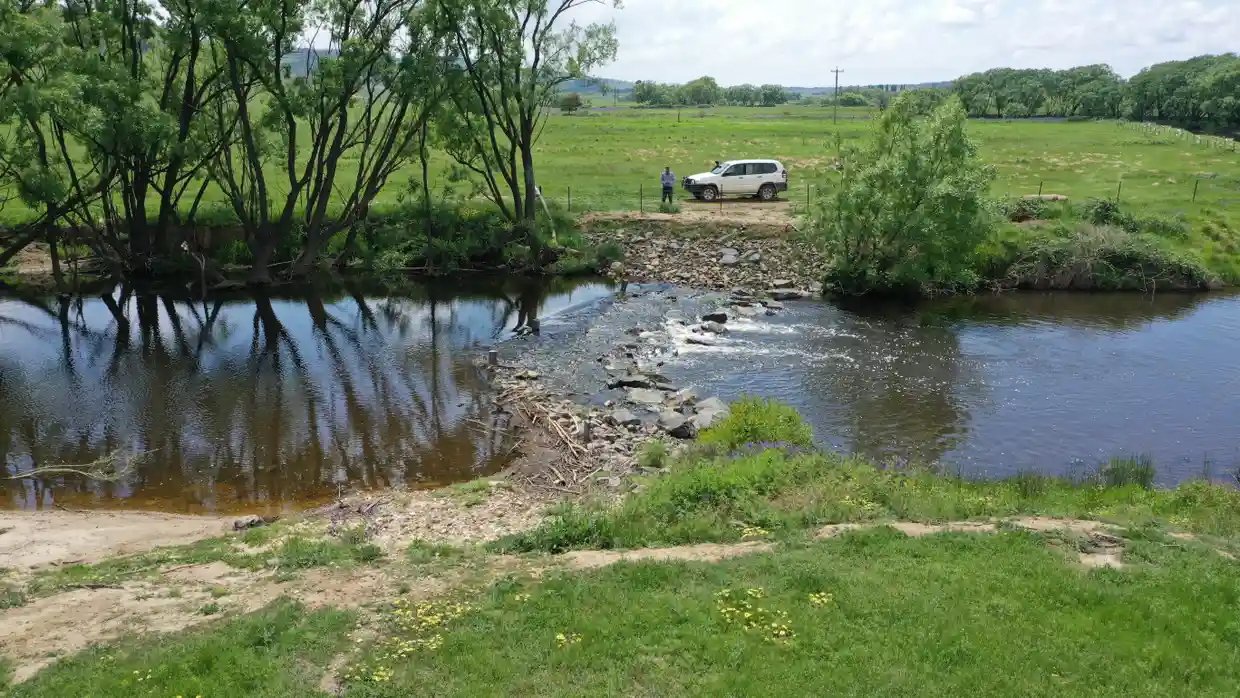
Initially, the institute’s rehydration project* was focused solely on the Mulloon Creek catchment, where landscape planners designed and installed leaky weirs, to slow the flow of surface water and return the creek to its natural state – a series of linked billabongs. Natural and planted revegetation has created a more healthy and biodiverse landscape.

More recently Hazell has been using satellite imagery to create 3D models to identify how water moves through the landscape and creates patterns of erosion in other New South Wales and Queensland catchments. Collaborating landowners are learning how to re-establish natural flow patterns on flood plains by using rocks and vegetation to create choke points and slow water, reducing soil erosion, Hazell says.

SOURCE: https://www.theguardian.com/vitasoy-growing-a-better-world/2022/dec/16/extreme-climatic-events-are-becoming-the-norm-how-we-manage-soil-landscapes-is-crucial-to-resilience

* The Mulloon Rehydration Initiative is jointly funded through the Mulloon Institute and the Australian Government’s National Landcare Program, with assistance from the NSW Government’s Environmental Trust.

Summer has begun and brought some drier weather which has been welcomed by all creatures great and small on the farms. The team have jumped at the opportunity and have been busy working on several key improvement projects at Duralla with the sound of excavators working and concrete being poured bringing sweet relief to the ears of our General Manager, Jim Steele.

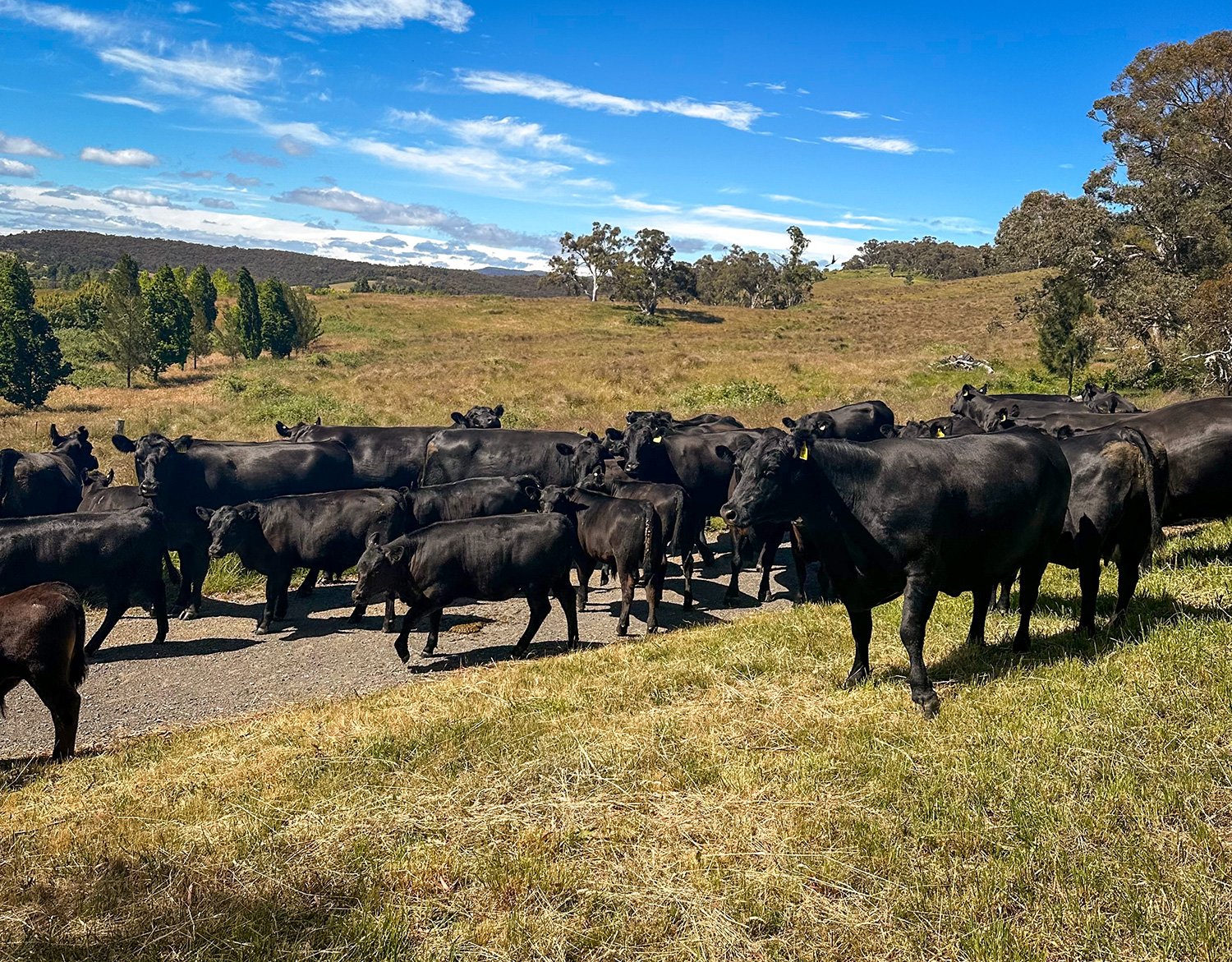
Our cattle continue to go from strength to strength with the favourable conditions and are looking exceptional coming off the peak of our growing season. After a tough winter, our pastured hens have finally had a chance to dry out and are performing well with the longer days and better conditions in the paddock.

All good things must come to an end… Sadly, our contingent of French and Argentinian backpackers are nearing the end of their time at MCNF. We thank Mathilde, Flavie, Marion, Justine, Valentina and Michele for their hard work over the last few months. Paris / Buenos Aires and Bungendore are chalk and cheese so thank you for stepping out of your comfort zones.

A highlight over the last few months has been welcoming back many visitors to the farms to observe the landscape rehydration measures within the Mulloon Rehydration Initiative along the Mulloon Creek and to plant trees at Duralla. Well done to the Mulloon Institute team for spreading the good news and we look forward to hosting many more groups in 2023.

To stay up to date with what’s happening on the farms, follow our MCNF Instagram @mullooncreeknaturalfarms.

* The Mulloon Rehydration Initiative is jointly funded through the Mulloon Institute and the Australian Government’s National Landcare Program, with assistance from the NSW Government’s Environmental Trust.

L-R – Kathy Kelly (TMI Chief Operating Officer), Wilf Finn (Mulloon Law Committee) and Carolyn Hall (TMI CEO, Managing Director) at the NSW Farm Writers’ Association lunch.

In late October, the Mulloon Institute’s CEO and Managing Director Carolyn Hall was invited to attend breakfast with NSW Minister for Environment James Griffin to learn about the NSW Government’s Natural Capital Statement of Intent. The morning provided an opportunity to learn about the efforts underway to accelerate natural capital investing in NSW.

The statement sets out the vision and pathway to enable the NSW Government to leverage first-mover advantage to attract international capital investment; and give landholders an increased opportunity to voluntarily participate in carbon, biodiversity and emerging natural capital markets.

Carolyn had the opportunity to speak to Minister Griffin the following day at the NSW Farm Writers’ Association lunch, where they discussed the opportunities to assist NSW farmers to build natural capital on-farm through landscape scale repair and rehydration, and the need for capacity building for farmers to support them through the changes required in building natural capital, and participating in the associated voluntary markets.

TMI’s CEO Managing Director Carolyn Hall introduces the Australian Conservation Foundation to the ground-breaking Mulloon Rehydration Initiative.

The Mulloon Institute was delighted to host Shar Molloy (ACF Acting President), Kelly O’Shanassy (ACF CEO) and the Board of the Australian Conservation Foundation (including Miles GeorgeSarah ReidLeon CermakDavid A Hood AM HonFIEAust CPEng and Melanie Birtchnell PhD) on a tour of the Mulloon Creek home farm and catchment.
 
Our CEO Carolyn Hall showed off the institute’s landscape and creek interventions which form part of the Mulloon Rehydration Initiative, and explained our partnership with the 23 local landowners to rehydrate and rehabilitate the catchment. The results are sensational. We can repair and rehydrate this country with diligent, thoughtful interventions.
 
The group couldn’t stop talking – we discussed drought and flood resilience, improved water quality, increased biodiversity, the return of native plants and animals, rising water tables, improved soil and farm productivity, and building social capital amongst landowners and traditional owners. All good, gritty stuff.
 
The technology and knowledge is here to repair our land, landowners are keen and funds are available. We now desperately need state and federal governments (no pressure Anthony Roberts and Tanya P. Plibersek!) to radically streamline the costly and energy sapping regulatory impediments to this work. Governments need to facilitate, not hinder, landowners to quickly and efficiently repair and rehydrate their land.

Viewing landscape rehydration infrastructure installed along Mulloon Creek as part of the MRI.

Thanks to the recent amendment to the NSW Infrastructure SEPP (State Environmental Planning Policy), the need for a Development Application to Council has been removed. Landholders will still need State Government approvals for most installations, however, taking the approval process from under-resourced local councils to better resourced NSW state bodies, is a significant improvement on the current approval process.” 

There is much to do but lots of hope. Thanks ACF for the visit!

* The Mulloon Rehydration Initiative is jointly funded through the Mulloon Institute and the Australian Government’s National Landcare Program, with assistance from the NSW Government’s Environmental Trust.

Mulloon Institute CEO and Managing Director Carolyn Hall and COO/Company Secretary Kathy Kelly were delighted to attend the Commonwealth Bank  Momentum Gala dinner following the conference: Advancing Australia’s Transition at the Sydney International Convention Centre on October 31st.

CBA’s Carmel Onions National Director Agribusiness with TMI’s CEO Managing Director Carolyn Hall.

They joined CBA’s Carmel Onions National Director Agribusiness at Commonwealth Bank on the Agri table for the evening along with Macdoch Foundation’s Alisdair Macleod and RCS’s Terry McCosker.  A wonderful dinner was provided by an organisation driving social change through food and beverage experiences – Plate it Forward and chef Nelly Robinson.

The event bought together some of Australia’s best leaders in sustainability to share ideas and solutions to support a net zero economy. It was also a pleasure to hear from physicist and science communicator Professor Brian Cox and catch up with RCS Australia Founding Director Terry McCosker .

L-R: Juliet Forward, Carolyn Hall, Tony Mahar, Jono Forrest, Warwick Wragg.

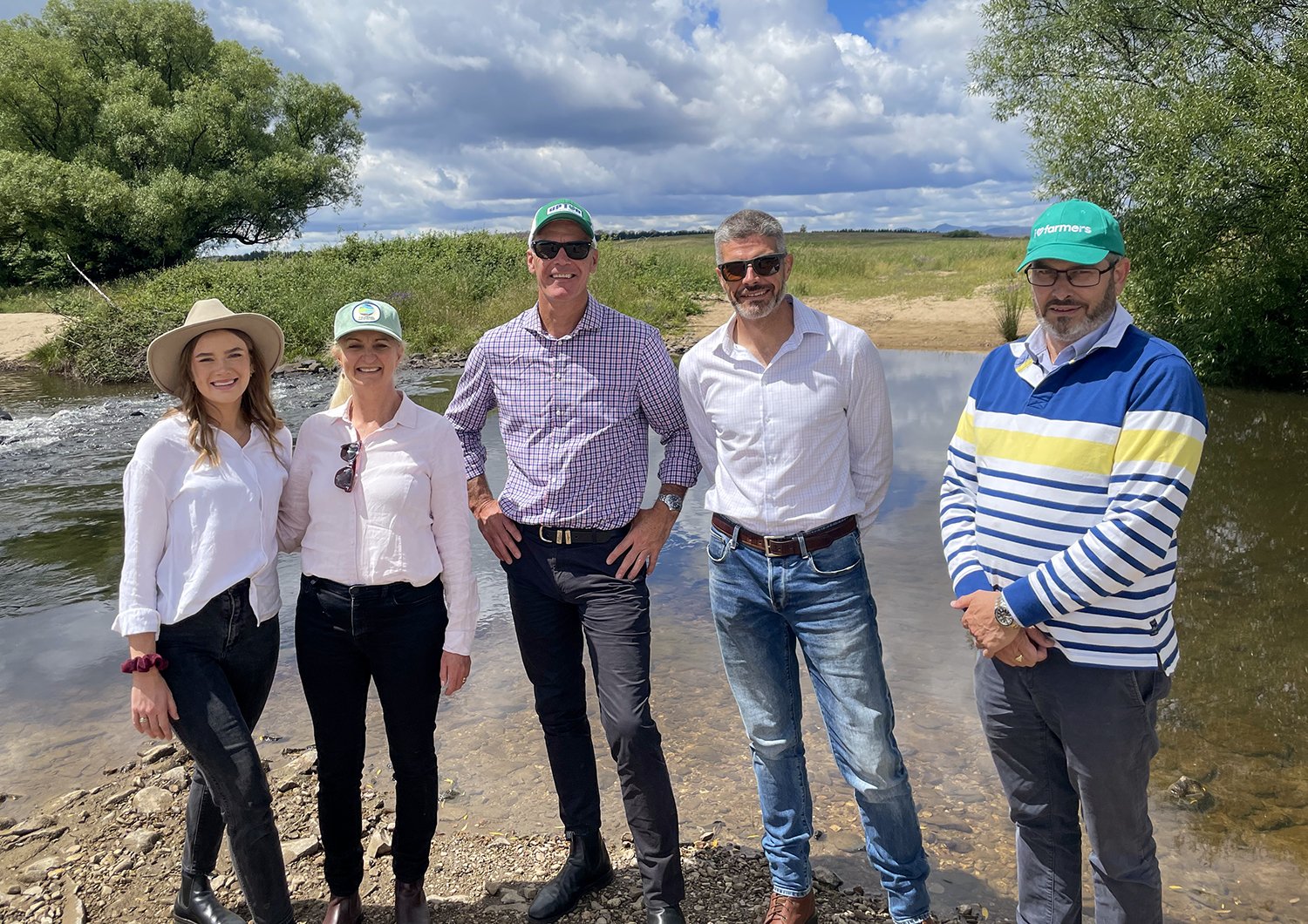
A fine sunny December morning brought old friends and new together at Mulloon when the team from the National Farmers Federation (NFF) came to visit.  Tony Mahar CEO, Warwick Wragg General Manager Natural Resource Management and Juliette Forward Policy and Project Officer joined the Mulloon Institute’s CEO and Managing Director Carolyn Hall, Chief Operating Officer Kathy Kelly and General Manager of Mulloon Consulting Jono Forrest for a tour of the Mulloon Rehydration Initiative

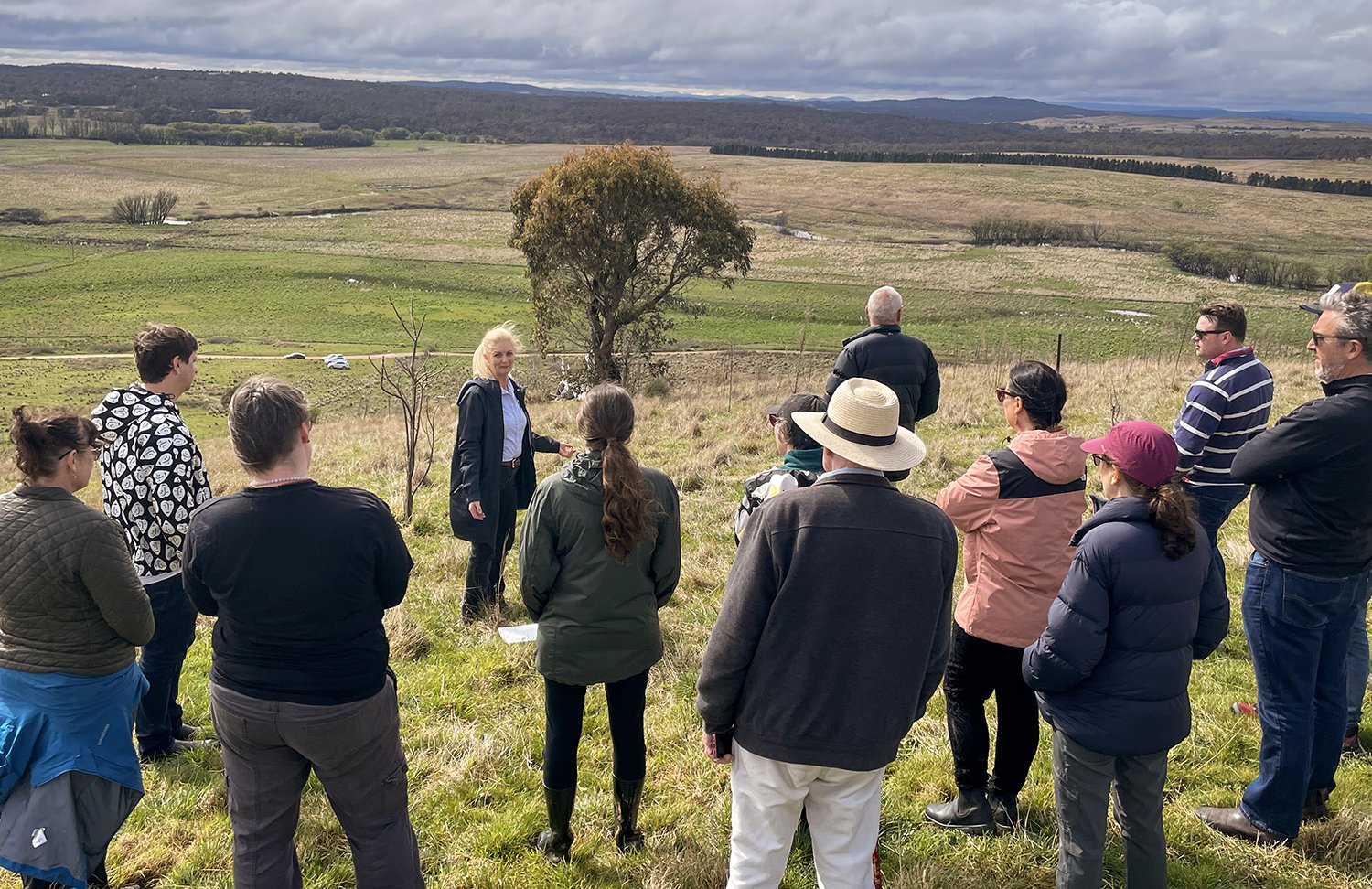
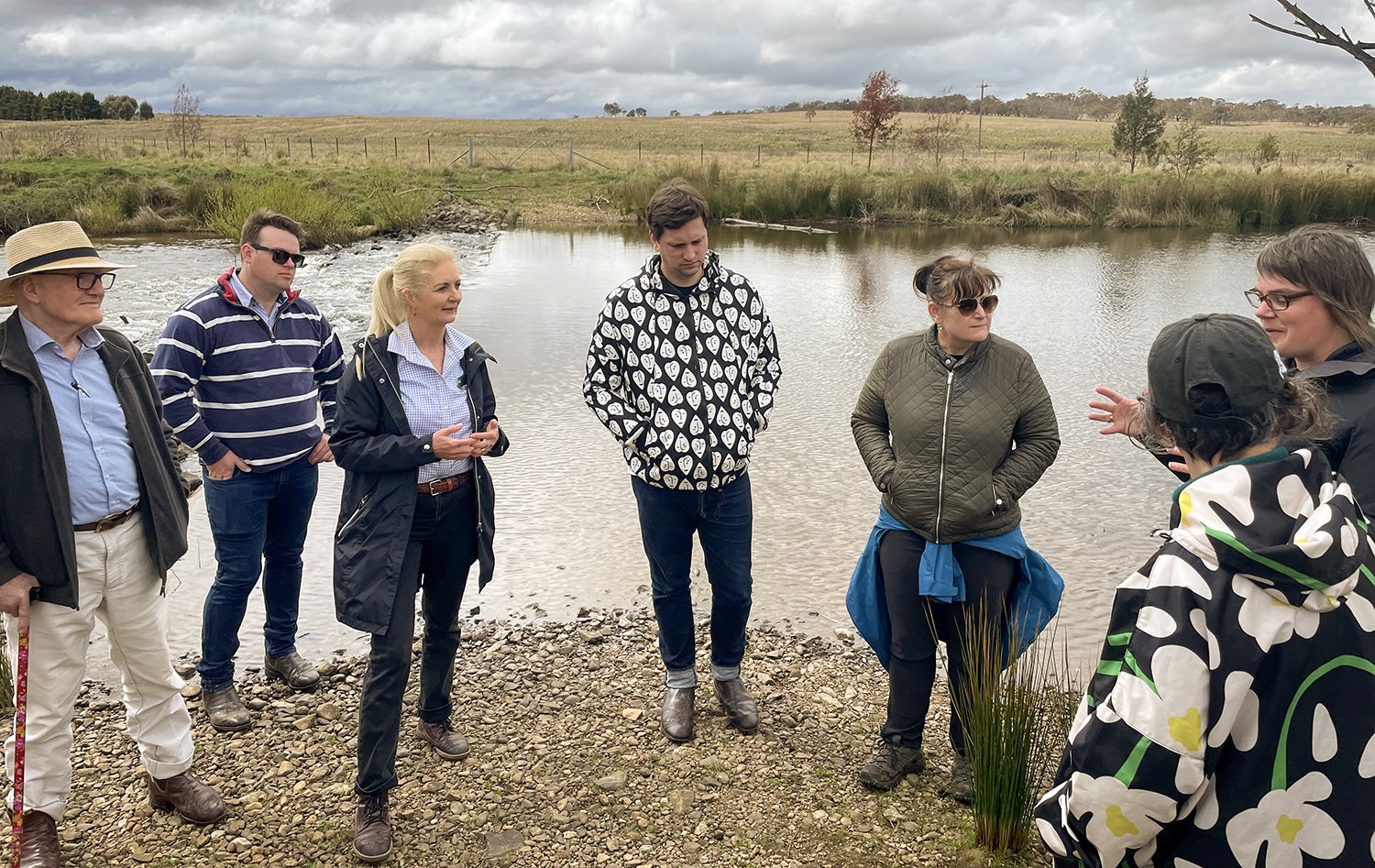
The group travelled to Duralla at Mulloon Creek Natural Farms where a “walk to the top of the hill” allowed us to take in a vista of the lower Mulloon Creek floodplain and to explain the aims and the intricacies of the MRI (and earn our lunch!).  Improved water management, increased productivity and biodiversity along with resilience to drought bushfire and flood all made sense to the NFF team.  We then explored a leaky weir on Mulloon Creek and finished the tour at Peter’s Pond on the Home Farm. 

We were treated to a lovely Christmas themed lunch to complete the day.  The TMI team had the opportunity to discuss the benefits of the MRI, the recent amendment to the NSW Infrastructure SEPP achieved by the Mulloon Law Committee and the need for capacity building and regulatory reform to support Australian farmers in building Natural Capital on farm.  We very much look forward to continuing the conversation with the NFF team and exploring ways we can assist more Australian farmers to repair and restore their landscapes.

* The Mulloon Rehydration Initiative is jointly funded through the Mulloon Institute and the Australian Government’s National Landcare Program, with assistance from the NSW Government’s Environmental Trust.

Photo: Leanne Thompson.

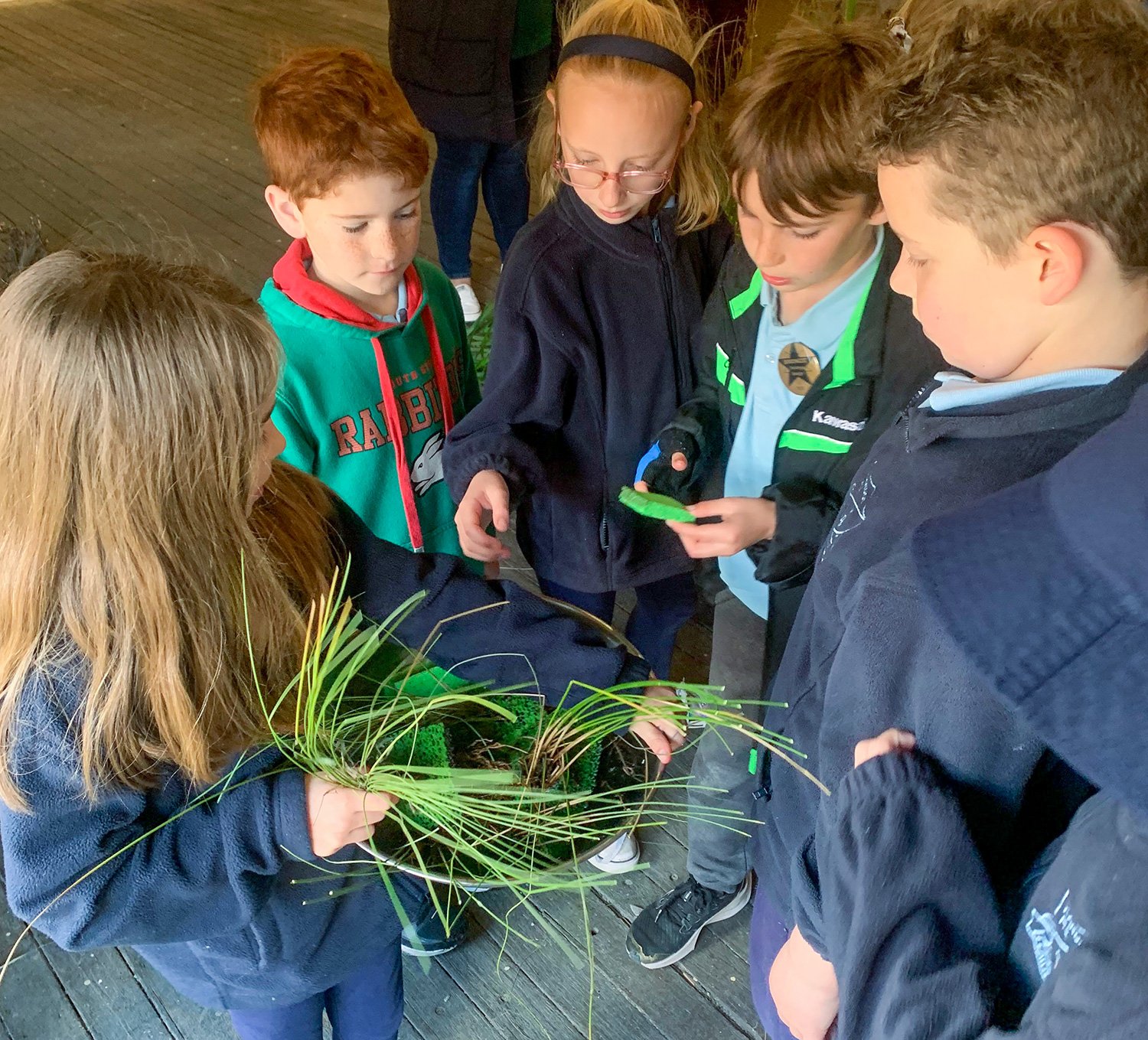
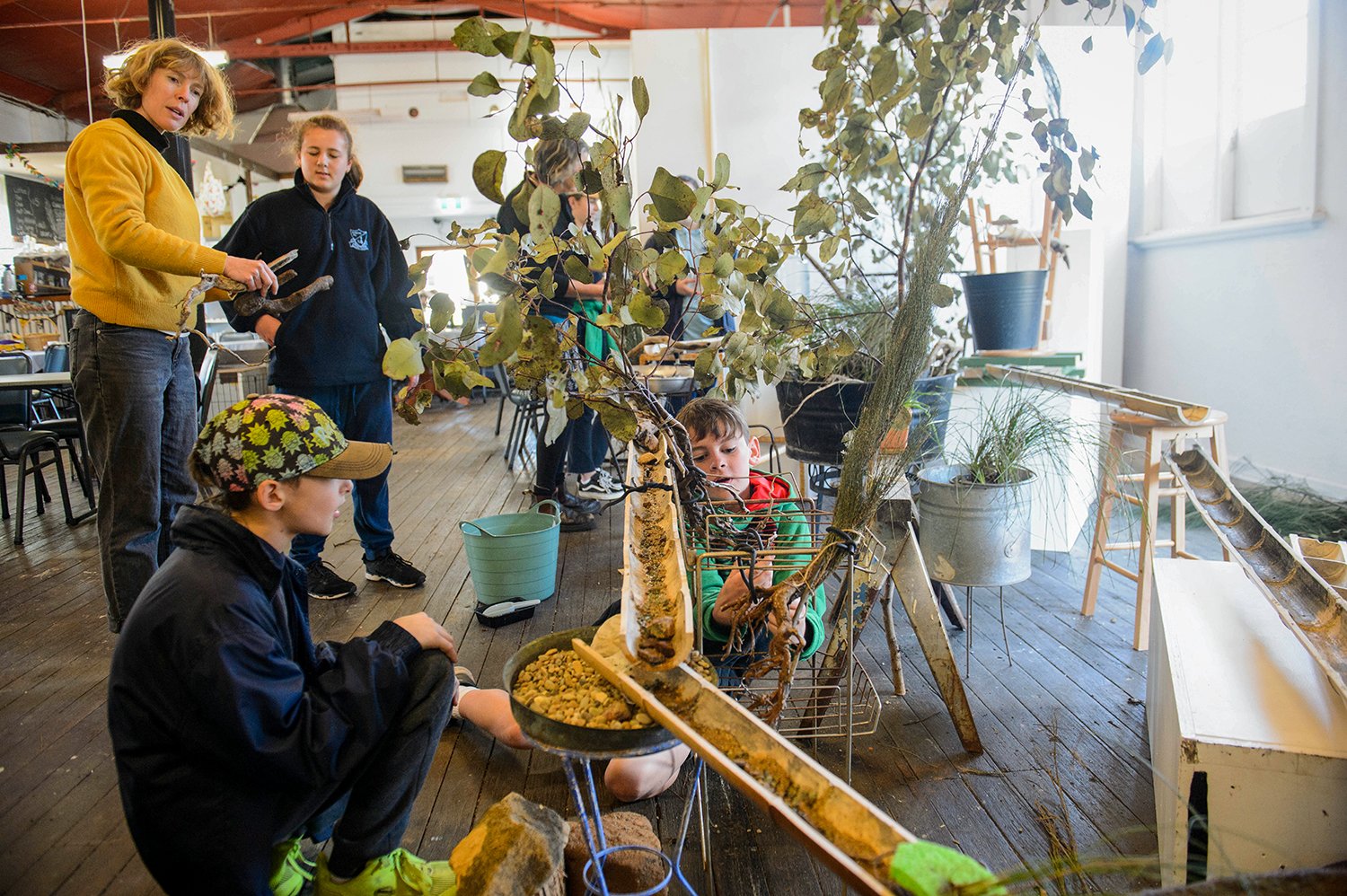
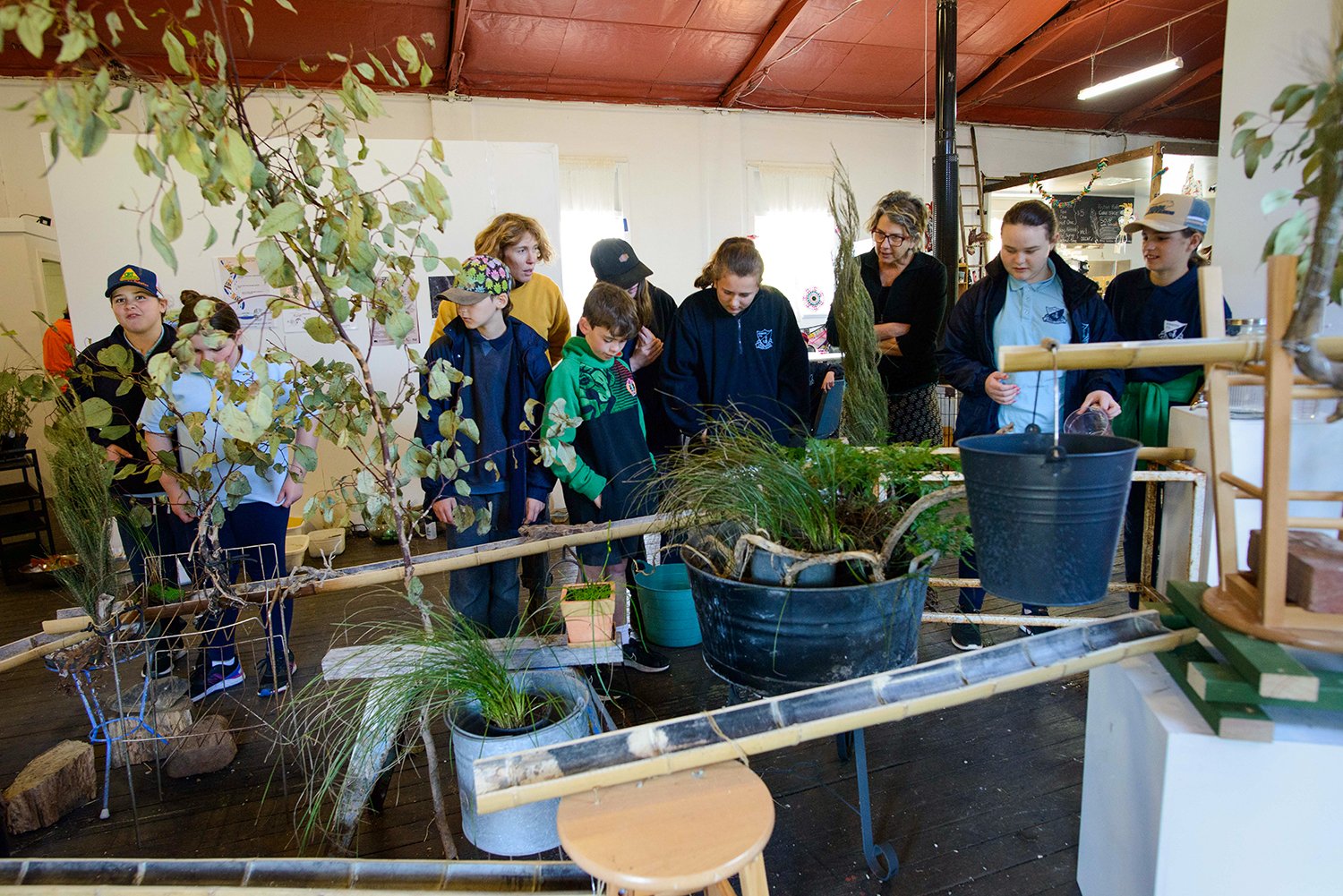
During the Waterland exhibition in August (curated by Mulloon’s Laura Fisher, with artist Kim Williams and curator Vashti Pearce), we hosted every class from Kandos Public School for workshops to build and interpret the waterway model. The students also painted dozens of smooth stones with the macro-invertebrates that are vital to fresh water food-chains. It was a delightful experience watching the model came to life, especially when the water was poured through. The model was designed in collaboration with two residents from the Capertee Valley with a big interest in the health of local rivers: Kerrie Cooke and Gary McGuiguin.

Reflections by Kim Williams.

Lengths of bamboo, split in half longways; old metal buckets, saucepans and tubs; various bits of furniture and junk; lots of water plants and others that like to grow near creeks; large and small pebbles; rocks painted with images of native critters; toy reptiles; knitted waterbirds; driftwood; two glass water dispensers with taps on them and a giant dish that was once a kids’ plaything.

These are the materials we assembled to create a waterway model for the Waterland project at Wayout Gallery. Laura and I had been chatting for months about how best to create an interactive model, one that could demonstrate both an unhealthy and a healthy waterway. We agreed early on that bamboo should be part of this system. We’re both excited by the beauty and versatility of bamboo, and it’s light and strong.

How could we simulate a living creek system – one that could move water slowly from a source to an endpoint, with healthy features such as snags, animals, plants, spongy soil and ponds? At the same time, how could we also show a denuded waterway through which water flows quickly and cannot be absorbed by the riparian landscape?

Photos: Gus Armstrong.

We ‘built’ this model in situ, in collaboration with farmer Kerrie Cook and model-maker Gary McGuigan. While we began with an idea of how it should look, Kerrie quickly intervened, saying “a creek wouldn’t do that”. So we adjusted our plans and organically assembled a quirky but lively interactive artwork. Turning bits of furniture upside down, hanging vessels from lengths of bamboo or balancing them on supports, populating the ‘riparian zone’ with plants – somehow we managed to create a split creek system that flowed successfully into our large ‘pond’ filled with water plants.

Sometimes you find solutions in the making of the thing. Our initial plan to create two waterways, one healthy and one unhealthy, was superseded through the discoveries of ‘making’. The model’s success lay in the act of co-creation: at first, school students could see that water moves quickly through the model in its bare state. Inviting them to add all the healthy bits themselves – pebbles for riffles, plants, snags, spongy bits and critters – they could see how these things slow the flow of water, thereby hydrating the land. Rather than having two different systems side by side, the effect was achieved through adding and subtracting materials.

Somehow, this disparate set of materials works, perhaps more so than a conventional model. The stylized representation of a waterway comes alive with the addition of plants as living elements. The buckets and vessels stand in easily for ponds and still points in a waterway. The painted rocks populate the creek with creatures, and the knitted waterbirds stand in wait for a tasty morsel. This model can be recreated anywhere, but due to the organic process of co-creation, can never be the same twice.

This project was supported by the Australian Government through the ‘Modelling Landscape Rehydration for Catchments, Communities and Curriculum’ Citizen Science project.

Photos: Alex Wisser.

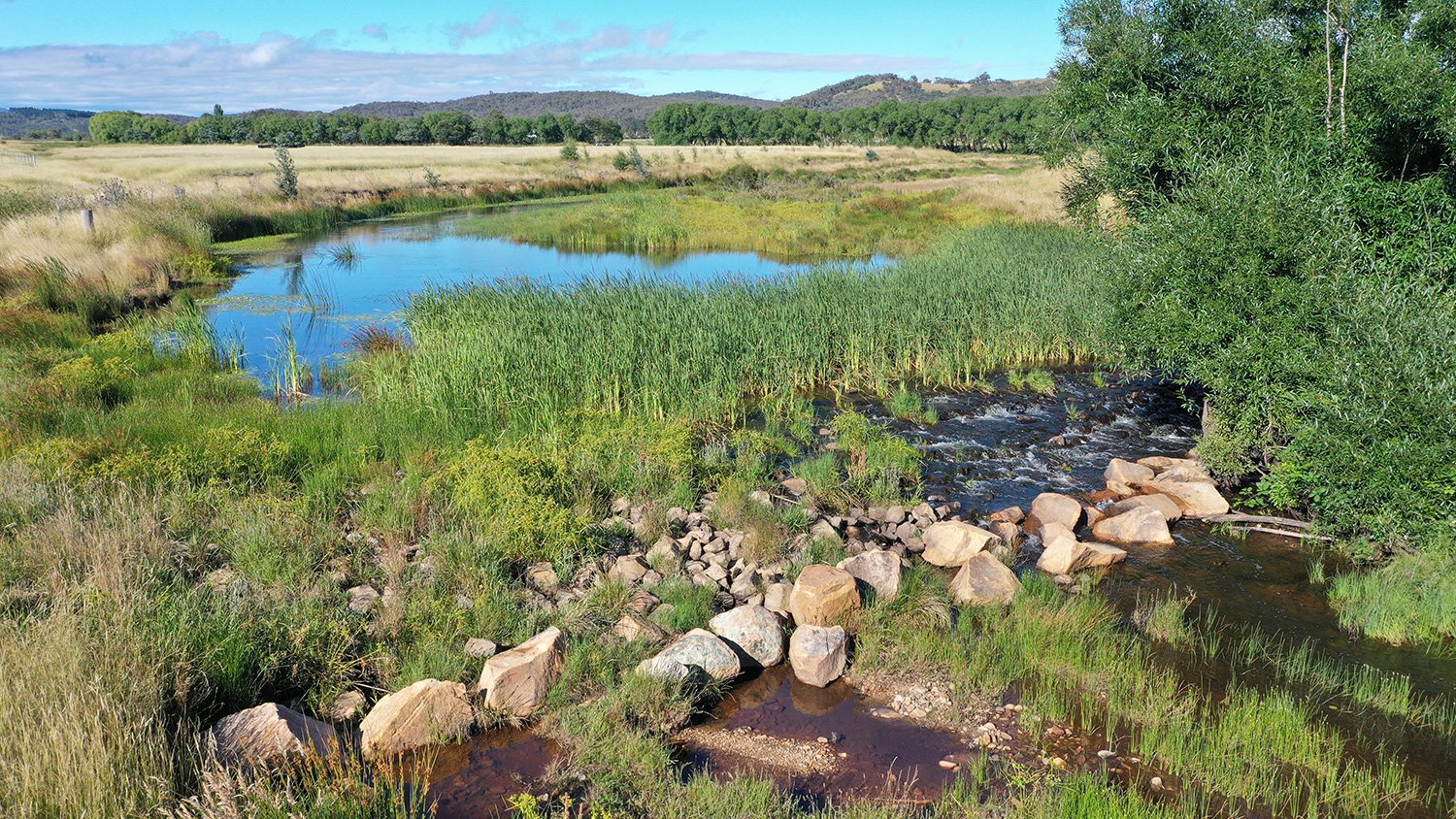
IMAGE – ‘Landscape rehydration infrastructure’ pictured at Westview Farm in 2020, two years after installation. Part of the catchment-scale, Mulloon Rehydration Initiative.

MEDIA RELEASE – 9 December 2022

A landmark regulatory amendment has put the NSW Government in the forefront of environmental governance reform, according to the Mulloon Institute’s (TMI) Chairman, Gary Nairn AO.

Acting on TMI’s direct submission, last week the State Environmental Planning Policy was amended to smooth the path for installation of natural structures to repair degraded streams, known as ‘Landscape Rehydration Infrastructure’. The amendment removes the need for a Development Application from Councils, a time-consuming and costly process currently preventing critical land restoration projects from proceeding across Australia.

This change does not remove oversight from such projects. All state-based environmental and water regulations will still apply. What has changed, is the simplification of the approvals pathway and the reduction of costs and time borne by applicants.

“Our waterways are severely degraded, behaving more like drains than the lifeblood of our landscapes,” Gary Nairn said. “Landholders and conservationists who want to repair them confront the same regulatory hurdles as those who want to build roads, supermarkets and housing developments, it’s absurd. We need a new governance regime for land restoration. This is a breakthrough step in that direction”. 

The NSW Government has defined Landscape Rehydration Infrastructure Works as, ‘works involving placing permeable structures on the bed of a stream to reduce erosion and maintain or restore flows for ecological purposes’. 

“These kinds of projects are not novel or untested,” says TMI CEO Carolyn Hall. “Around the world they have proven effective in hydrating vast landscapes, building soil and biodiversity, mitigating floods, halting erosion, re-establishing wetlands and driving carbon sequestration. 

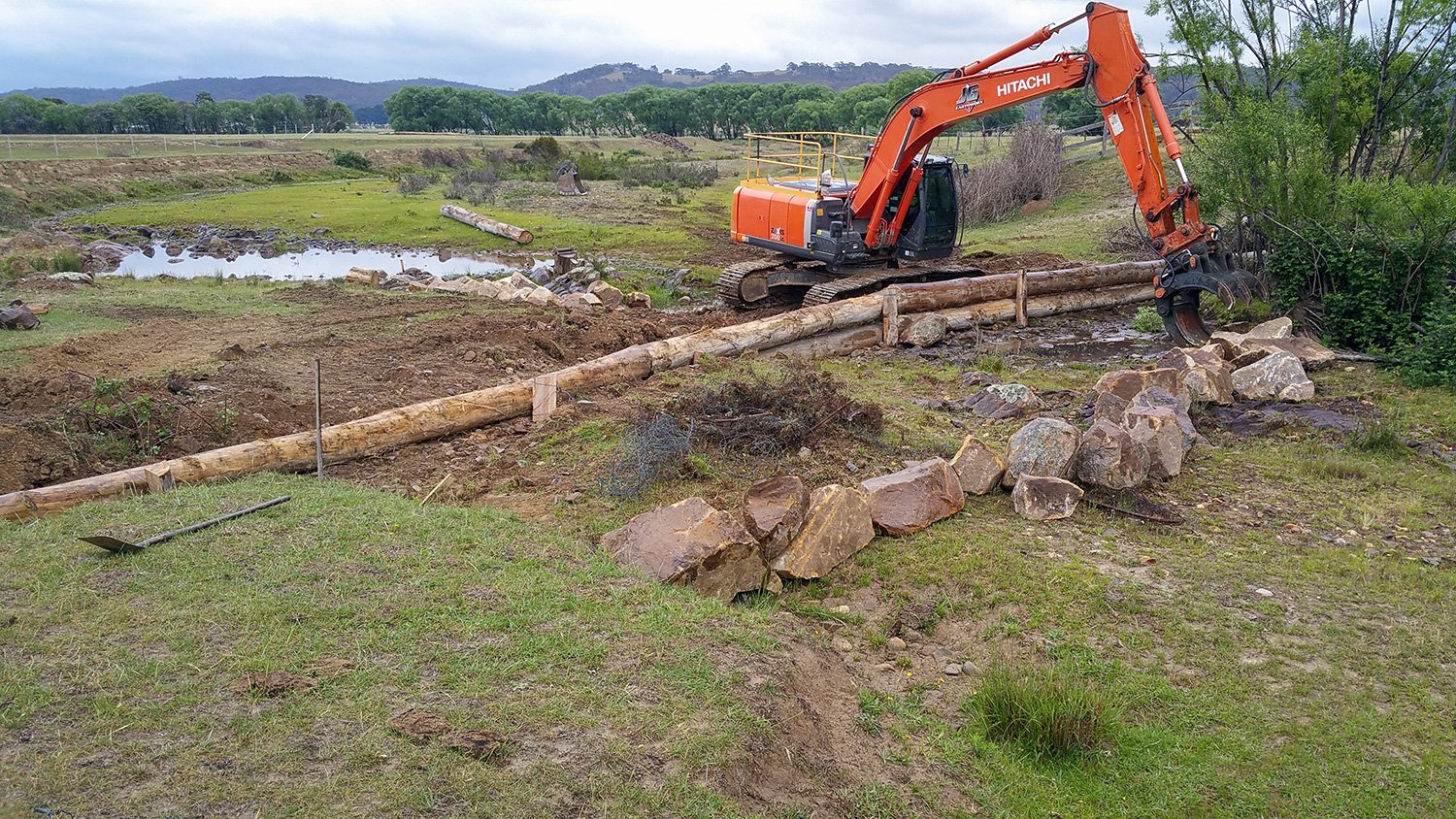
IMAGE – During installation of a ‘landscape rehydration infrastructure’ at Westview Farm in 2018, as part of the catchment-scale Mulloon Rehydration Initiative.

Every day landholders ask us for help with landscapes that are so degraded they no longer store moisture – even flooding rains don’t hydrate them but simply erode them further. Before these landscapes were cleared of trees for agriculture, they were remarkably good at cycling available water on our arid continent. These structures simply slow things down and give those magical natural processes time to rebuild absorbent, resilient landscapes. We are truly inspired by the leadership of the NSW Government driving this change for landholders,” she said.

It is likely this will be a tipping point, leading to reform in other states. But the Mulloon Institute is pushing for more, lobbying for a National Code of Practice for Landscape Restoration and Rehydration. This would integrate the many environmental safeguards that protect water quality, biodiversity and cultural heritage into a streamlined compliance process.

Environmental Law Scholar Dr Gerry Bates is contributing to the draft Code: “There is such urgency now, as the State of Environment Report tells us. If we want to heal our environments, we need an outcomes-focused approach that is easy to navigate. What we have now is a tangled spaghetti of approvals processes stalling hundreds of worthwhile projects. Many other sectors have a Code-compliant approach, why don’t we have one for Environmental Restoration?” he asked. 

Gary Nairn congratulated Planning Minister Anthony Roberts, and former Minister Rob Stokes, and their staff at the Department of Planning and the Environment. “Changing legislation isn’t easy, but it is absolutely necessary if we are to adapt to climate change and achieve real benefits for the land. This initiative has the support of all sides of politics, and farmers and environmentalists alike – it’s a win-win for the Australian bush. We have the momentum now, 2023 is going to be a game-changer for Environmental Restoration.” 

– ENDS –


For media queries, please contact:
Kelly Thorburn, Communications & Marketing Manager
Mulloon Institute, 3585 Kings Highway, Bungendore  NSW  2621

kelly@themullooninstitute.org  |  0419 099 894


The Mulloon Rehydration Initiative is jointly funded through the Mulloon Institute and the Australian Government’s National Landcare Program, and with assistance from the NSW Government’s Environmental Trust.