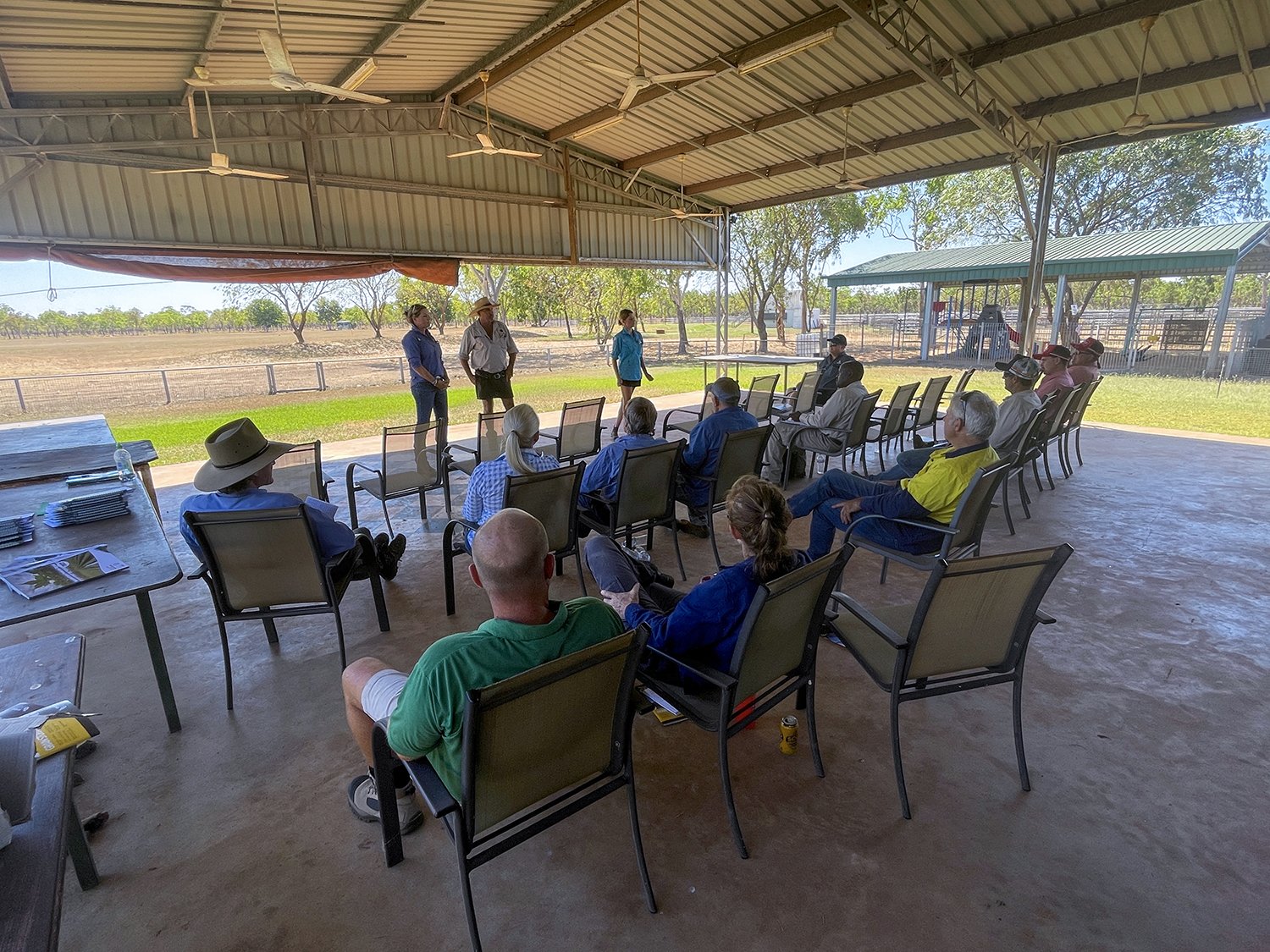
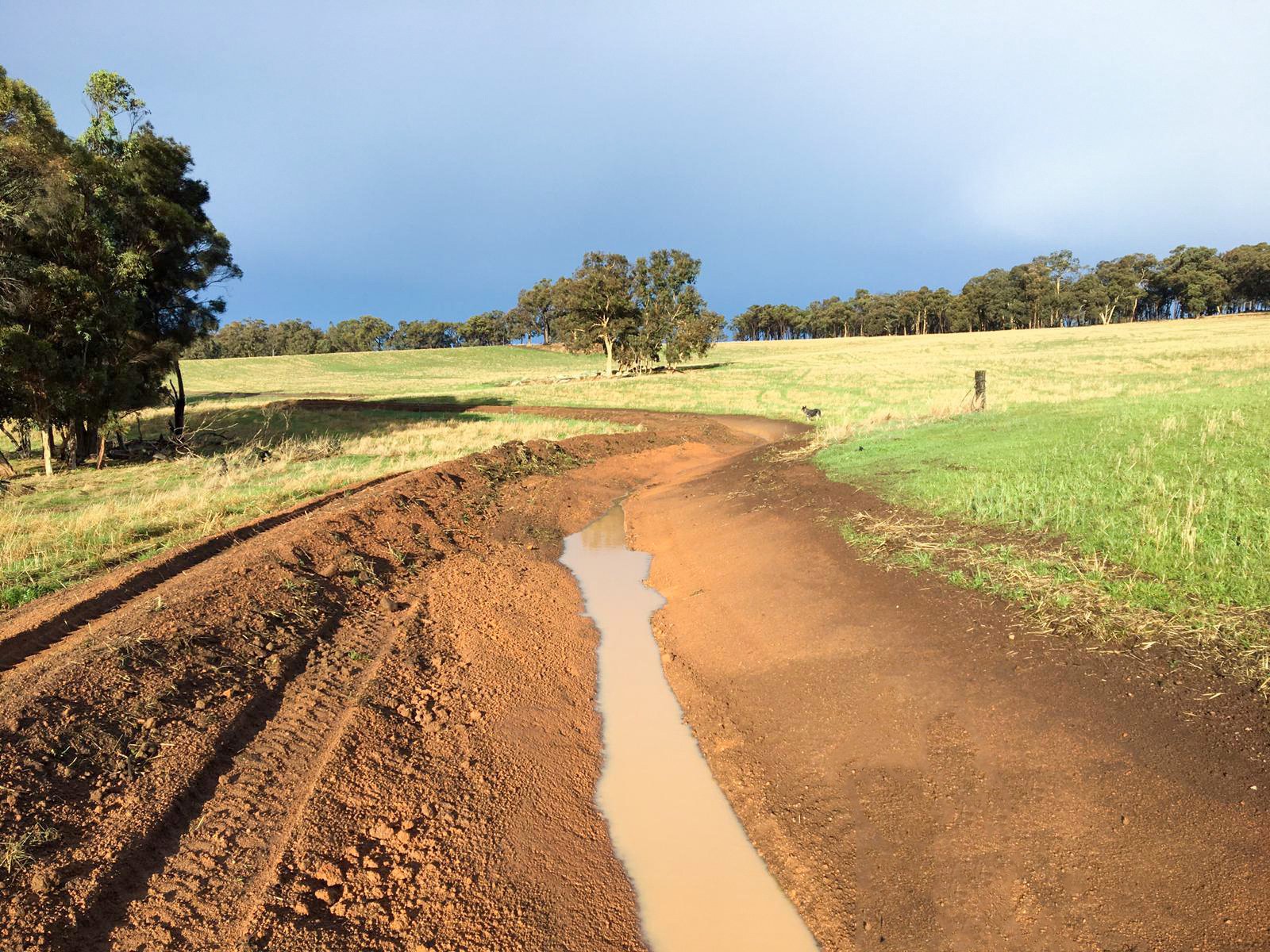
Lunchtime shed talks at Douglas Daly. Photo: Stephanie Coombes, NT Farmers
TMI’s Research Coordinator Luke Peel delivered a landscape rehydration presentation as a casual ‘shed talk’ style event in the Douglas Daly district of the Northern Territory during August, organised by NT Farmers Association.
As an ex-Territorian, Luke was back on his home turf where he started his career with NT Soil Conservation on a soil erosion monitoring and modelling project. He also included a side visit to the old Douglas Daly Research Farm where he previously worked and met with NT Department of Primary Industry Research Farm colleagues Peter Shotton and Rowena Eastick (Territory NRM).
Luke talked with local farmers about their current land use and management strategies to describe how it ties in with landscape rehydration, reducing soil erosion (a big problem), rebuilding soil processes, managing for the climate in this region (semi-arid tropics, distinct wet/dry seasons), and possible future climate change/extremes.
Cropping can be challenging in the region due to the haphazard rainfall of the build-up (September-November), so farmers are keen to maximise their chances of establishing their crops. Landscape rehydration works are expected to be able to help with this process with increasing plant available water for crops and pasture.
Luke explained how TMI can assist with training and demonstrations of understanding landscape processes to better manage water to increase plant available water, reduce erosion, and regenerate soil structure and function that will increase productivity. Examples include the Old Cameron Downs workshop presented by Peter Hazell in 2021, and collaborations with Mike Clarke and representatives from Charles Darwin University on the Aileron Project in Central Australia.
The planned LiDAR acquisition for the Douglas-Daly region will be of great value and benefit for land managers to understand and visualise how surface water moves through the country and how TMI can assist with how to manage these resources in context of soil and hydrological processes.
The event featured:
Mulloon Institute – Luke Peel/Mike Clarke – Landscape rehydration, soil erosion, Cropland Erosion Program/Land Management in semi-arid tropics.
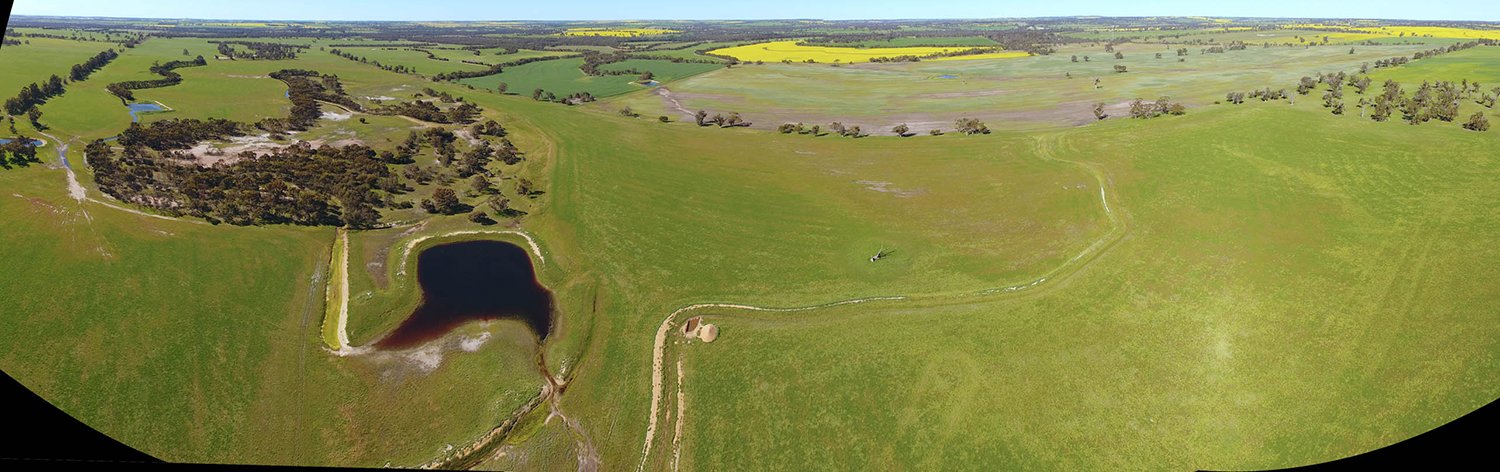
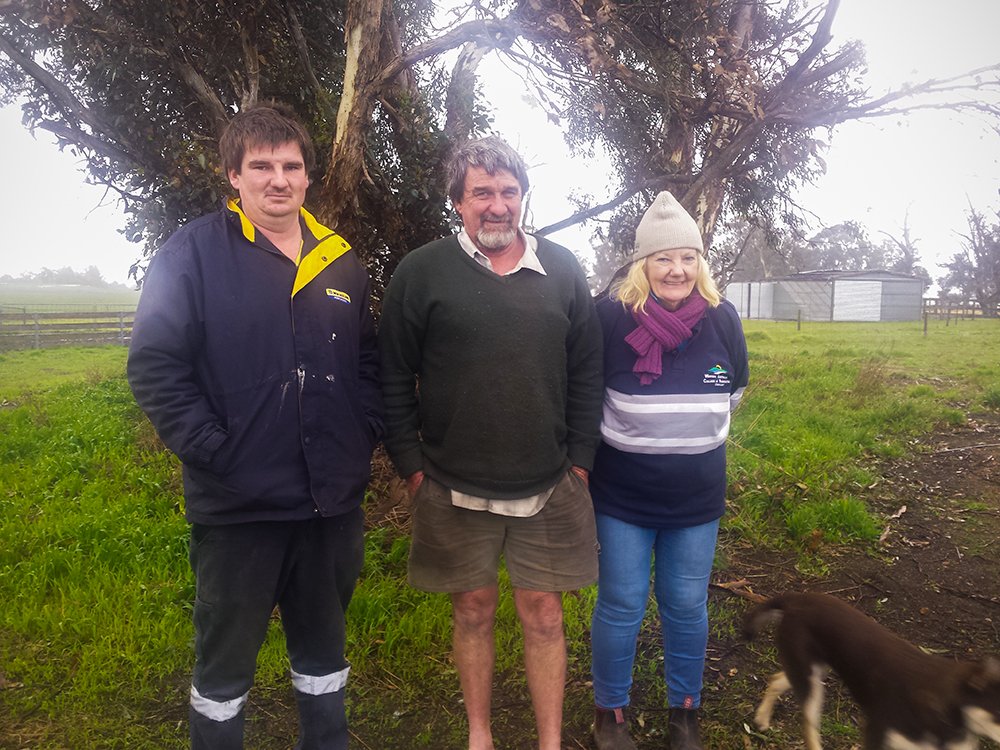
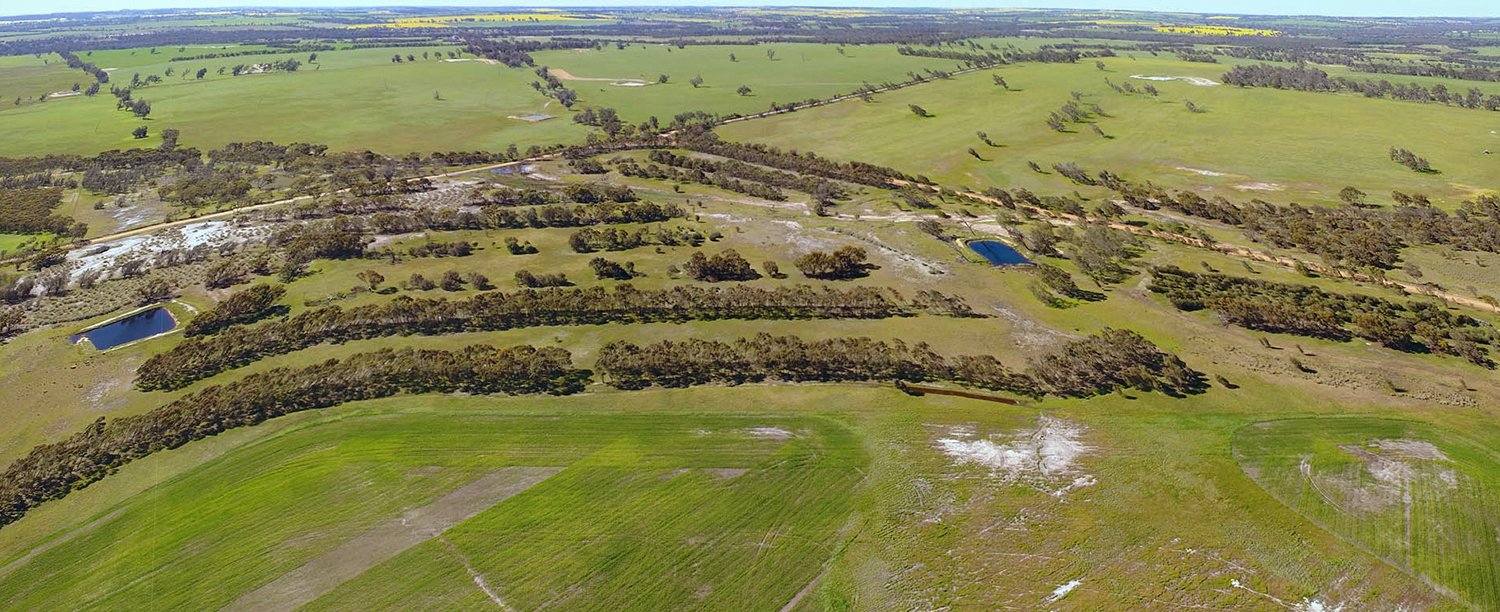
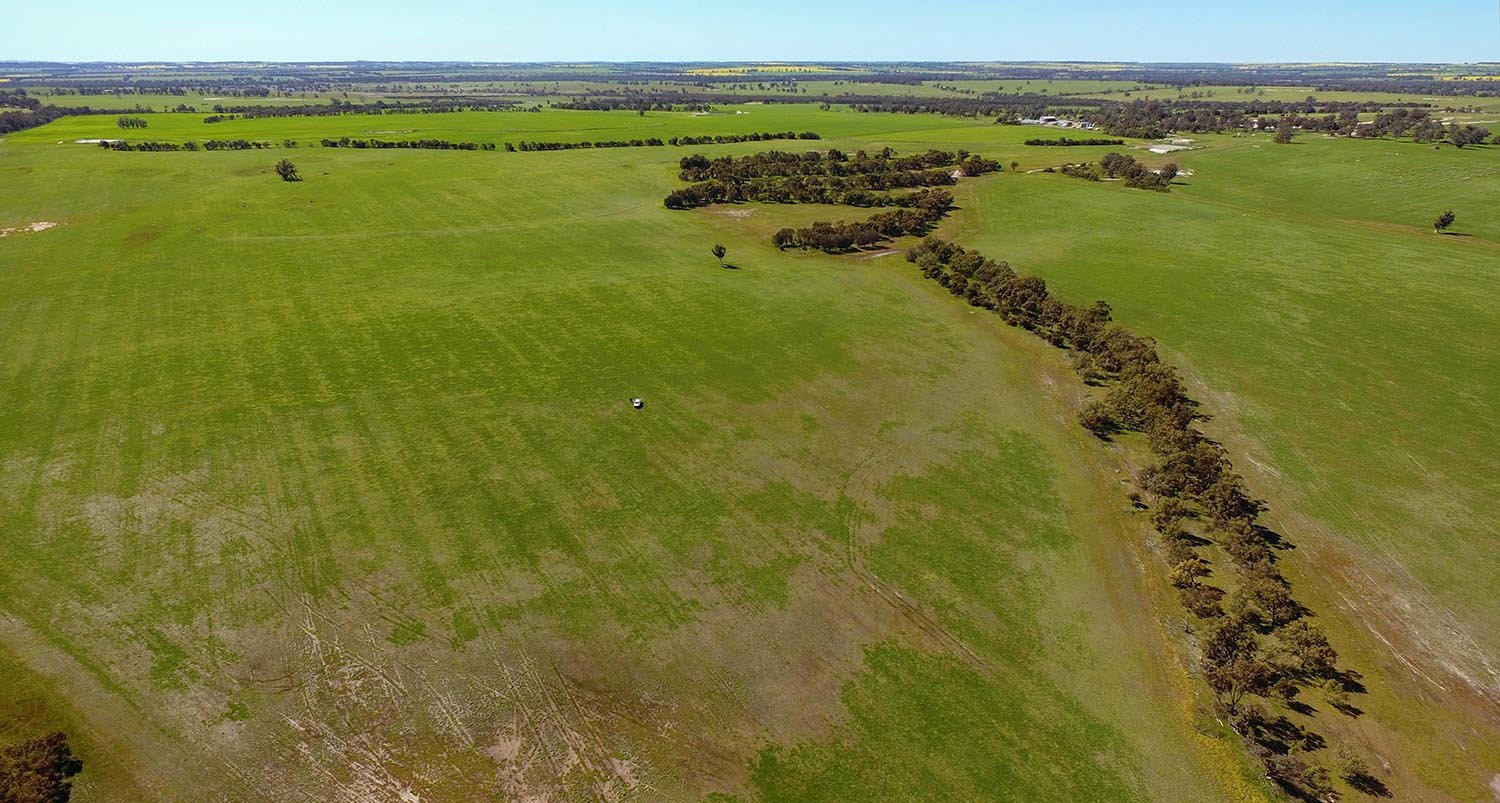
The low rolling hills from ridgelines down to the valley floor on Bazil’s and Wayneflete lead down to the Carlecatup River, a charming landscape near Katanning. Geoff, Bev and Jeremy Kowald know this area well; the home farm was taken up by Geoff’s grandfather in 1905. For many years, the Kowald’s have been Landcare champions while practicing holistic grazing and implementing principles similar to Yeoman’s keylines.
Recently, our WA Landscape Planner Lance Mudgway visited the Kowald’s as a part of the WA Community Stewardship Grant: Landscape Rehydration Trial and Demonstration in the Wheatbelt of WA. Their properties received an Initial Site Inspection report, with the aim to improve the long-term sustainable productivity of Bazil’s and Wayneflete and provide a holistic water plan for the property. Learn more about the Kowalds and their regenerative journey.
View fullsize
View fullsize
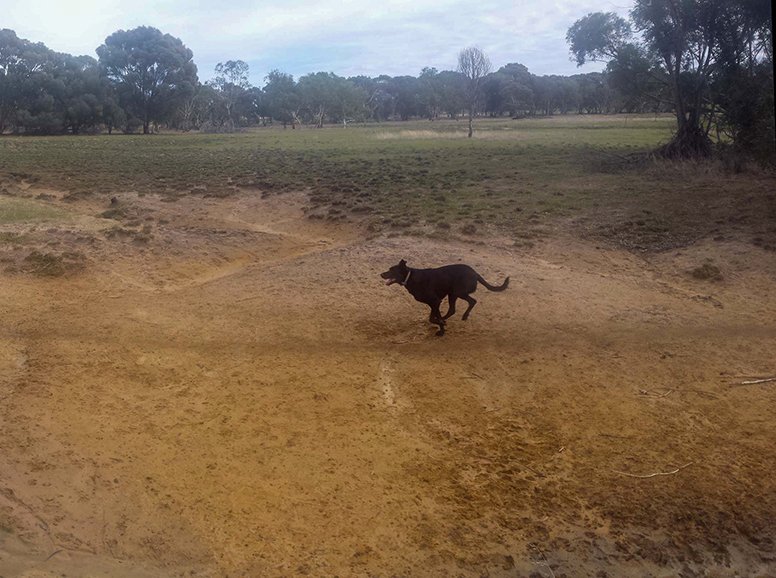
Lance’s dog Bilbo investigating saline scalded creek riparian zone on Bazil’s.
What has been your journey on the properties?
We have had a whole of farm water harvesting plan drawn up and now implemented by Ron Watkins on our home farm. Ron’s acronym is ESSWAPAH, meaning Energy, Soil, Seasons, Water, Air, Planets, Animals and Humans are taken into account when planning. He started our plan in 1995 and now we have contoured our farm to harvest water which fills dams and provides for a commercial yabby farm. All banks have around five rows of trees behind them to help link vegetation corridors of shade and shelter for land and livestock. All are double fenced with permanent electric fences.
The new property was a chance we couldn’t pass up, as its close proximity is really advantageous for stock management. We farm in a tightly held area which is fairly reliable so land is well sought after when it comes on the market. We purchased half in 2019 and leased the other half for three years then purchased it as well in 2020, with take-over in February 2021. Our whole enterprise is mainly livestock with some cropping for grain and sheep feed and some feed lotting.
Our new farm is only 1.4 kms away which has made management a lot easier than the block we sold which was 24 kms away. This farm has had some trees planted and banks put in to catch water but does have some salt which has come to surface. It also includes some high points which have native trees growing, some very old. So there are quite a few challenges we face which we are hoping the Mulloon Institute will be able to help us address. Many fences on the property are at the end of their life so we look at the farm as a blank canvas that we may be able to contour, implement corridors of trees and fence to fit with Holistic Management and planned grazing.
View fullsize
View fullsize
How did you get involved in Holistic Management?
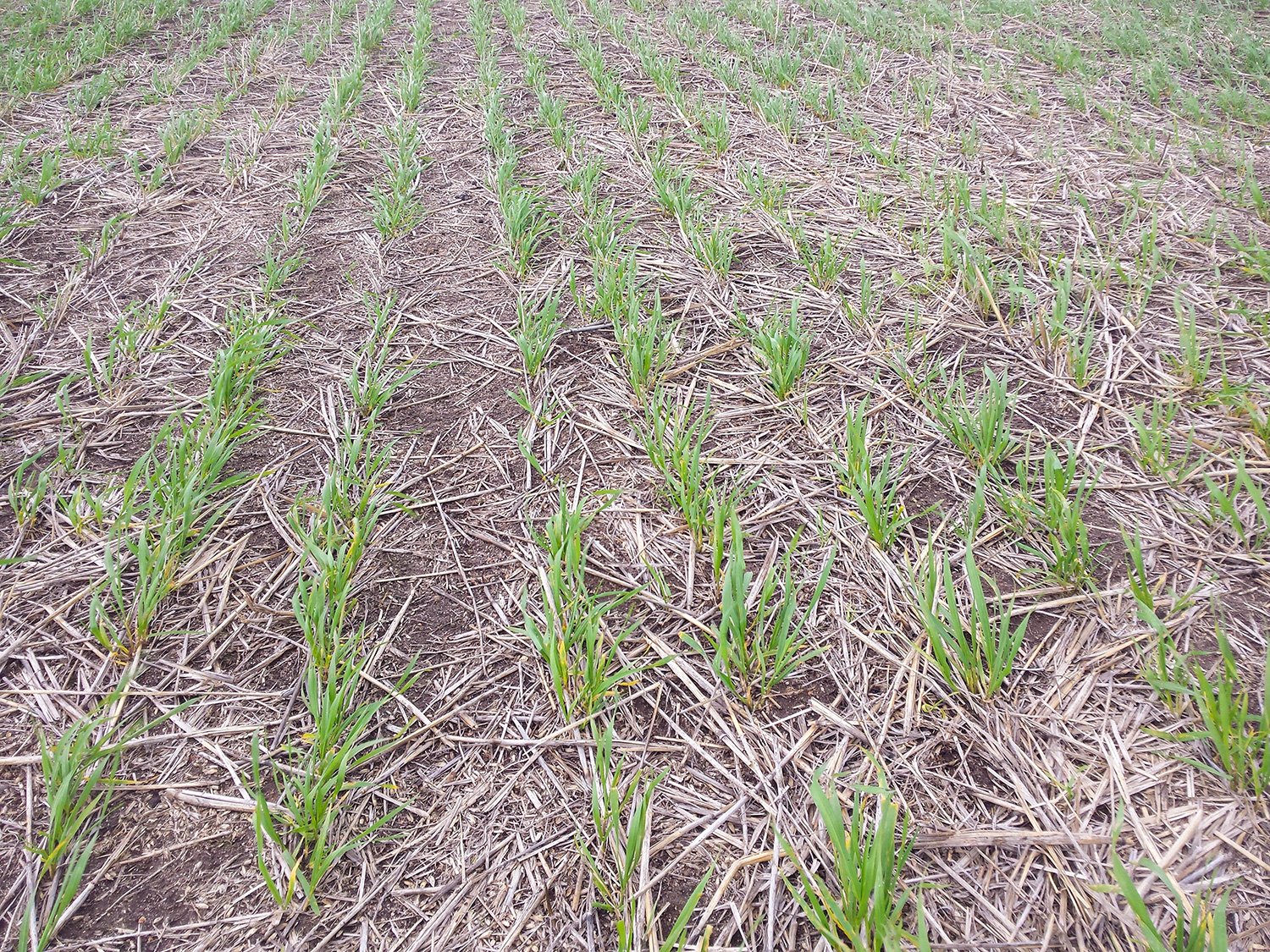
We did a course in Holistic Management in 2010 because we were looking for new ideas to increase our profit. and at that time we had coined the phrase “that when the profit goes out of your business, the rest of that word is OFIT and that is where we are headed if we can’t change”. So we felt there had to be another way we could approach our business. The Holistic Management course was amazing, it opened our minds to new ways of decision making and testing our ideas. We found implementing planned grazing challenging and exciting, one large mob of sheep and cattle moving daily and using temporary electric fencing does teach you a lot about how much feed you have. With Planned Grazing and scanning for twins we have increased our lambing from 75 – 85% to 105 – 115% over the last 5 years in our Merino flock and our terminal flock is higher. We are striving to have green all year round in our 350 – 450 mm rainfall zone and to do this we have planted many perennials and we also summer crop using millet, tillage radish, serradella medic clover, cereal rye, grazing barley, canola and sunflowers. In a three year summer crop trial conducted by Katanning LCD we saw a increase in PH from 4.5 – 5.5.
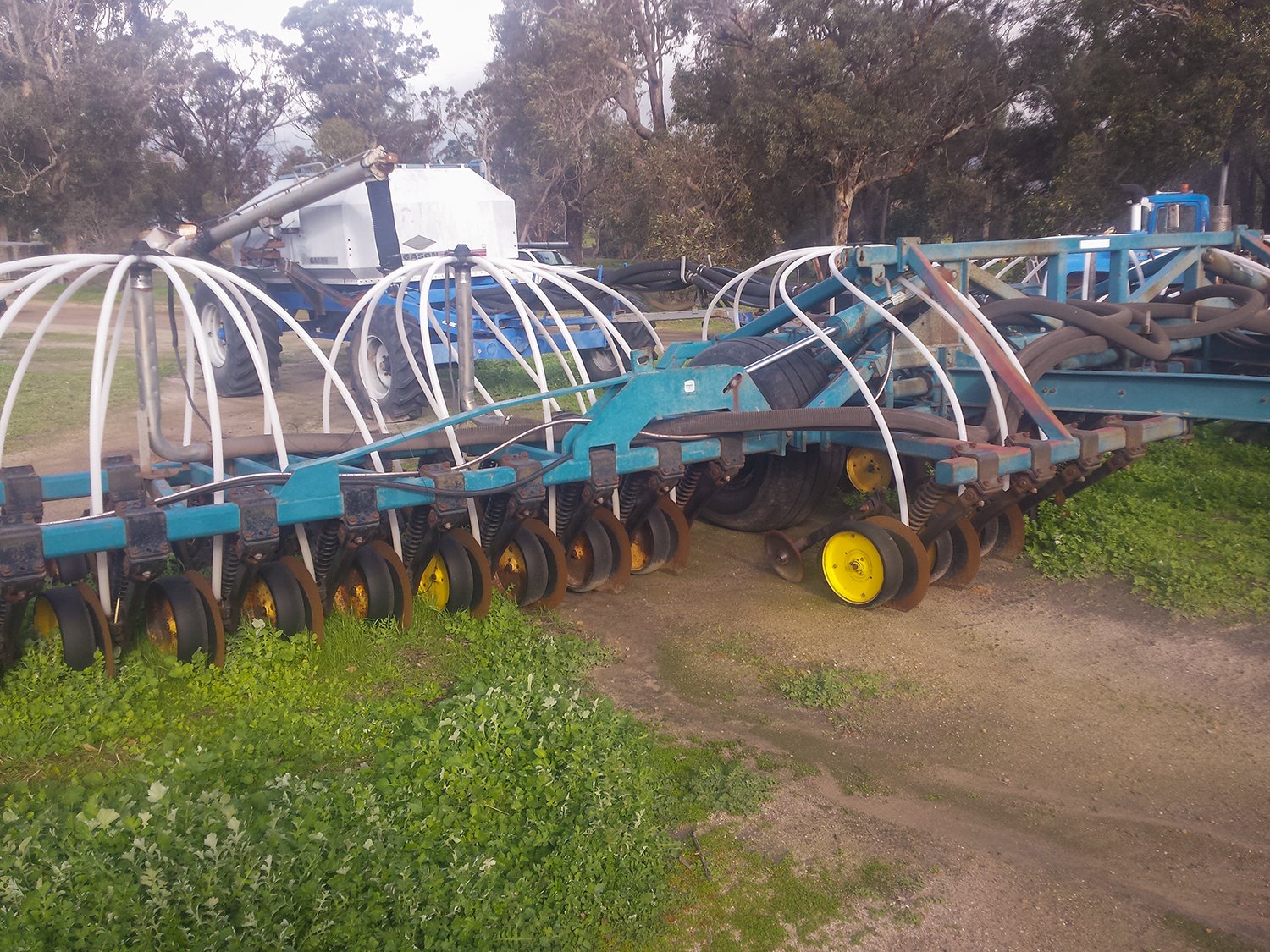
Our son Jeremy bought a disc seeder in 2015 while working in the mines (fly in fly out) so he could continue his summer cropping program. This machine has proven to be a game changer as it does not disturb the soil; it just opens up the ground for the seed and then gets closed with a press wheel. We are confident sowing under any conditions as there is no risk of erosion. This machine now sows all of our crops in winter, summer and autumn dry sowing. It is a high maintenance machine but is light to pull so saves fuel.
We are involved in the local Landcare District Committee where we can share ideas and be involved in many projects helping to make changes and learning from others about ecosystems and the whole wider environment Many trees are planted each year in our area and we also do much rehabilitation in the town creating canopy cover to mitigate heat and also use plant to control water.
How did you get involved in the project?
Australian Stories sparked our interest in Peter Andrews ideas and after having read two books from our local library “Back from the Brink” and “Beyond the Brink” many interesting ideas have filled our thoughts. Now with the amazing projects The Mulloon Institute has created we feel very excited to be involved with such talented people. I have seen Lance plan other water and lake projects and they worked very well so we look forward to working with him.
Agriculture is always challenging and exciting so we look forward to the whole rehydration implementation including contours, trees, mulching, new fences and fresh water on top of the salt water.
This project is supported by funding from the Western Australian Government’s State NRM Program.
WA Farm Moment – Pensini
Date published: 15 August 2022
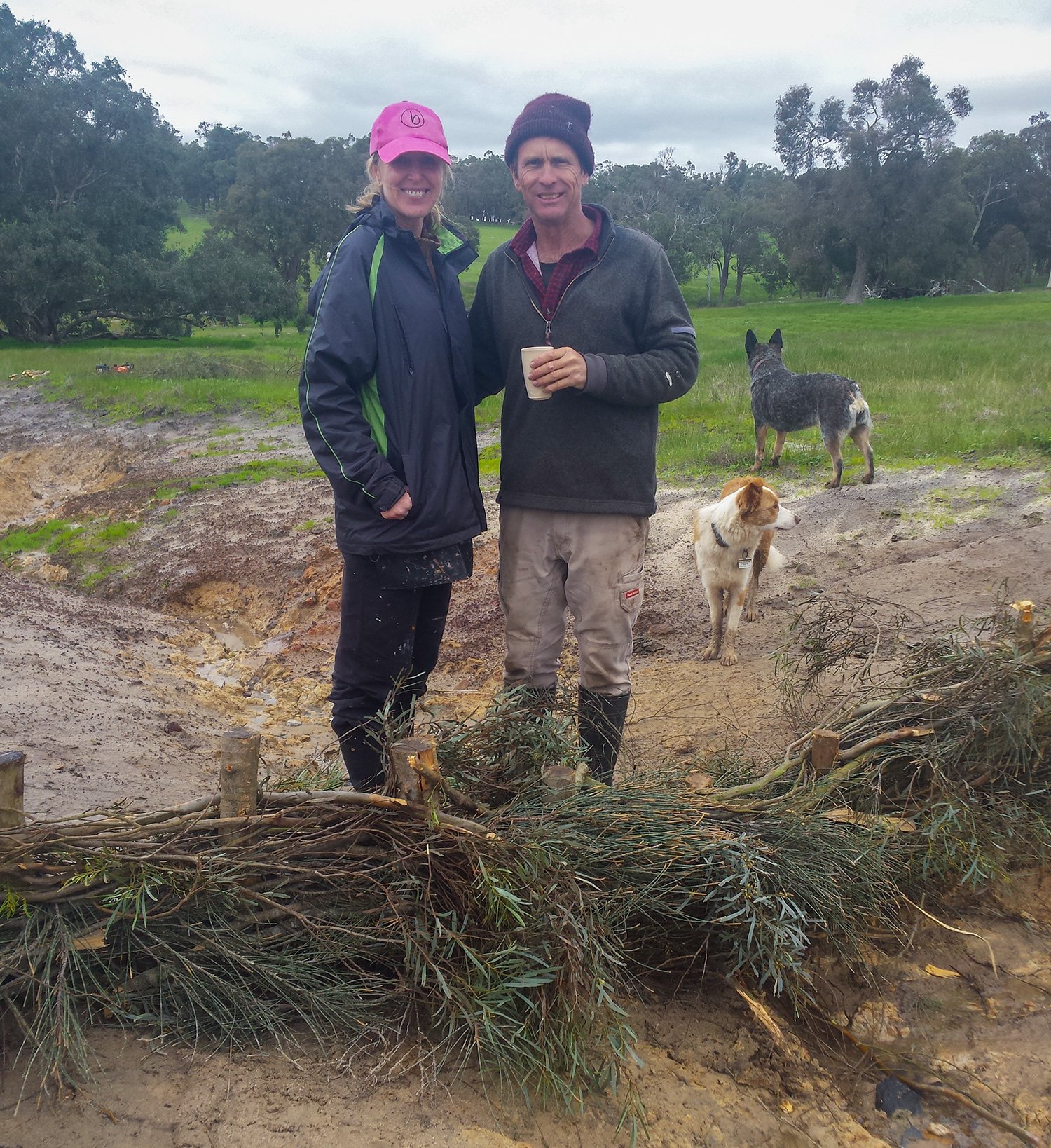
L-R: Lori & Warren Pensini with one of their brushpack contours.
The panoramic view from the top of the Blackwood River Catchment gives spectacular views of the Boyup Brook district. For Warren and Lori Pensini, this landscape is home.
In 2001, Warren and Lori moved down from a cattle station in the Pilbara to ‘Paraway’ in Boyup Brook, taking with them cattle they had been faithfully managing.
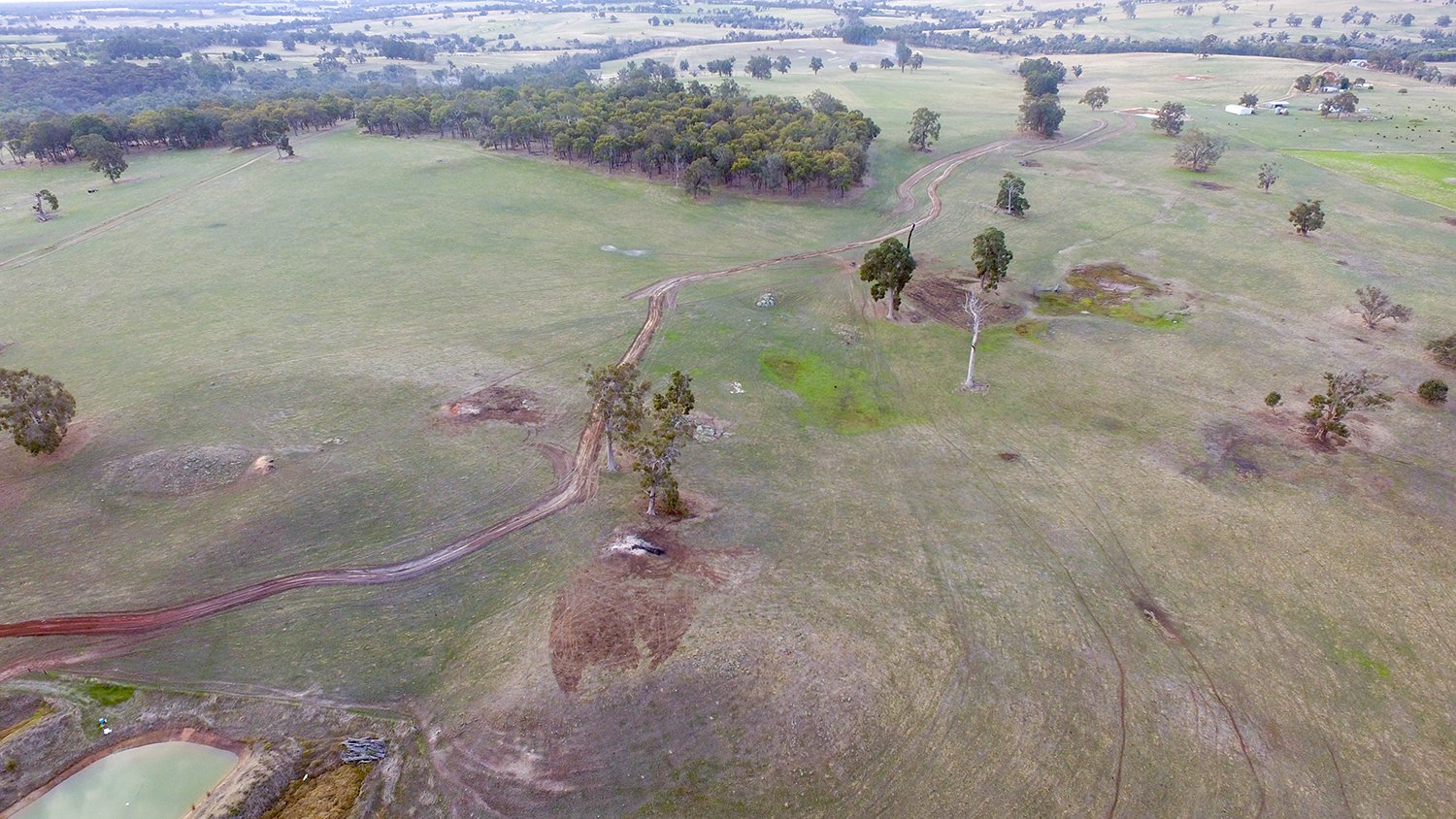
Aerial imagery shows most of ‘Paraway’ had been cleared by the 1950s, with jarrah trees extensively harvested for local railway sleepers. The loss of vegetation has created challenges on the property with areas of waterlogging and seepage creating salinity issues. Coming from pastoral farming, the Pensinis were familiar with moderating stocking rates to suit the landscape. They bought this mindset down south, which was reinforced through attending an RCS Grazing for Profit course.
Warren and Lori noticed that the flavour profile of their beef had changed on ‘Paraway’ and were keen to try different management, part of which was organics. In the early 2000s there was a good premium for organic beef, which was the genesis for their beef brand Blackwood Valley Beef. They found this had positive impacts on their landscape but began to see productivity losses due to the constraint and expenses of running an organic system. Instead, they turned to nurturing the soil rather than their animals and focused on biological products and groundcover as they began their regenerative journey. This led them to working with Wide Open Agriculture and it’s food brand Dirty Clean Food. Warren is also the Livestock Operations Manager and Logistics and Supply Chain Manager for Dirty Clean Food, while Lori is a nationally recognised artist engaging with the environment and relationships in pastoral Australia in her works.
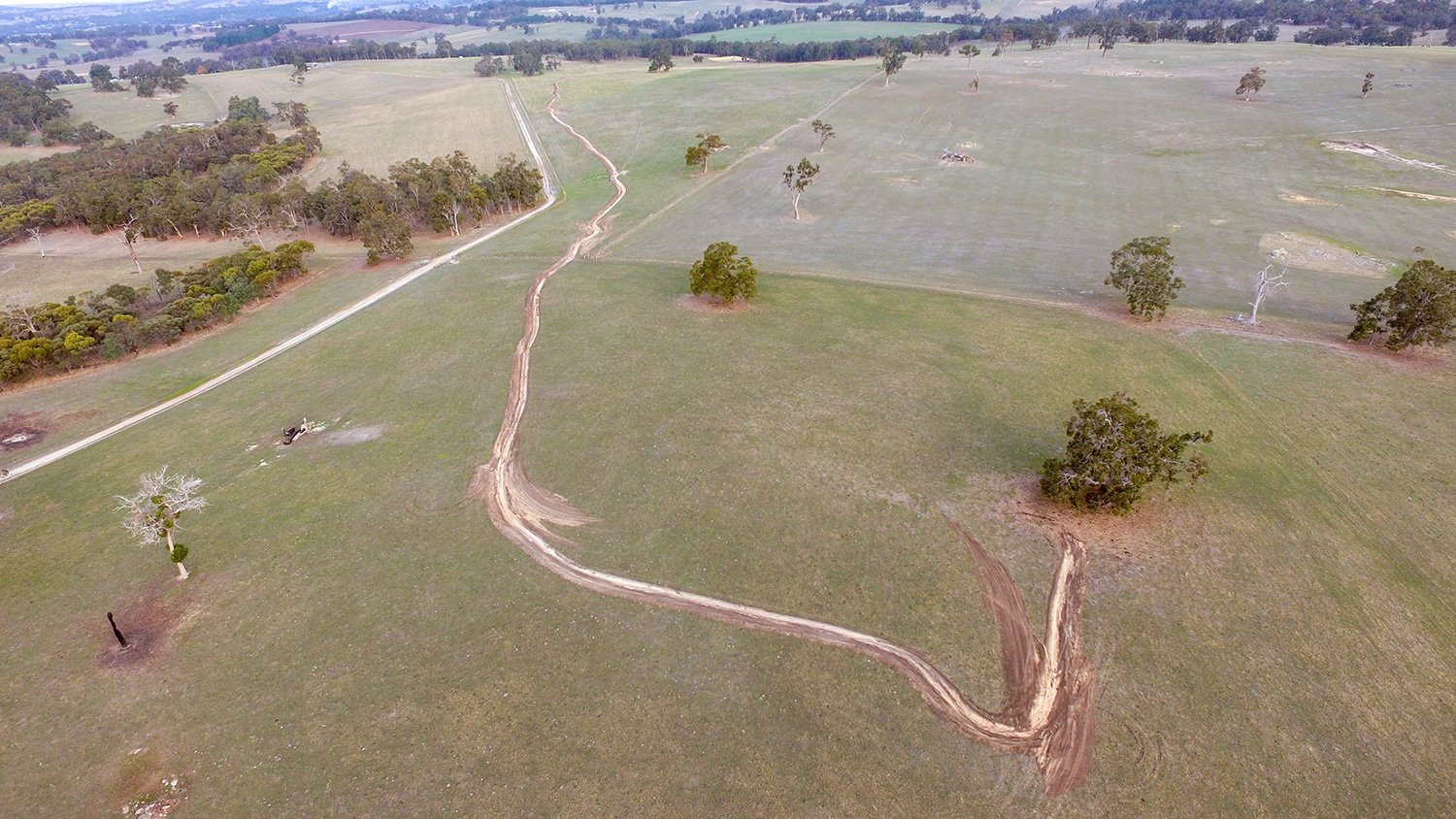
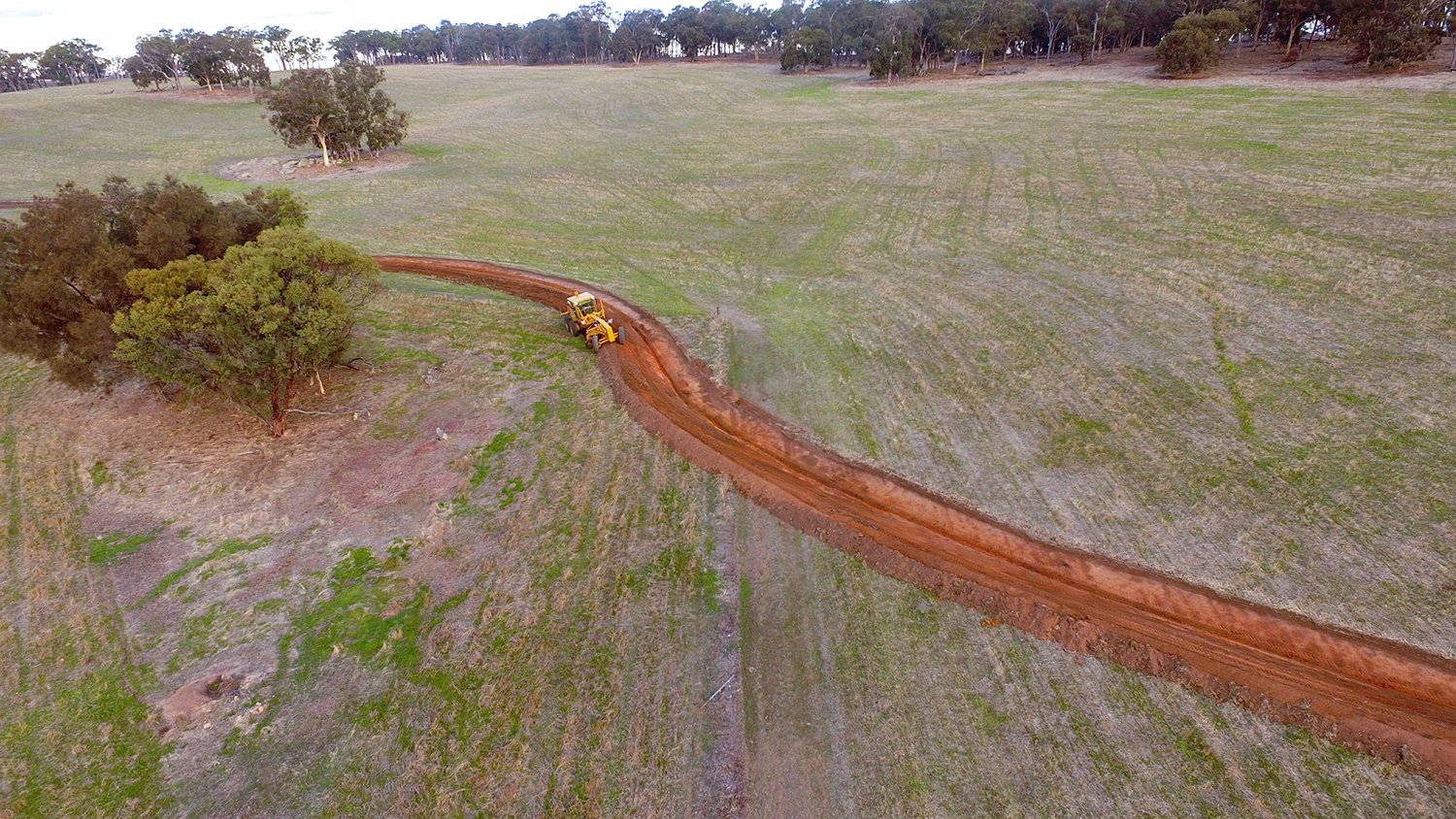
The Pensinis are now trialling landscape rehydration on ‘Paraway’, guided by TMI’s Landscape Planner Lance Mudgway. On-ground works have just begun, hear from Warren about their journey:
View fullsize
View fullsize
Do you think you have been successful in what you have been trying to achieve over the last 5-10 years?
Sometimes you feel that it’s two step forwards one step back. And that’s a seasonal thing. You’ll get a good year and think everything is going really well, and then you have a 2019 where we had a failed spring and then you realise it’s not working as good as you thought it was, and I suppose that was the next catalyst to where we are now.
We were thinking, what do we need to do to make this system more resilient in the longer term? We need to be able to stand up to those seasonal fluctuations, so when there’s a really bad season we’re not going to be as exposed because our system is more resilient. That’s the whole fundamentals around landscape rehydration and the work Peter Andrews has done – it’s about retaining much more of that moisture in the landscape so you can utilise it in the rough seasons. There needs to be broader change in managing the landscape in terms of the rehydration and the hydrological cycle.
I know it’s early days, but what are your thoughts on the activities done so far?
It’s really interesting, getting the trees in the ground you can actually see it all coming together now. When we put contours in, you can pick out what’s going on, but now it’s starting to infill with the trees it’s starting to come together in terms of how it’s going to function. Part of that is seeing some of the function with the contours; already where we were planting the trees there is definitely more moisture in the profile. If the contour wasn’t there it would be further down the landscape. It’s exciting to see that we are already making a difference, and that’s our goal – to retain more moisture on the farm and improve water quality. One of my goals for this project is, that every drop of water that leaves this property is fresh.
View fullsize
View fullsize
What are some of the major issues or hurdles to doing this work?
Cost is the number one.We are yet to prove that and that’s part of this project, but we are hoping to demonstrate an improvement in productivity and profitability. The productivity one is going to be super interesting, I’m convinced we are going to see productivity gains in some of the lower areas of the profile where there is waterlogging. There are some areas potentially in that central catchment we are really focused on, that have been terribly unproductive because they just get waterlogged for half of the year, and then they dry out in summer and nothing grows on them. The interesting one will be in the agricultural zones below where we are planting the trees, in terms of what productivity gains we will see. I’m not 100% sure how we are going to measure all of the change at this stage.
In some ways it is difficult to measure because there are other ecological benefits, and a lot of that we don’t really know about yet. The benefits to ecological outcomes is probably immeasurable at this point, but it could turn out to be a bigger gain than productivity gains. It is a leap of faith in terms of what we achieve in ecological outcomes and natural capital. There will hopefully be bigger picture changes we are going to see, and the lower landscape might become more productive and resilient. Get those salt scalds out of the equation. That’s why I come back to the water quality, because I think at the end of the day if we address the water quality then everything else will look after itself. Let’s measure this stuff and see where it all lands.
In terms of your future outlook, what are your hopes for the project and your property?
The environment and broader community are areas that I like to think we are going to make an impact. I remember when we had Jim Mackintosh and Justin Wolfgang here, we really hatched this plan 2-3 years ago. The one thing I said to them is why I thought this site was a good site for landscape rehydration – we are literally right up the top of the watershed of the Blackwood River. When TMI’s Peter Hazell came and did the workshops here, it didn’t take me long to think the same thing! We have a creek that starts on our property that’s right up the top of the catchment, and it’s interesting that when we were planting some trees today, it’s basically the highest point and you can see exactly why you would be planting trees there.
We are just a very small part of the whole Blackwood Catchment, but if we can make an impact here and demonstrate that broader environmental impact, and therefore societal impact in terms of what we are contributing to that river, if we can change that than we are doing our bit. There are probably a few hundred farmers in the catchment in the same position, so if we did this on other farms imagine the impact we could have. Imagine if marron (WA crayfish) lived in the upper reaches of the Blackwood River again. It’s always really difficult to measure those broader environmental and societal impacts, but as the phrase goes, “from little things, big things grow”.
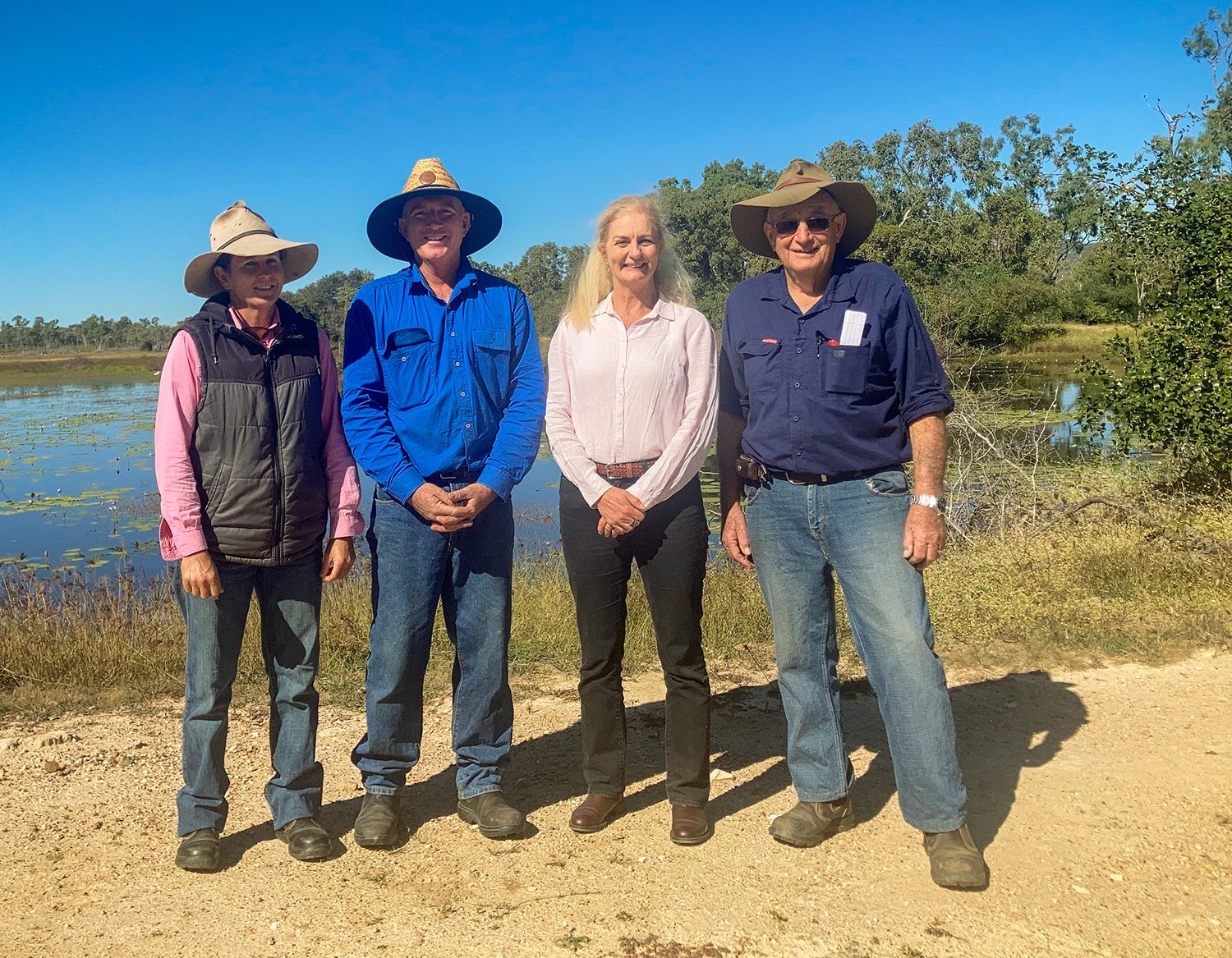
CEO Carolyn Hall meeting with Jodene and Troy Green.
Earlier this year, CEO Carolyn Hall visited Townsville for a week to catch up with the Queensland team of Sam Skeat and Joe Skuse. During the visit the team met up with our key partners at NQ Dry Tropics and Townsville City Council.
Carolyn also spent a few hours on the Stone Hut property with landholders Troy, Ty and Jodene Green who are participating in the Lansdown Catchment Rehydration Initiative. Ty and Troy (Dad and Dave, as they call themselves) have recently completed constructed landscape rehydration measures that were designed by the Mulloon Institute, and which Carolyn was eager to see.
The Lansdown Catchment Rehydration Initiative is a catchment scale project that is building drought resilience into the Lansdown community by empowering graziers to undertake landscape rehydration measures in their landscape. The Mulloon Institute is working with six landholders to identify opportunities for landscape rehydration and undertaking detailed designs of leaky weirs, contours and fencing plans. The Lansdown Catchment Rehydration Initiative is supported by NQ Dry Tropics and the Mulloon Institute, through funding from the Australian Government’s Future Drought Fund.
Engaging with landholders is an essential and enjoyable part of any catchment scale work, and something that the whole Mulloon team finds a lot of joy in.
CEO Carolyn Hall meeting with Jodene, Troy and Ty Green.
Warren’s tackling salinity with natural sequence farming – WA
Date published: 27 July 2022
Warren Pensini explores the benefits of regenerative agriculture to his beef operation in the southwest of Western Australia.
After hosting the Mulloon Institute at his Boyup Brook property, Warren has now partnered to bring the Mulloon Institute to WA, developing and implementing a whole farm plan centred around landscape rehydration.
The flow-on effects have been extraordinary, and the project hasn’t even begun planting! Warren’s property is turning into a global standard for holistic land management and carbon sequestration outcomes.
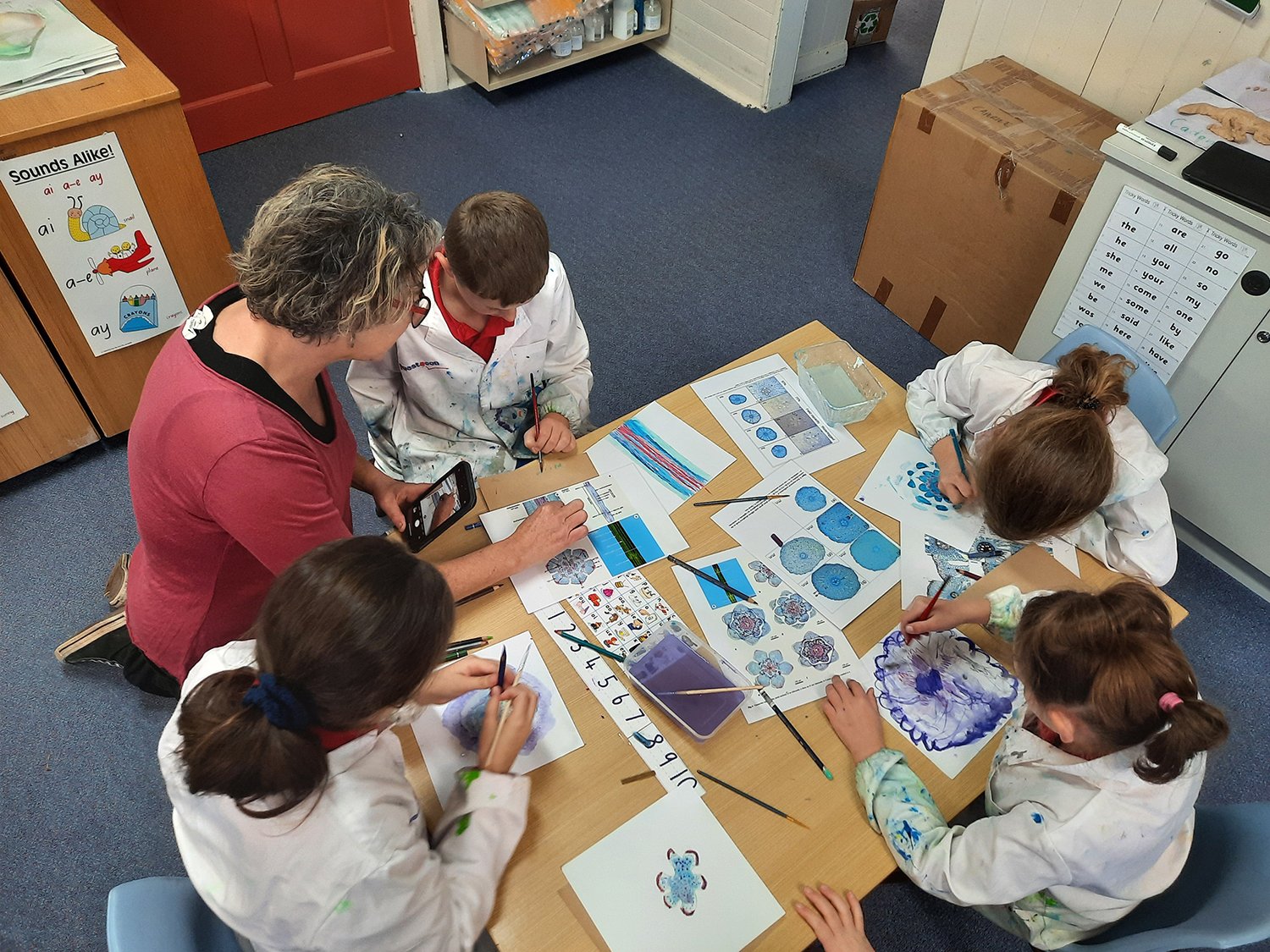
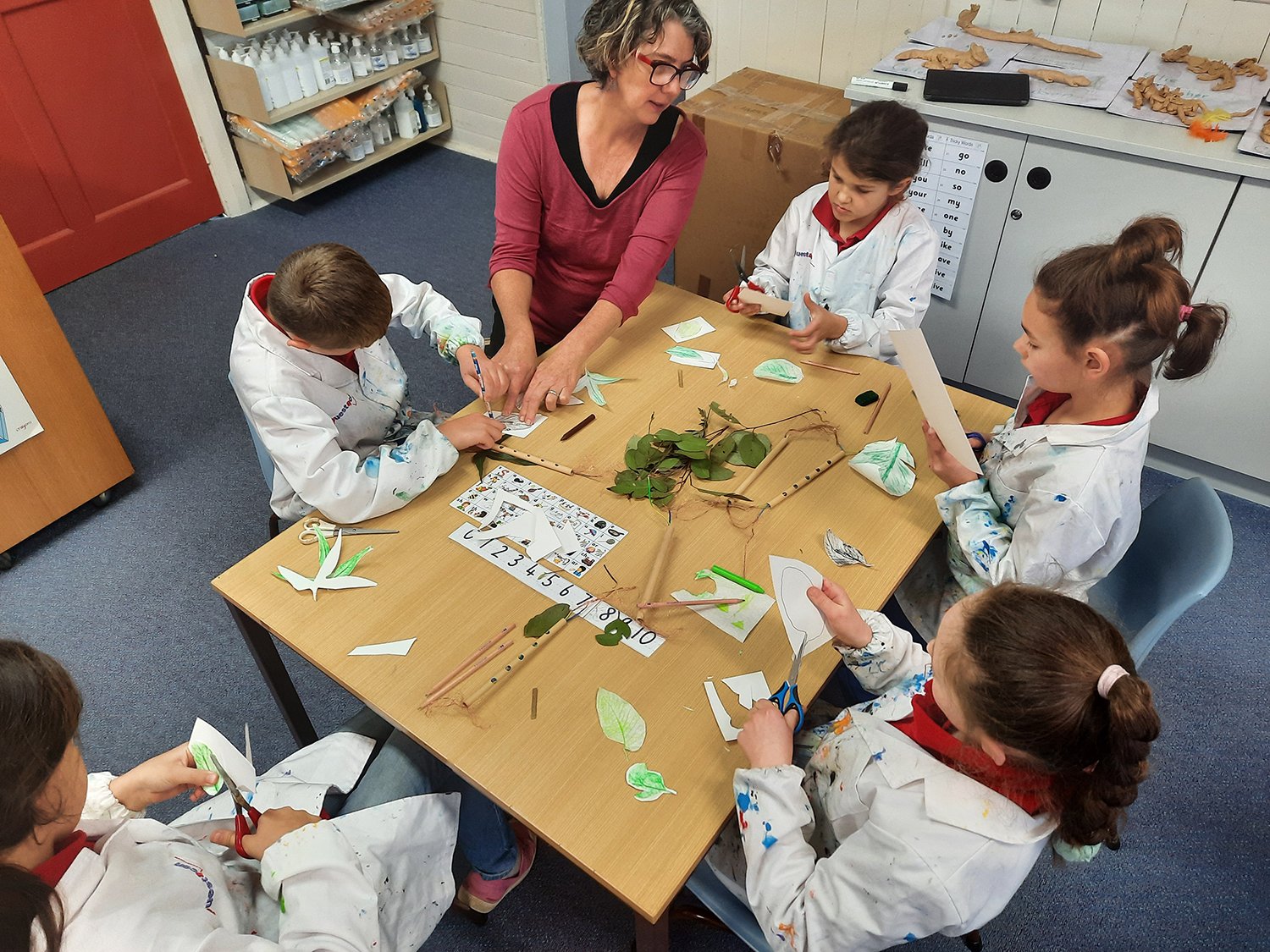
Students have been learning about plant anatomy, the small water cycle and river ecology in several workshops!
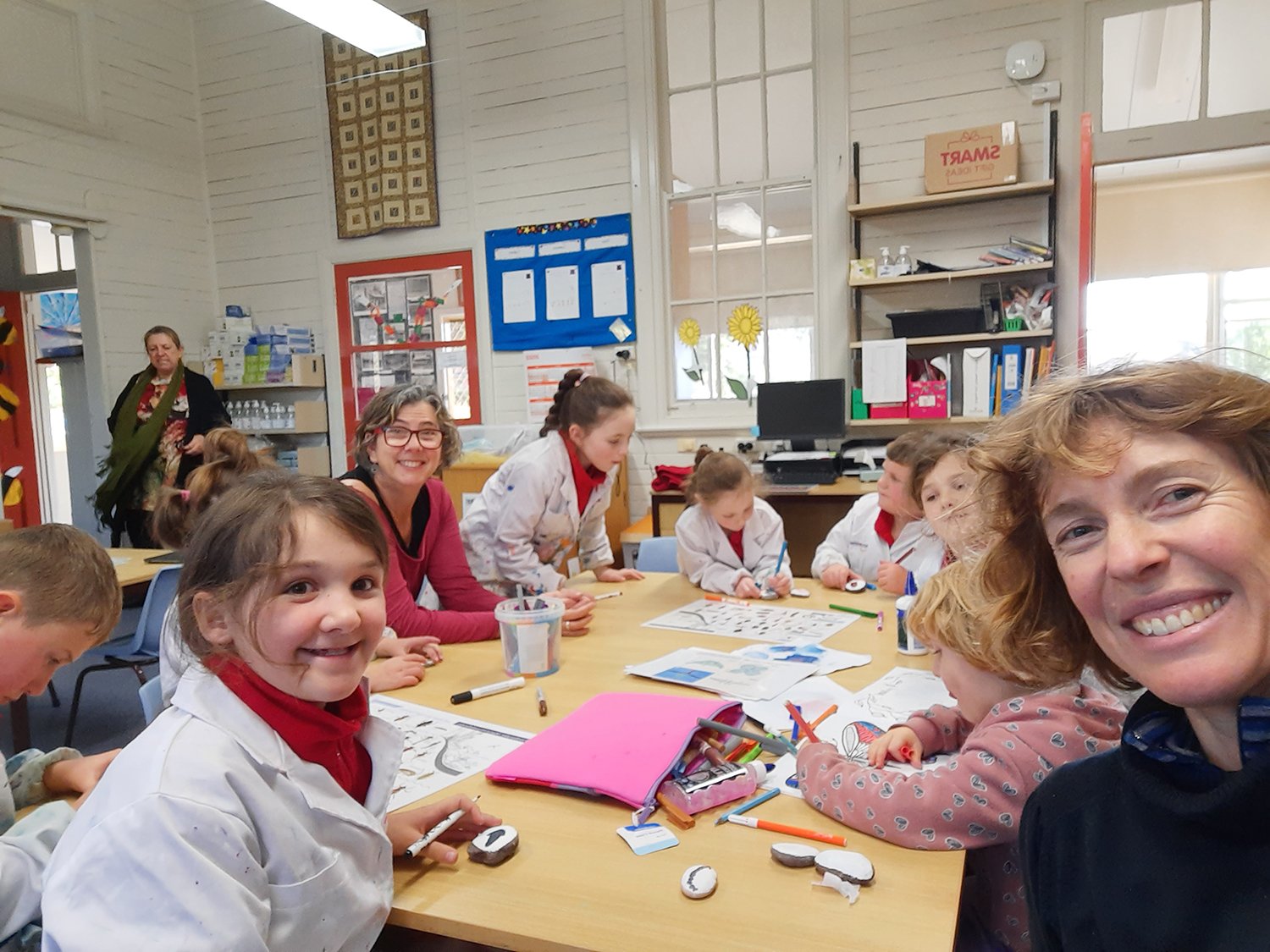
Our own Laura Fisher visited the delightful Ilford, Capertee and Glen Alice Public Schools with fellow artist and Capertee Valley landowner Leanne Thompson. Students made drawings and models of plants to understand how they transpire water and cool their environment, and made painted stones of the tiny critters that are so vital to river food webs and highlight the importance of riparian vegetation.
We love the sciencey art smocks too!
These creations will all form part of our Waterland exhibition in Kandos, opening on Saturday 6th August at 2pm!
These school workshops form part of the ‘Modelling Landscape Rehydration for Catchments, Communities and Curriculum project’, which received grant funding from the Australian Government.
View fullsize
View fullsize
View fullsize
View fullsize
Exploring landscape rehydration, artistically
Date published: 27 July 2022
View fullsize
View fullsize
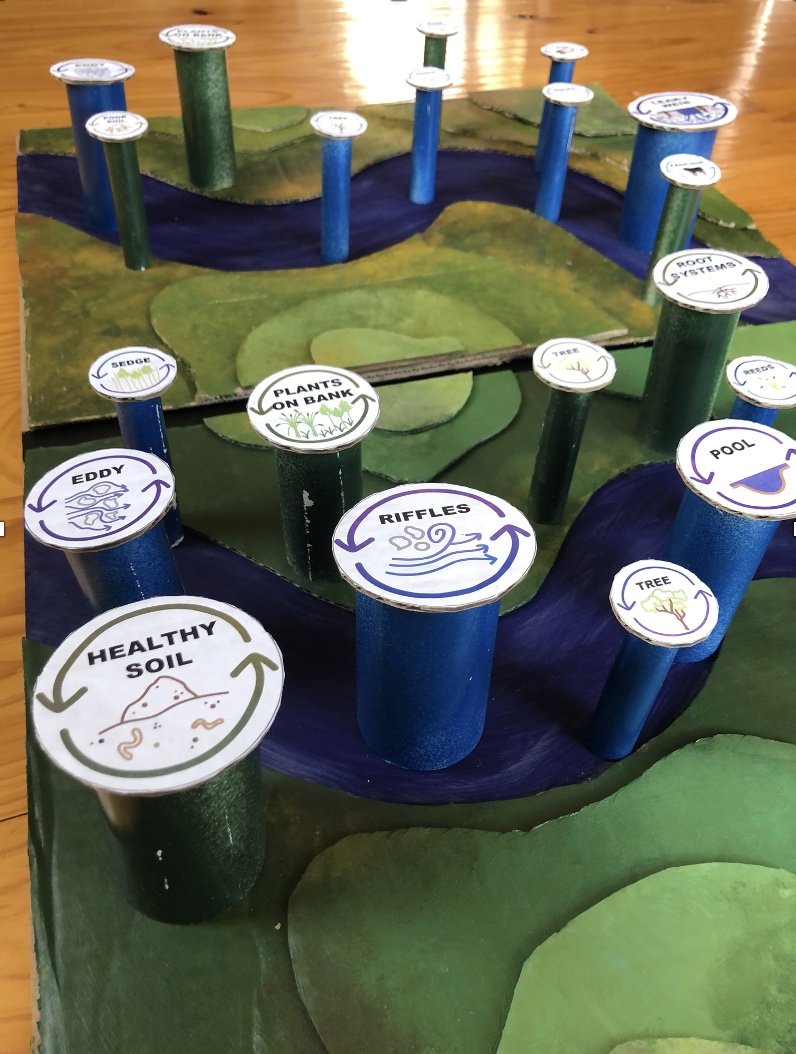
With our Waterland exhibition on the horizon, it’s wonderful to be able to share some of the models that will feature in the show.
Kylie Kiu responded to Laura Fisher’s invitation to explore Landscape Rehydration in one of her Design projects at ANU. She’s designed an interactive board in which string – representing water – can be wound around landscape features that give water a slower, gentler journey. The more the string meanders, the better. It’s such an inventive project built on lots of research and we’re thrilled Kylie came on the journey with us!
You’ll be able to see Kylie’s work and many other fascinating objects at Waterland, which runs from 6 August – 5 September.
The show is a collaboration between the Mulloon Institute and Kandos School of Cultural Adaptation.
Mapping the Capertee Valley
Date published: 27 July 2022
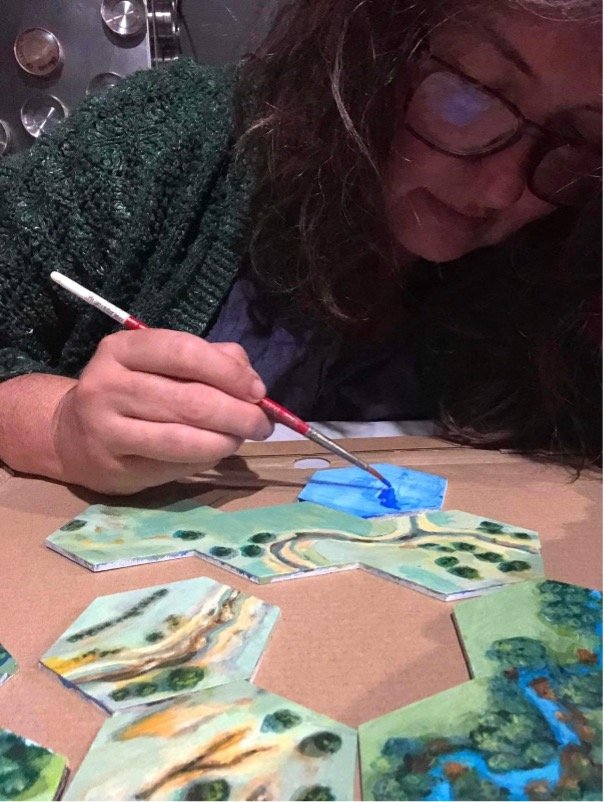
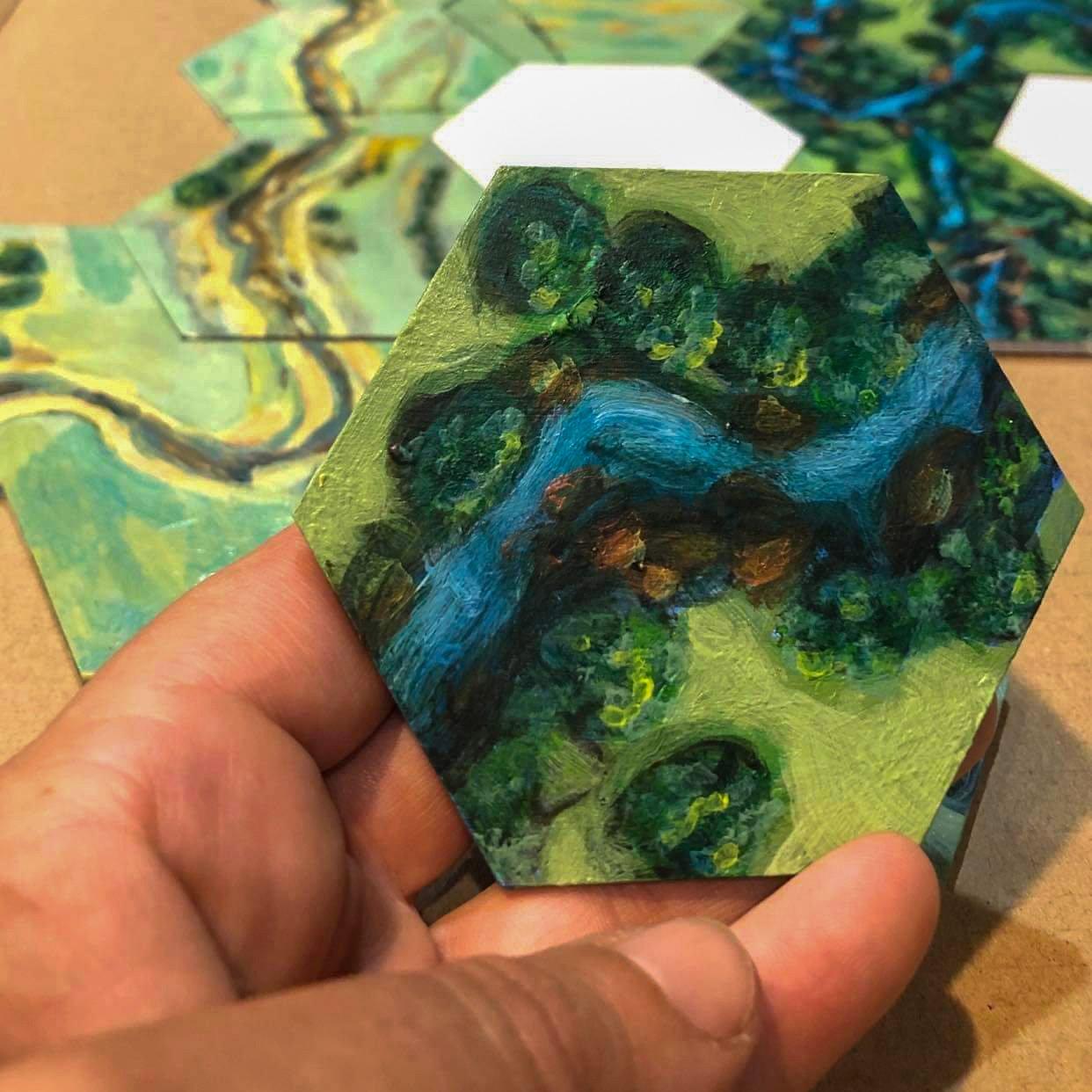
These gorgeous images are fragments of an artwork by Georgie Pollard. Georgie is a Kandos-based artist who has “mapped” the Capertee Valley using tiny collaged words, incorporating Capertee Valley hydrology, botany and Indigenous/colonial history. She is exploring how we inscribe many meanings over landscapes, meanings that jostle for our attention when we try to repair them.
Georgie’s map will be part of Waterland, the exhibition the Mulloon Institute is staging with Kandos School of Cultural Adaptation. Georgie is also contributing her talents to the landscape rehydration puzzle, as the other images show.
View fullsize
View fullsize
View fullsize
View fullsize
View fullsize
Frogs for Waterland!
Date published: 27 July 2022
View fullsize
View fullsize
View fullsize
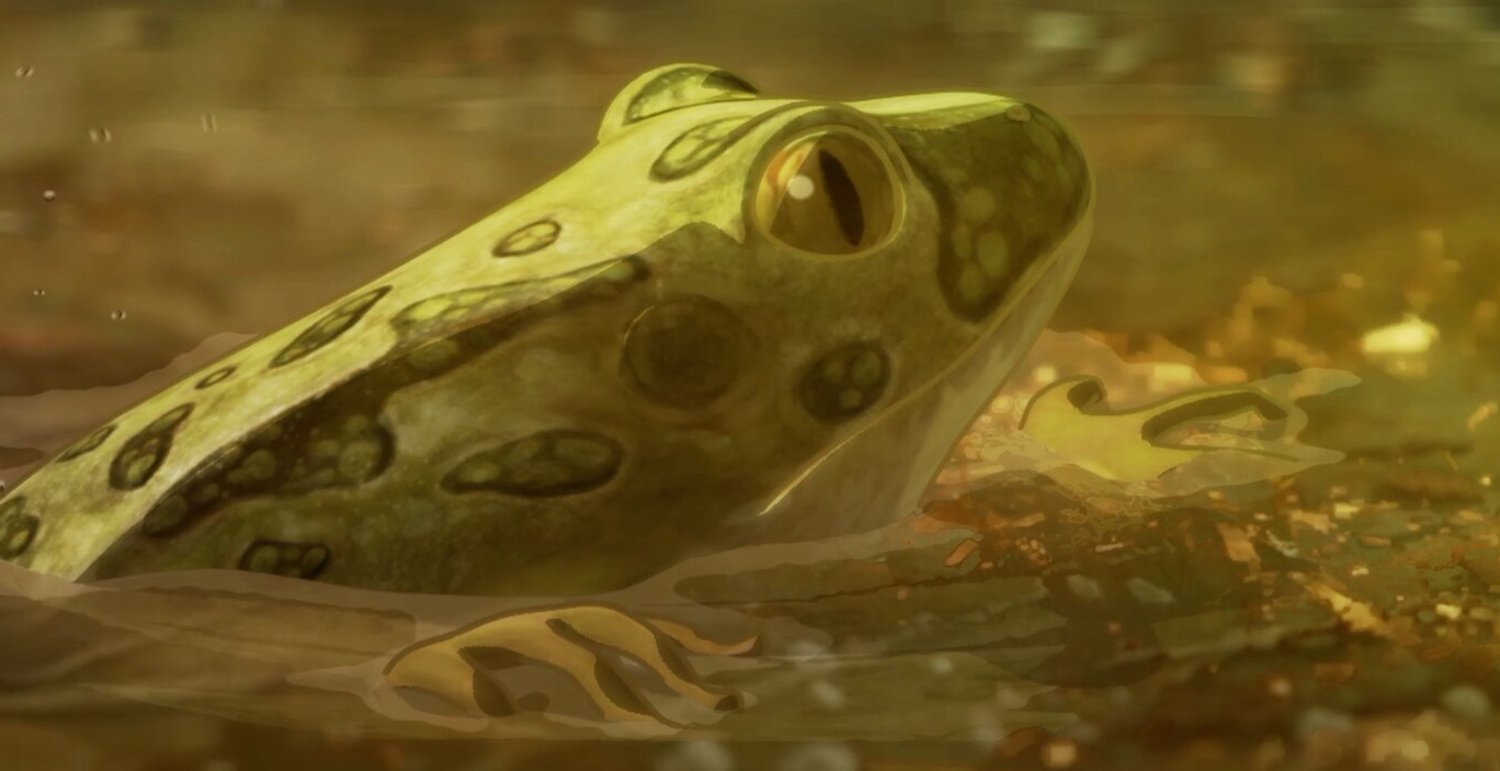
We care a lot about frogs here at Mulloon, and love this remarkable image created by Nicholas Tory, artist and artistic director at Ample Projects.
This image was one of many hundreds created by Nick, his close collaborator Jonathan Nix, and a large team of animators for the award-winning short film Lifeblood. Lifeblood tells the story of the Baaka (Darling) River and its creation spirit, Biami, and was the outcome of a collaboration between Ample Projects and members of the Ngemba community in Bourke Shire. It’s stunning to watch, you can find the trailer on Vimeo!
We’re excited to be featuring Nicholas Tory’s images at our current Waterland exhibition at WAYOUT in Kandos, until 5 September.
We’re also thrilled to be working together on an animation of the water cycle, with Wanda the Water Drop as the lead character. We can’t wait to see Wanda’s transformative power through Nicholas’ eyes!
Welcome changes will help reverse environmental degradation
Date published: 21 July 2022
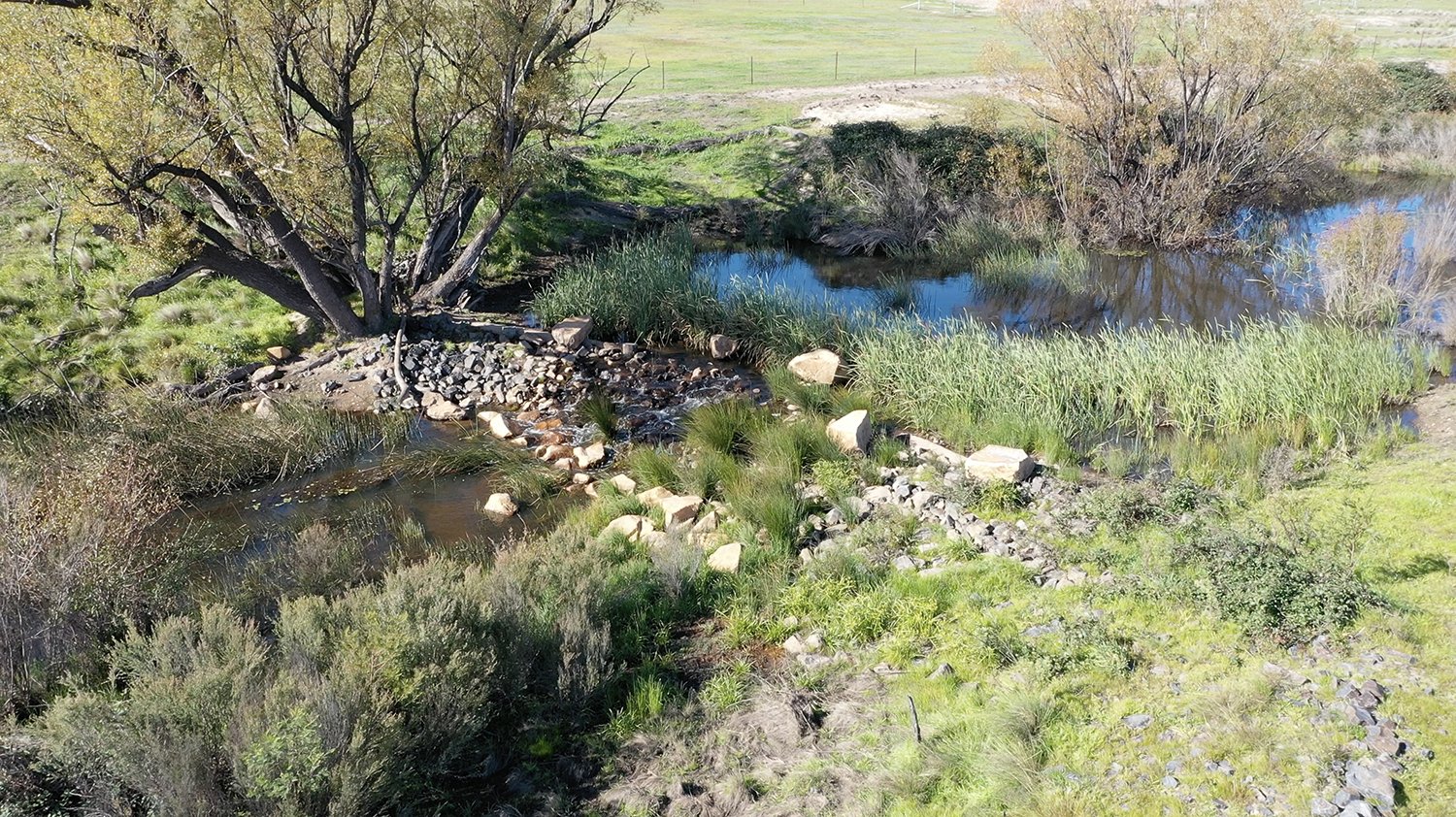
Environmental regeneration occurring around a leaky weir installed at Mulloon Farm North, as part of the Mulloon Rehydration Initiative. Photo taken in April 2020.
“The Mulloon Institute heartily welcomes the Environment and Water Minister Tanya Plibersek’s calls for structural reform and new environmental legislation,” said Mr Gary Nairn AO, Chairman of the Mulloon Institute and former Federal Liberal MP.
The Institute restores degraded landscapes across Australia for improved agricultural productivity, enhanced environmental outcomes, improved biodiversity including habitat for threatened species, and greater community resilience to drought, bushfire and flood.
It leads the way in Australia for property and landscape scale environmental repair in partnership with Australian farming communities, that includes rigorous scientific research, education programs and demonstration sites. Globally, its work has been recognised by the United Nations Sustainable Development Solutions Network.
“We’re working with farmers and community groups to restore landscape function and create more resilient, productive and profitable landscapes where agriculture and the environment are working together. This benefits a diversity of landscapes by improving soil health, boosting biodiversity, increasing farm productivity and bolstering community resilience,” said Mr Nairn.
The Institute’s award-winning Mulloon Rehydration Initiative is working with 23 landholders to regenerate and rehydrate the 23,000ha Mulloon catchment on Australia’s east coast. The Initiative is underpinned by a comprehensive, integrated research program monitoring the effects of stream interventions on the catchment’s hydrology, ecology and farm productivity.
The results so far are positive, satellite monitoring shows increased biomass production (and so increased farm productivity) on adjacent floodplains, hydrological monitoring shows improved water quality and quantity and increased soil moisture, biodiversity monitoring has revealed an increase in species richness and density in treated areas particularly for frogs, fish and birds.
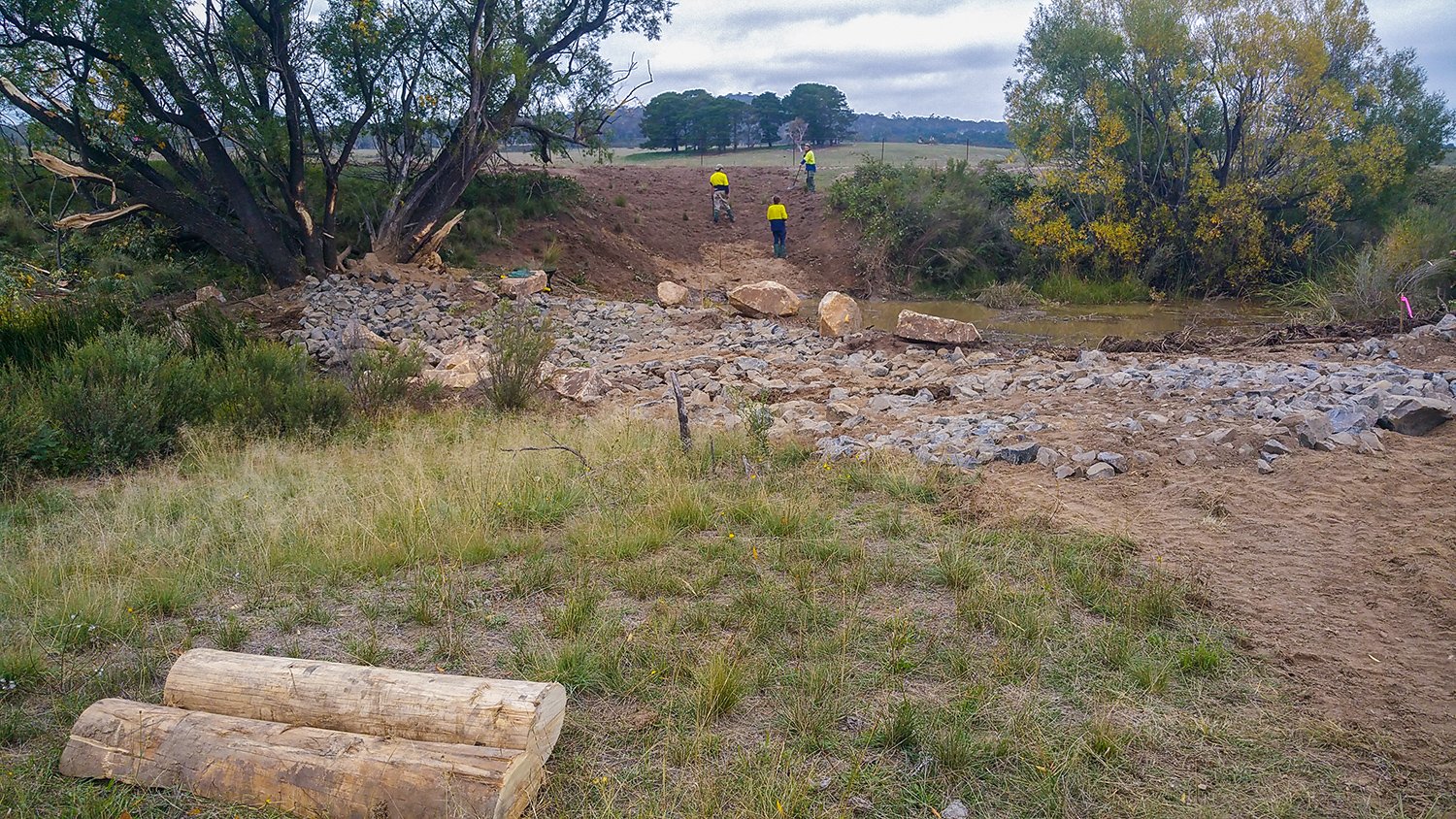
The leaky weir at Mulloon Farm North during construction in March 2018.
Urgent demand from farmers across Australia for similar projects in their area has seen the Institute develop a National Rehydration Initiative, with the goal to provide fully monitored catchment-scale landscape rehydration demonstrations and training in every state and territory. These works are fully scalable with projects being replicated in New South Wales, Australian Capital Territory, northern Queensland, West Australian Wheatbelt and the Northern Territory. Works are also planned for sites in Victoria.
Such projects regularly hit hurdles from environmental legislation that was originally designed to protect the environment – with regulatory obstacles and prohibitive costs to farmers deterring them from undertaking regenerative works.
“While it is relatively easy to build leaky weirs and other landscape rehydration works in degraded catchments, the problem is getting approvals to build such structures. Constraints of state-based regulations are proving prohibitive to farmers in getting these important landscape works done,” said Carolyn Hall, TMI’s CEO Managing Director.
“We’re currently working with the NSW Government’s Department of Planning, Industry and Environment to streamline the approval process for landscape restoration projects in the state. This is critical for expanding this kind of work and will help inform regulatory reform in other states and at the national level,” Mrs Hall said.
This work is considered critical in farmers providing solutions to climate change. Under the NSW’s Department Primary Industries Climate Change Adaptation Program, the Institute is working with environmental monitoring specialists HydroTerra and a variety of experts to develop a landscape rehydration priority map for NSW, identifying which catchments are most suitable to build drought resilience with this technique.
“We’d like to invite Environment Minister Tanya Plibersek to visit the Mulloon Institute and see how our work helps reverse the degradation of our Australian landscapes, making them more resilient to climate extremes”, said Mrs Hall.
The Mulloon Rehydration Initiative is jointly funded through the Mulloon Institute and the Australian Government’s National Landcare Program, with support from the NSW Government’s Environmental Trust.